CVE (Common Vulnerabilities and Exposures) is an identification scheme that distinguishes publicly disclosed security vulnerabilities. CVE-2026-99999 is indeed a publicly disclosed Linux kernel vulnerability. You cannot dismiss it as fake just because the number seems unfamiliar. However, you also shouldn’t interpret its severity score alone to mean that all virtual machines on the internet can be immediately compromised. Official CVE JSON
There are three things to check: official registration status, the scope of proven impact, and whether fixes have been applied to operational hosts. This article is a review draft based on publicly available information and does not include attack reproduction or server test results.
Verification Standard: October 19, 2026, 06:55 UTC (15:55 KST). The update time of the data and the viewing time of this article are different. Discrepancies in exploitation status remain in the data mentioned below.

Featured Image: A conceptual diagram checking virtual machine isolation boundaries. It is not an actual attack screen or a configuration diagram of a specific product.
1. What was confirmed in the official records?
CVEProject’s official JSON indicates the status as PUBLISHED and the assigning authority as Linux. The publication date is October 15, and the update date is October 17. The core issue is a checksum_start validation problem in the IPv4 processing. A checksum is a value used to verify errors in packet data, and if related location information processes incorrect input, it can lead to kernel memory corruption. Official CVE JSON
The NVD entry also confirmed the Received status and registration in the search results. However, this query could not extract the detailed body. Therefore, the 9.3 score below is not stated as a score independently calculated by NVD.
2. 9.3 points and 8.8 points have different premises
CVSS (Common Vulnerability Scoring System) expresses attack conditions and impacts as scores. The evaluations by the CNA (vulnerability registration authority) and product vendors may have different premises.
WRIMO-MD-TABLE-0]The difference lies in the privilege requirements. In the CNA’s microVM scenario, PR:N means no host credentials are required. The condition remains that the guest can send input to its assigned virtual network interface. PR:N cannot be interpreted to mean immediate remote code execution is possible from the internet without authentication. Both evaluations are AV:L. [CNA Evaluation, Red Hat Evaluation
The host is the physical server running virtual machines, and the guest is the virtual machine running inside it. The critical boundary in this case is where the host kernel processes the guest’s network input. Operators must check the actual virtualization configuration along with the vendor’s impact assessment.
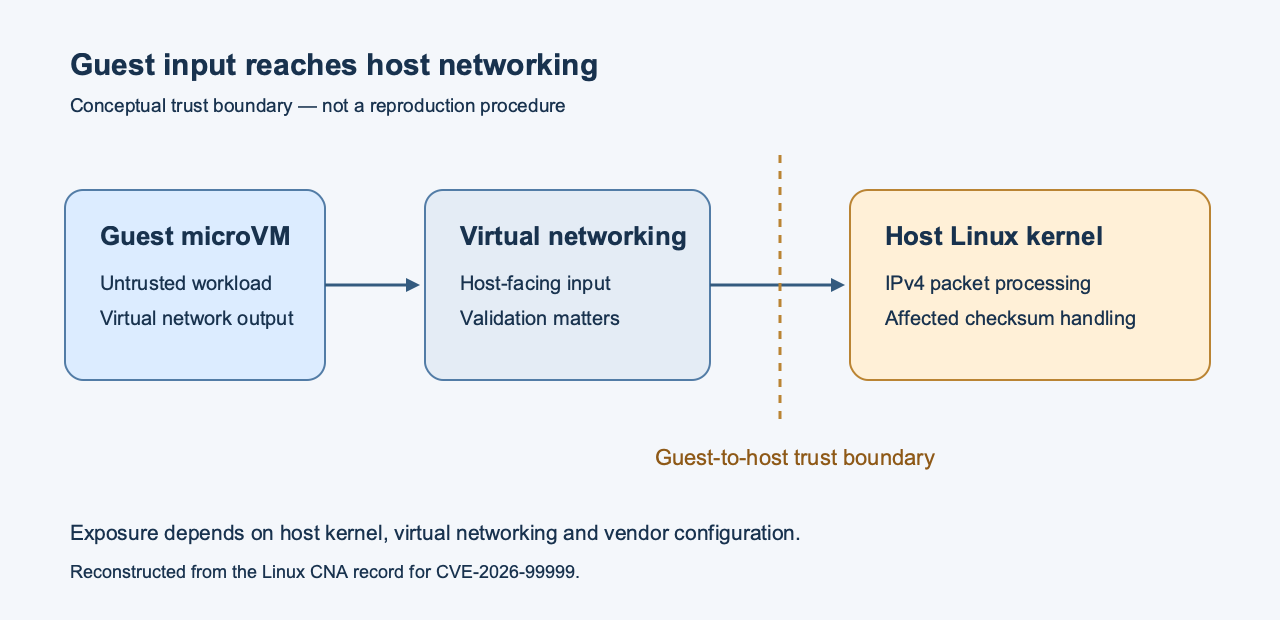
Figure 1. Conceptual path reconstructed based on official documents. This diagram does not represent attack conditions or reproduction procedures. Source: Linux CNA Scenario
3. To what extent has Vercel’s operating environment been proven?
Vercel’s October 14 announcement should be read by distinguishing the proven environment. A microVM is a small configuration virtual machine, but the fact that it is a small configuration does not eliminate the vulnerability’s impact on the host.
The ‘CVE pending’ and ‘private patch review’ in the same announcement refer to the situation as of October 14. This should be distinguished from the current registration status of the CVE, which was disclosed on October 15. The CVE record also links to this Vercel announcement as a reference. Vercel Announcement, Official CVE Record
4. Can actual exploitation be definitively stated?
There are discrepancies in the public data reviewed. The CISA ADP assessment included in the CVE JSON, dated October 16, 15:49 UTC, records Exploitation: none. In contrast, the Red Hat article at the time of inquiry states that it tracks this issue as a KEV active-exploit case. CVE JSON, Red Hat Article
The KEV (Known Exploited Vulnerabilities) catalog retrieved from CISA’s official GitHub mirror is version 2026.10.16, distributed at 2026-10-16T17:15:48.8752Z, with a total of 1,748 entries. Further cross-verification confirmed that this CVE was not in that list. This repository states that it synchronizes with the CISA original within minutes. However, access to the cisa.gov original JSON was restricted during this verification. Official Mirror Guide
Therefore, this article does not definitively state ‘no actual exploitation’ or ‘listed in CISA KEV’. Evidence from research environment demonstrations, vendor tracking statements, and listing status in a specific catalog at a given time are recorded as separate grounds. The absence from the list alone is insufficient grounds to conclude there is no risk or to delay patch review.
5. Operators should first confirm the application of fixes to the host kernel
The following are operational review suggestions based on the above data. Rather than executing commands uniformly across environments, apply them according to the security advisories and change procedures of the responsible vendor.
- Identify target hosts. List virtualization hosts running untrusted guests or sandboxes first. Separately record the update completion status inside the guest and the host kernel status.
- Check the distribution’s CVE advisory. Compare the exact release and fix status of the product, support stream, and kernel package. Do not determine the vulnerability of a distribution package solely by the upstream version number.
- Apply vendor-provided fixes to the host. Do not consider it complete by only changing guest images or applications. For managed services, confirm the provider’s impact assessment and completion of actions.
- Verify the running kernel. Distinguish between package installation and actual running status. After rebooting as advised or using an approved application method, confirm that the modified kernel is active.
- Track unresolved hosts separately. Record whether fixes are provided, responsible personnel, application schedule, and verification basis. Operational decisions to reduce the scope of untrusted workloads can be considered, but these are not called verified vulnerability mitigations.
Distributions may provide backports that bring security fixes to older versions. Therefore, you should not conclude that a kernel is unpatched solely because its major version number is low. Conversely, the existence of a fix upstream does not mean that patches have been distributed for all products. Red Hat states that it is pursuing fixes for affected products at the time of inquiry and advises that no mitigations meeting its criteria are currently available. Red Hat Impact, Fix, and Backport Advisory
The existence of this vulnerability is confirmed by official public records. Actual operational decisions require further verification of host configuration, distribution fix status, and the running kernel. While discrepancies in exploitation status should be tracked, it is reasonable to proceed with actions for confirmed isolation boundary risks concurrently.
Official References: CVE.org · CVEProject JSON · NVD · Red Hat · Vercel · CISA KEV Official Mirror
Leave a Reply