Hello! Today, I’d like to talk about a hidden bottleneck that many people experience when operating an OpenTelemetry (OTel) Collector in a Kubernetes environment, and its solution.
Have you ever had this experience? 🤔 You’ve clearly deployed multiple Collector pods to ensure scalability, but for some reason, traffic is concentrated on a specific pod, leading to severe load. A frustrating situation where you diligently scale-out but see no effect!
The root cause of this problem lies in the mismatch between gRPC and the load balancing method of Kubernetes’ default Service. Today, we will clearly resolve this issue and delve deep into the combination of Deployment and Headless Service that will transform your OTel Collector into a truly distributed system. 🚀
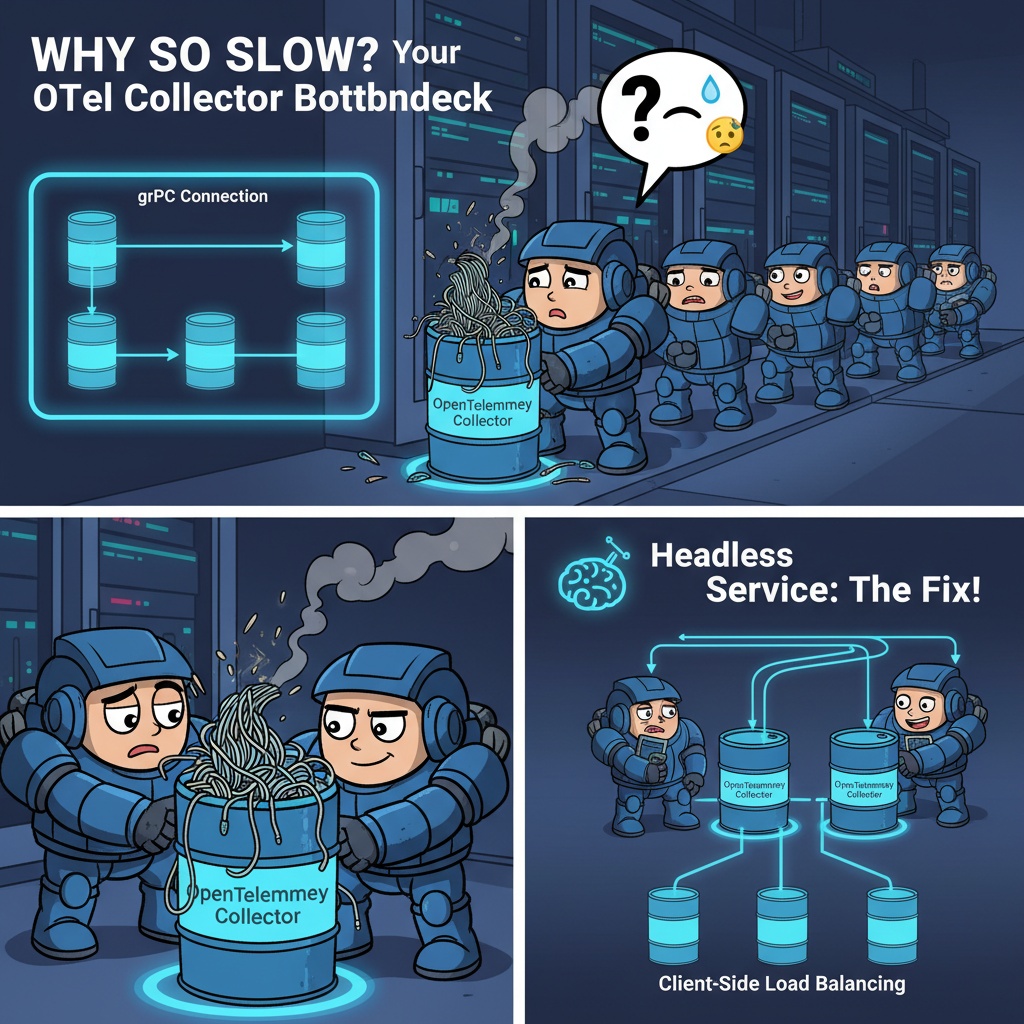
🤔 What’s the Problem? The Trap of gRPC and ClusterIP Service
Typically, in Kubernetes, you use a Service to expose multiple pods externally. The most basic ClusterIP type service is assigned a unique virtual IP, and it distributes requests coming to this IP among the pods behind it.
So far, it seems perfect. However, the characteristics of the gRPC protocol used by the OTel Collector introduce a variable.
gRPC is based on HTTP/2 and is characterized by maintaining a single TCP connection for a long time for communication. However, the load balancing of a ClusterIP service occurs at the connection level.
What does this mean?
- The application (client) attempts its first connection to the OTel Collector service’s ClusterIP.
- The Kubernetes service forwards this connection request to one of the several Collector pods.
- Once a connection is established, gRPC continuously reuses that connection to send numerous telemetry data (requests).
- As a result, all data sent by that client will be poured into the single pod it initially connected to. 😱
Ultimately, no matter how many pods you add, the load is only distributed by the number of clients, resulting in a ‘distribution in name only’ state where actual traffic is not evenly distributed.
✨ The Perfect Solution: Deployment + Headless Service
The most ideal strategy to solve this problem is to use Deployment and Headless Service together. This combination leverages the characteristics of gRPC in reverse, allowing the client to perform load balancing directly.
1. Manage Collectors with Deployment! 🚀
Deployment is a core controller for stably operating stateless applications, ensuring the number of pods (replicas), rolling updates, and automatic recovery. Managing your OTel Collector with Deployment allows you to flexibly scale up/down by adjusting the number of replicas according to traffic volume. This is a fundamental principle!
# otel-collector-deployment.yaml
apiVersion: apps/v1
kind: Deployment
metadata:
  name: otel-collector
  labels:
    app: opentelemetry
    component: collector
spec:
  # 🔽 Adjust the number of pods to 3, 5, etc., as needed!
  replicas: 3
  selector:
    matchLabels:
      app: opentelemetry
      component: collector
  template:
    metadata:
      labels:
        app: opentelemetry
        component: collector
    spec:
      containers:
      - name: otel-collector
        image: otel/opentelemetry-collector-contrib:latest # Use an image version suitable for your actual environment
        ports:
        - name: grpc
          containerPort: 4317
          protocol: TCP
2. The Core of Load Balancing, Headless Service! 🧠
Unlike ClusterIP services, Headless Services do not have a unique virtual IP. Instead, when you query the service’s DNS name, it returns a list of the actual IP addresses of all pods connected to that service.
How does this work its magic?
- Create a Headless Service. (The
clusterIP: Nonesetting is key!) - The application’s OTel SDK sets the Headless Service’s DNS name (otel-collector-headless:4317) as the Collector endpoint.
- The gRPC library within the SDK queries this DNS name and receives the entire list of IP addresses for the 3 pods.
- The gRPC client uses this IP list to distribute requests directly to different pods for each request, according to a policy like round_robin.
Now, true request-level load balancing, not just connection-level, becomes possible!
Below is the YAML file defining a Headless Service.
# otel-collector-headless-svc.yaml
apiVersion: v1
kind: Service
metadata:
  name: otel-collector-headless
  labels:
    app: opentelemetry
    component: collector
spec:
  # 🔽 This one setting changes everything!
  clusterIP: None
  selector:
    # Selects the pods managed by the Deployment.
    app: opentelemetry
    component: collector
  ports:
    - name: grpc
      port: 4317
      targetPort: 4317
      protocol: TCP
How to configure the application?
You just need to specify the OTel exporter’s endpoint as the Headless Service’s DNS address in your application code or environment variables.
- Endpoint Address:
otel-collector-headless:4317(if in the same namespace) - Or FQDN:
otel-collector-headless..svc.cluster.local:4317
With this simple configuration change, your system will start distributing the load much more intelligently.
🤔 Why are other methods not ideal?
1. DaemonSet 🧐
DaemonSet deploys one pod on all (or specific) nodes in the cluster. It is suitable for ‘agent’ roles that collect logs or metrics from each node, but unsuitable for ‘gateway’ roles that gather data from multiple applications into one place.
- Problem: Scalability is tied to the number of nodes. No matter how much traffic increases, you cannot increase the number of Collectors without adding nodes, making it prone to bottlenecks.
2. Service Mesh (Istio, Linkerd, etc.) 🕸️
Using a service mesh can transparently implement gRPC load balancing without modifying application code. This is certainly a powerful feature.
- Problem: It’s too heavy. Introducing a massive system like a service mesh just to solve the OTel Collector’s load balancing problem is like the tail wagging the dog. Unless you are already using a service mesh enterprise-wide, it’s an excessive solution.
Conclusion
In distributed environments like Kubernetes, it’s crucial to deeply understand the characteristics of each technology and find the optimal combination. For OpenTelemetry Collector and gRPC, ensuring flexible scalability with Deployment and enabling client-side load balancing with Headless Service is the most efficient, simple, and powerful method.
Don’t let just one Collector pod struggle anymore. Apply this architecture to build a stable and highly scalable observability pipeline! 💪
Leave a Reply