Hello! Today, we’ll delve deep into Cilium Cluster Mesh, a groundbreaking solution that innovatively addresses a challenge inevitably faced as Kubernetes environments expand: ‘multi-cluster networking.’
Are you operating multiple clusters for disaster recovery (DR), edge computing, or team-specific isolation, beyond a single cluster? If so, discover how this technology can simplify and strengthen your infrastructure configuration. 👇
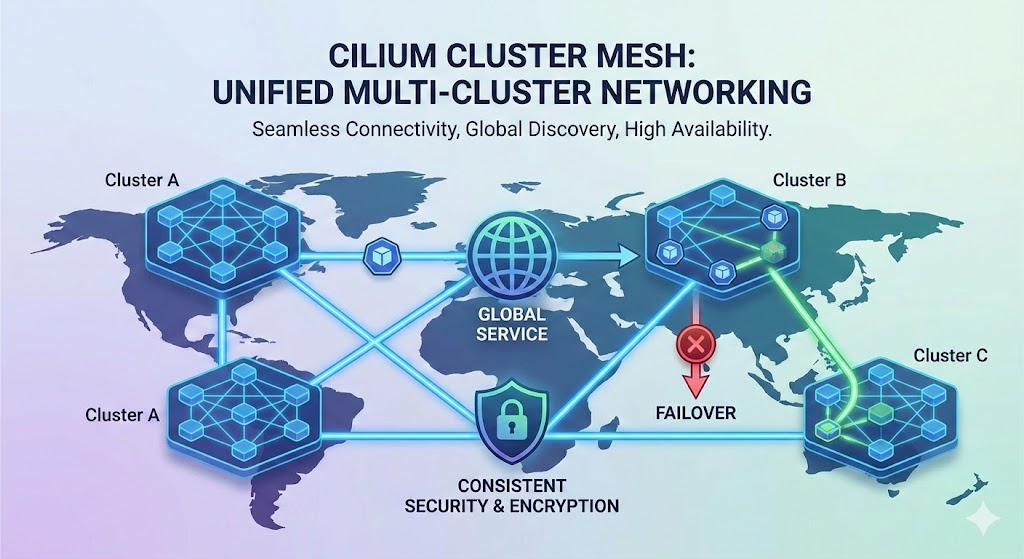
1. What is Cilium Cluster Mesh? 🧐
Cilium Cluster Mesh is a technology that connects multiple independent Kubernetes clusters into a single logical network (Flat Network).
Previously, inter-cluster communication involved the hassle of configuring complex VPNs or double-routing through Ingress/Egress gateways. However, with Cluster Mesh, Pods can communicate directly with each other as if they were within one giant cluster.
- Platform Independence: It works seamlessly across any environment or distribution, including on-premise bare metal, public clouds like AWS/Azure/GCP, and managed services such as EKS/GKE/AKS.
- Network Simplification: It removes complex overhead and simplifies configuration, providing optimized connectivity for edge computing or multi-region deployment environments.
2. Global Services & Automatic Service Discovery 🌍
One of Cluster Mesh’s most powerful features is the concept of ‘Global Services.’
- Automatic Merging: What if services in different clusters (e.g., Seoul region, Tokyo region) have the same name and namespace? Cilium automatically detects and merges them into a single service.
- Configuration Method: Instead of complex configuration files, simply add a straightforward annotation (io.cilium/global-service: “true”) to the service resource.
- Benefits: Service discovery and communication between clusters occur seamlessly, without the need for external DNS configuration or separate service registry management.
3. High Availability (HA) and Smart Load Balancing ⚖️
When services are merged, traffic management also becomes more intelligent.
- Automatic Load Balancing: When a client calls a service, traffic can be distributed not only to pods in the local cluster but also to pods in other connected clusters.
- Failover: What happens if a backend service in Cluster A goes down or fails? Cluster Mesh immediately detects this and automatically redirects traffic to an instance in the healthy Cluster B.
- Uninterrupted Service: This ensures users can continue to use services without experiencing any disruption due from specific region or cluster failures.
4. Principles of Network Connectivity and Routing 🛣️
So, how do packets actually travel? Cluster Mesh supports two main routing modes:
- Tunneling: Uses VXLAN or Geneve encapsulation. It’s the most commonly used method as it allows for overlay network configuration without needing to change the existing network infrastructure (Underlay).
- Direct Routing: Used when the network directly knows the Pod’s IP via BGP, etc., offering performance benefits due to the absence of encapsulation overhead.
⚠️ Essential Precaution: For all this magic to be possible, there’s a crucial prerequisite: the Pod CIDRs (IP ranges) of all clusters must not overlap (Non-overlapping). Each cluster must have a unique IP range to identify and route to each other.
5. Security and Policy Consistency 🛡️
As networks connect, security must also extend. Cilium extends its powerful eBPF-based security features to multi-cluster environments.
- Consistent Network Policies: Policies like “the frontend in Cluster A can access the backend in Cluster B” can be defined based on labels, and these policies are enforced globally, regardless of cluster location.
- Transparent Encryption: WireGuard or IPsec can be used to automatically encrypt all traffic moving within and between clusters. This strengthens security at the infrastructure level without requiring application modifications.
Conclusion ✨
Cilium Cluster Mesh goes beyond simply connecting clusters; it’s an integrated solution that reduces operational complexity (Simplicity), increases availability (High Availability), and enhances security (Security).
As Kubernetes environments grow, network management inevitably becomes more challenging. However, with Cluster Mesh, you can easily manage clusters scattered across the globe as if they were on your local computer.
We hope this helps your infrastructure evolve to the next level!
Leave a Reply