Hello everyone! Today, I’d like to delve deeply into eBPF (extended Berkeley Packet Filter) and Cilium, which utilizes it – the hottest keywords in the cloud-native ecosystem, especially in Kubernetes environments.
We will thoroughly explore the principles of how they overcome the limitations of existing Linux networking methods to provide high performance, robust security, and transparent observability. With this one article, you’ll be able to perfectly understand the core concepts of eBPF! 😊
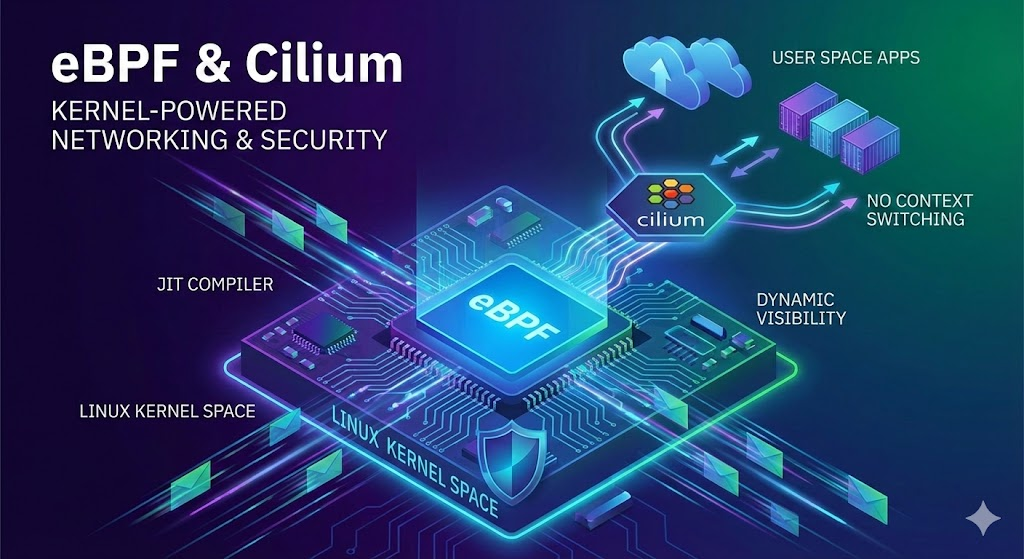
1. What is eBPF? 🧠
eBPF is an innovative technology that allows sandbox-isolated programs to run inside the Linux kernel.
✅ Key Feature: Run in Kernel Space without Kernel Modification
In the past, extending kernel functionality required modifying the kernel source code or loading unstable kernel modules. However, eBPF allows programs to run safely in Kernel Space without modifying the kernel source code.
- Execution Location: Operates in Kernel Space, not User Space.
- Safety: Before an eBPF program is loaded, a Verifier thoroughly analyzes the code to ensure there is no risk of crashing the system or falling into an infinite loop. This means it runs safely, isolated from core kernel functions.
⚡ JIT Compiler and Performance
eBPF is not an interpreter. When eBPF bytecode is loaded into the kernel, it is converted into native machine code via a JIT (Just-In-Time) compiler. This allows the CPU to understand it directly, boasting incredible performance close to native speed.
2. Why is it more powerful than traditional methods (IPtables)? 💪
Comparing it with IPtables, a staple of Linux networking, reveals the true value of eBPF.
| Feature | IPtables (Traditional Method) | eBPF (Next-Generation Method) |
|---|---|---|
| Processing Method | Sequential rule search (Linear Search, O(N)) | Uses Hash Table (Map) (O(1) lookup) |
| Performance | Slows down as the number of rules increases | Almost no performance degradation even with many rules |
| Flexibility | Static rules based on IP/Port | Programmable for fine-grained control at runtime |
| Update | Must reload all rules on change (causes Lock) | Dynamic updates of necessary parts without downtime |
🏎️ Minimize Context Switching
Traditional proxies or user-space applications had to switch between kernel and user space to process packets. This is called Context Switching and is a major cause of performance degradation.
eBPF maximizes performance by significantly reducing unnecessary context switching, as all processing occurs within the kernel.
3. Cilium: A Kubernetes Superhero leveraging eBPF 🦸♂️
Cilium is open-source software built on eBPF technology, responsible for networking, security, and observability in Kubernetes environments.
🛠️ Key Roles and Functions
- High-Performance Networking and Security: Beyond simple connections, it processes packets at high speed and applies sophisticated security policies.
- kube-proxy Replacement: Kubernetes’ default networking component, kube-proxy, performs service load balancing using IPtables. Cilium completely replaces this role via eBPF, eliminating IPtables bottlenecks.
🛡️ Security: Identity-Based, Not IP-Based
In cloud-native environments, container IPs change frequently. Therefore, IP-based firewalls are almost impossible to manage.
Cilium establishes security policies based on Pod labels or identities instead of IPs. Policies are dynamically applied based on real-time data, so security is maintained even if IPs change.
🔍 Enhanced Observability
Cilium (and Hubble) goes beyond simple ‘connected/blocked’ logs, providing real-time monitoring and traffic visibility.
- Not only L3/L4 (network level), but also
- L7 (HTTP, DNS, API calls, etc.) application layer can be inspected at the kernel level without overhead.
4. When does eBPF operate? (Event-Driven Architecture) 🔔
eBPF does not run as a continuous program but operates in an event-driven manner.
- Network Events: When a packet arrives at the network card
- System Calls: When an application requests a task from the kernel
- Process Events: When a process starts or ends
- Tracepoints & kprobes: When a specific kernel function is executed
As such, eBPF is not limited to networking but can operate triggered by various system-wide events, making it widely applicable in areas such as network filtering, security policy enforcement, and system monitoring.
📝 Summary: Essential Knowledge for the Cloud-Native Era
- Performance: Achieves peak performance by eliminating context switching through JIT compilation and kernel-space execution.
- Security: Operates safely (Verifier) without kernel source modification and provides identity-based dynamic security.
- Operations: eBPF-based Cilium replaces kube-proxy, resolves IPtables complexity, and enables uninterrupted updates.
eBPF and Cilium are not just trends; they are the most powerful foundational technologies supporting complex microservices and cloud environments. A good understanding of these concepts will be a great asset for operating next-generation infrastructure! 🚀
Leave a Reply