Hello, platform engineers! When customizing Backstage or creating new backend plugins, there’s one library you’re bound to encounter: @backstage/backend-common. Knowing the powerful tools this library provides can cut your development time in half. ⏱️
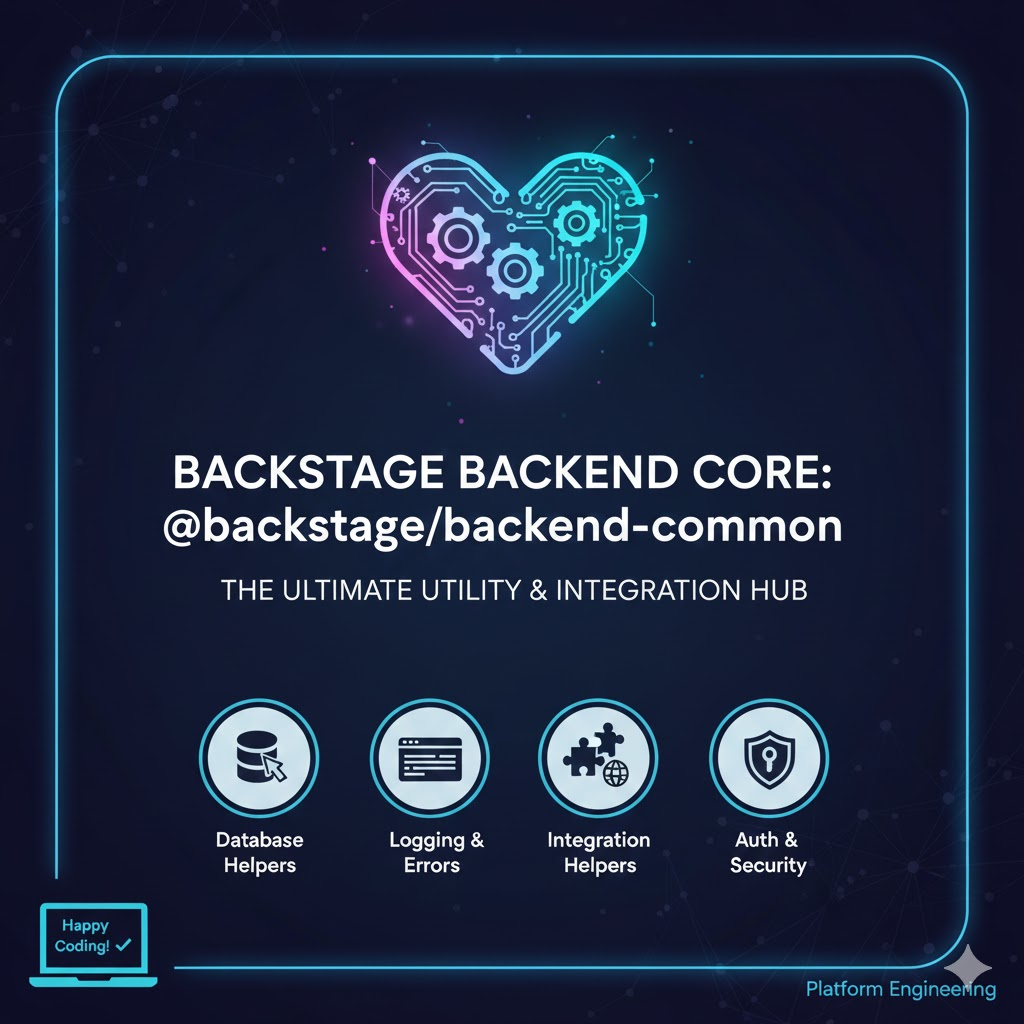
1. What is @backstage/backend-common? 🔍
This package is like a “treasure trove of common utilities” in the Backstage backend ecosystem. It provides repeatedly needed functionalities for building backend services in a standardized way, helping developers focus solely on business logic.
2. Key Features Provided (Core Utilities) 🛠️
The main utilities provided by this library are as follows:
- Database Helpers: Provides tools based on Knex.js to easily manage database configurations and execute migrations. 🗄️
- Logging: Offers a standardized logging interface based on the Winston library, allowing all plugins to log in the same format. 📝
- Error Handling: Provides standard HTTP error classes like NotFoundError and ConflictError to ensure consistent API responses. ⚠️
- Token Management: Includes helpers for generating and validating tokens required for inter-service communication. 🔑
3. Integration Helpers 🤝
Backstage’s biggest advantage is its extensibility. This library includes powerful features for integrating with external systems.
- UrlReader: Provides a unified interface to read files from various source code hosting services such as GitHub, GitLab, and Bitbucket. 🌐
- Config Loading: Responsible for safely reading and validating configurations from the app-config.yaml file.
- Discovery: Supports a discovery mechanism that dynamically finds the location (URL) of other backend services.
4. Why should you use this library? 💡
It’s not just about convenience. The reason to use @backstage/backend-common is Consistency.
- Standard Compliance: You can follow the best practices defined by the Backstage core team.
- Ease of Maintenance: If all plugins use the same common utilities, system updates or refactoring become much smoother.
- Proven Stability: You can use stable code that is already being used by numerous companies. ✅
5. Latest Trend: New Backend System 🆕
Recently, Backstage has been evolving into the “New Backend System.” As a result, functionalities that were in @backstage/backend-common are tending to move to more specialized packages (e.g., @backstage/backend-plugin-api, @backstage/backend-defaults). However, this library still plays a pivotal role in existing plugins and legacy code.
6. Conclusion 🏁
It’s no exaggeration to say that Backstage backend development largely depends on how well you utilize this common library. If you’re planning to create a new plugin, first check if the functionalities you need are already implemented within this package!
Leave a Reply