Hello everyone! Today, we’re going to dive deep into the Argo Project, one of the most beloved collections of tools in the Kubernetes ecosystem. 🚀
If you’ve ever wondered, “How can I automate deployments and efficiently manage workflows in a cloud-native environment?”, then Argo is a powerful weapon that provides the answer. Invest just 10 minutes and completely master Argo’s four siblings!
The Argo Project is a Graduated project of the CNCF (Cloud Native Computing Foundation), a collection of tools that help run and deploy applications in a Kubernetes environment. Named after ‘Argo’, the ship ridden by heroes in Greek mythology, each tool is independent yet creates tremendous synergy when used together.
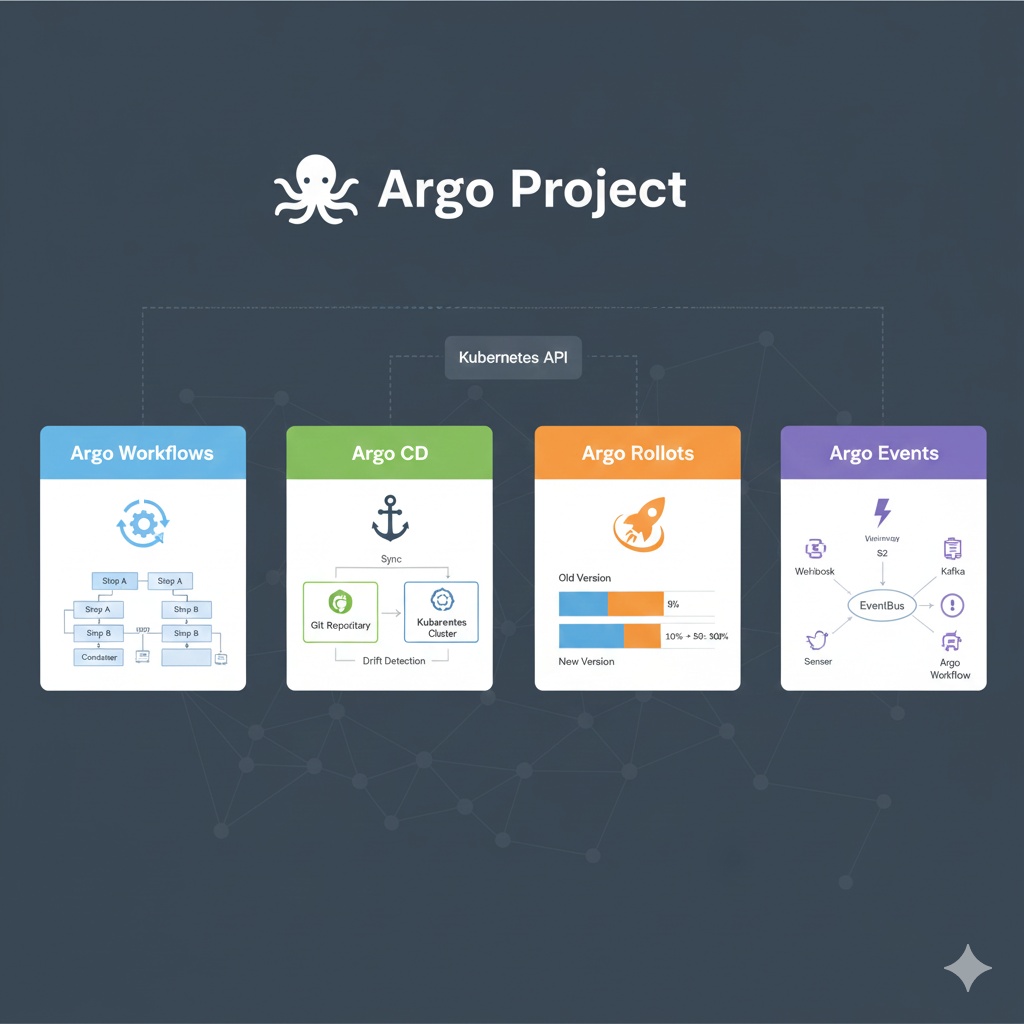
1. Argo Workflows: Container-Native Workflow Engine ⚙️
Argo Workflows is an engine that enables the sequential or parallel execution of complex jobs in Kubernetes.
- Core Concept: Every step runs as a container.
- Key Features: * DAG (Directed Acyclic Graph) Support: Define dependencies between tasks to build complex pipelines.
- CI/CD Pipelines: Build cloud-native CI environments, replacing Jenkins.
- Data Processing: Suitable for machine learning training or large-scale data analysis tasks.
📝 Argo Workflows Example Code (DAG Method)
YAML
apiVersion: argoproj.io/v1alpha1
kind: Workflow
metadata:
  generateName: dag-diamond- # Random characters are appended to the name upon execution
spec:
  entrypoint: diamond
  templates:
  - name: diamond
    dag:
      tasks:
      - name: A # First task
        template: echo
        arguments:
          parameters: [{name: message, value: "Hello, Start!"}]
      - name: B # Run after A finishes
        depends: "A"
        template: echo
        arguments:
          parameters: [{name: message, value: "Node B"}]
      - name: C # Run after A finishes (in parallel with B)
        depends: "A"
        template: echo
        arguments:
          parameters: [{name: message, value: "Node C"}]
      - name: D # Run only after both B and C finish
        depends: "B && C"
        template: echo
        arguments:
          parameters: [{name: message, value: "Finished!"}]

  - name: echo # Template that performs the actual work
    inputs:
      parameters:
      - name: message
    container:
      image: alpine:3.7
      command: [echo, "{{inputs.parameters.message}}"]
2. Argo CD: GitOps-Based Continuous Deployment (CD) ⚓
This is the most popular project! Argo CD is a tool that keeps the configurations in a Git repository identical to the state of the Kubernetes cluster.
- Core Concept: GitOps. “Git becomes the Source of Truth.”
- Key Features: * Auto Sync: Pushing code to Git is immediately reflected in the cluster.
- Drift Detection: Sends an ‘OutOfSync’ alert if someone manually modifies the cluster.
- Multi-Cluster Support: Manage multiple clusters with a single Argo CD instance.
3. Argo Rollouts: Master of Advanced Deployment Strategies 🎨
Kubernetes’ default Deployment only supports rolling updates, right? Argo Rollouts enables advanced deployments like Canary and Blue-Green.
- Core Concept: Progressive Delivery. Deploy incrementally while minimizing risk.
- Key Features: * Analysis-Based Approval: Automatically roll back if the error rate increases during deployment.
- Fine-Grained Traffic Control: Integrate with Istio, NGINX to adjust traffic in 1%, 5%, 10% increments.
📝 Argo Rollouts Example Code (Canary Strategy)
YAML
apiVersion: argoproj.io/v1alpha1
kind: Rollout
metadata:
  name: guestbook-rollout
spec:
  replicas: 5
  strategy:
    canary: # Canary deployment settings
      steps:
      - setWeight: 20 # Send only 20% of traffic to the new version
      - pause: {duration: 1h} # Observe and wait for 1 hour
      - setWeight: 50 # If no issues, expand to 50%
      - pause: {} # Wait indefinitely until user approval
4. Argo Events: Event-Driven Automation Framework ⚡
Argo Events detects external events and triggers Argo Workflows or other tasks.
- Core Concept: Event-Driven. “If something happens, run this!”
- Event Sources: Supports over 20 types, including Webhook, S3 file creation, GitHub Push, Slack messages, Kafka, etc.
- Flow: EventSource (detection) -> EventBus (delivery) -> Sensor (judgment and trigger).
💡 Argo Projects at a Glance
| Project Name | Main Role | Analogy |
| — | — | — |
| Workflows | Define complex task sequences | Orchestra Conductor |
| CD | Synchronize Git and cluster state | Strict Overseer |
| Rollouts | Safe and precise deployment strategies | Veteran Pilot |
| Events | React to external stimuli | Sensitive Detection Sensor |
—
🏁 Conclusion: Where Should You Start?
If you’re just starting out, we recommend experiencing the convenience of GitOps with Argo CD first. Afterwards, add Rollouts for deployment stability, and when you need build or data processing, combine Workflows and Events to complete a perfect cloud-native pipeline! 🏗️
Leave a Reply