Anthropic’s Top Public Model Aimed at Long-Term Autonomous Tasks
The competition among AI models is increasingly shifting from “short answers” to “agents that work autonomously for extended periods.” In this trend, Anthropic has unveiled Claude Fable 5. Anthropic describes Fable 5 as “the most powerful Claude model released to the general public,” stating that it surpasses previous Claude models, especially in software engineering, knowledge work, vision, scientific research, and the ability to perform long-term tasks. (Anthropic)
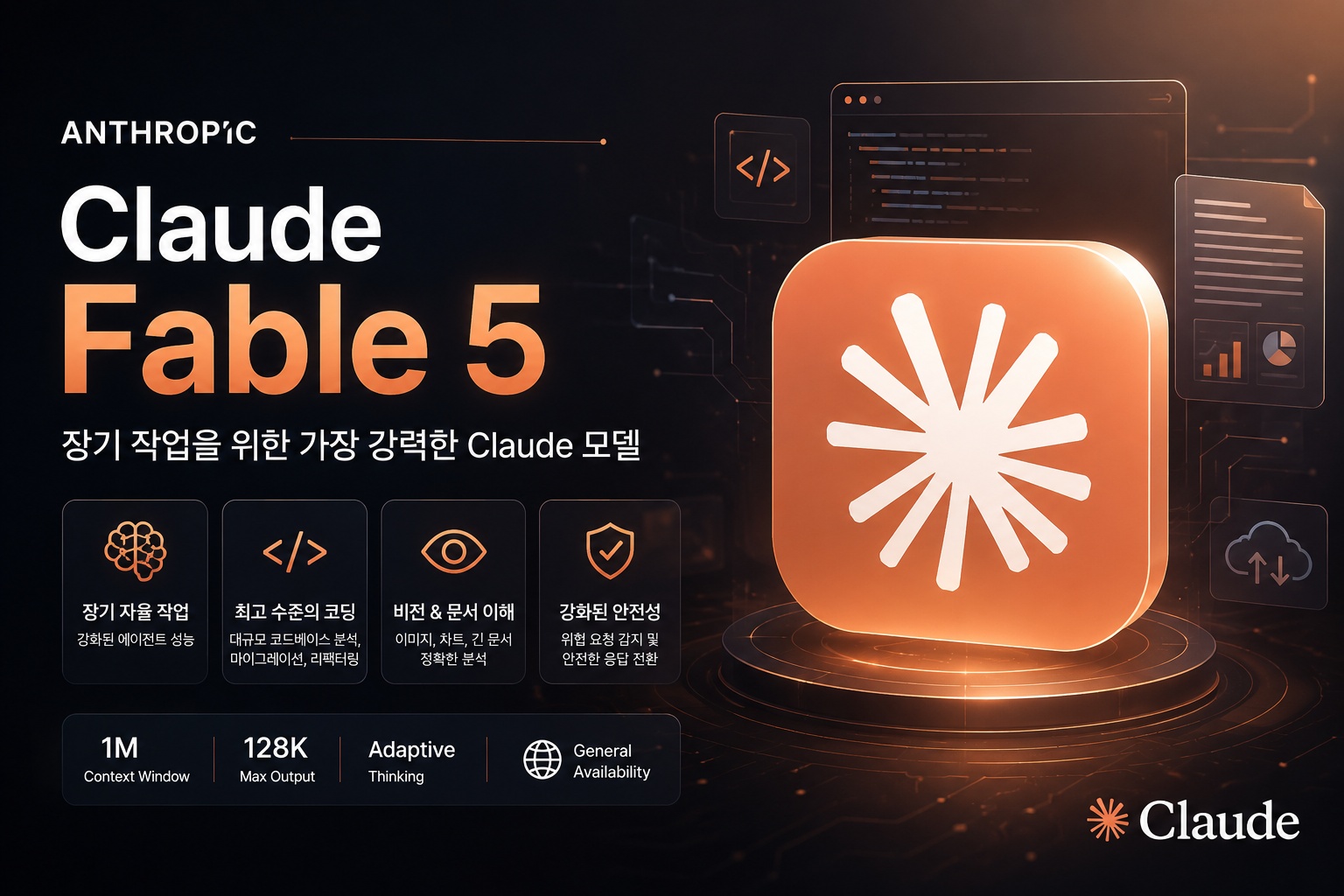
In a Nutshell
Claude Fable 5 is a model that makes Mythos-level performance available to general users, but with strong safety measures in high-risk areas such as cybersecurity, life sciences, and model distillation.
Key Features of Fable 5
The most important aspect of Fable 5 is its long-term task capability. Anthropic explains that Fable 5 and Mythos 5 can work autonomously for longer periods than previous Claude models. It is a model focused on multi-step tasks such as codebase analysis, migration, research, document analysis, and complex visual information interpretation, rather than simple Q&A. (Anthropic)
Key specifications from a developer’s perspective are as follows:
Relationship Between Fable 5 and Mythos 5
To understand Fable 5, one must look at its relationship with Mythos 5. According to Anthropic, Fable 5 and Mythos 5 use the same base model. The difference lies in the safety measures. Fable 5, being for general public release, applies conservative safety measures for risky requests related to cybersecurity, life sciences, chemistry, and model distillation. Mythos 5, on the other hand, is provided to partners in limited trusted access programs, such as Project Glasswing. (Anthropic)
Simply put, it’s as follows:
CategoryClaude Fable 5Claude Mythos 5
| Target | General users/enterprises/developers | Approved partners-centric |
| Base Model | Same as Mythos 5 | Same as Fable 5 |
| Safety Measures | Strongly applied | Relaxed in some areas |
| Availability | Public release | Limited release |
| Core Purpose | Popularization of high-performance models | Utilization in high-risk specialized areas |
Safety Measures: Why Do Some Requests Fallback to Opus 4.8?
The most controversial aspect of Fable 5 is its safety measures. Anthropic explains that Mythos-level models could be misused for cyberattacks, biological risks, model distillation, etc. Therefore, if a specific request is detected, Fable 5 will not respond directly; instead, it will automatically switch to Claude Opus 4.8. Users will be informed of this switch. (Anthropic)
Anthropic states that, based on initial data, over 95% of Fable sessions operate without fallback. However, they acknowledge that because the safety measures are conservatively tuned, legitimate requests might also be incorrectly detected. (Anthropic)
From an education, research, and security consulting perspective, this point is crucial. For example, in areas where “benevolent research” and “knowledge that can be misused” overlap, such as vulnerability analysis, reverse engineering, exploit analysis, or life science research, it might be difficult to fully utilize Fable 5’s performance.
Pricing
API-based pricing for general use is $10 per million input tokens and $50 per million output tokens. Using the Batch API reduces the cost to $5 per million input tokens and $25 per million output tokens. (Claude API Docs)
ModelInputOutput
| Claude Fable 5 | $10 / MTok | $50 / MTok |
| Claude Fable 5 Batch | $5 / MTok | $25 / MTok |
| Claude Opus 4.8 | $5 / MTok | $25 / MTok |
| Claude Sonnet 4.6 | $3 / MTok | $15 / MTok |
| Claude Haiku 4.5 | $1 / MTok | $5 / MTok |
In terms of price alone, Fable 5 is twice as expensive as Opus 4.8. Therefore, it is more realistic to use it selectively for tasks with high failure costs, such as high-difficulty coding, large-scale refactoring, long document analysis, and complex agent tasks, rather than for all tasks.
Data Retention Policy
Fable 5 and Mythos-level models are subject to a 30-day data retention policy. Anthropic explains that inputs and outputs of Mythos-level models are retained for 30 days for trust and safety purposes, and this data is not used for training new Claude models. (Claude Help Center)
Companies using Zero Data Retention (ZDR) should be particularly cautious. According to Anthropic, this policy affects organizations accessing ZDR via Claude Console’s ZDR workspace, Claude Enterprise’s ZDR settings, AWS Bedrock, Google Cloud Agent Platform, and Microsoft Foundry. (Claude Help Center)
Points to check when adopting for enterprise use are as follows:
| Check Item | Verification Point |
| Personal Information | Inclusion of customer data, logs, source code |
| Security Policy | Whether 30-day retention is permissible |
| Cloud Path | Where to use: API, Bedrock, Vertex AI, or Foundry |
| Audit | Check access logs, encryption, data deletion policies |
| Task Segregation | Use Sonnet/Opus for general tasks, Fable only for high-difficulty tasks |
What Tasks Is It Best Suited For?
Fable 5 is suitable for “tasks that are assigned for a long duration at once.” Examples include:
| Field | Suitable Use Cases |
| Software Development | Large-scale codebase analysis, migration, refactoring, test generation |
| Cloud/DevOps | IaC code review, Terraform structure improvement, root cause analysis of failures |
| Security | Defensive code auditing, security design review, detection rule improvement |
| Document Analysis | Comparison of long policy documents, contracts, technical documents |
| Educational Content | Lecture curriculum design, practical scenario generation, assessment item composition |
| Vision Tasks | Screenshot-based UI analysis, chart/table interpretation, image-based code reconstruction |
However, in cybersecurity and life sciences, some requests may be routed to Opus 4.8 due to safety measures. When using Fable 5 for security education or vulnerability analysis, it is more stable to design prompts focusing on “defensive analysis, code review, risk explanation, and patch direction” rather than “attack reproduction.”
Summary
Claude Fable 5 is less of “just a smarter chatbot” and more of a high-performance agent-type model designed for long-term tasks. Its 1M token context, 128k output, and strong coding, document, and vision capabilities are attractive. However, due to its high price, 30-day data retention policy, and high-risk area fallback policy, security and compliance reviews are necessary first in an enterprise environment.
In conclusion, Fable 5 should be viewed not as a “model to always use,” but rather as a premium model to be deployed for tasks where the reason for using an expensive model is clear, such as significant codebase changes, complex analyses, or long-term agent operations.
Leave a Reply