Hello everyone! For all those struggling on the front lines of cybersecurity, today we’re going to dive deep into three core challenges that Security Operations (SecOps) teams face every day. These are alert fatigue, delayed event analysis, and repetitive tasks. 😫
Many companies implement the latest security solutions to build their defenses, but in the operational phase, these issues often lead to security teams burning out and missing actual threats. Why do these problems occur, and how can we solve them? Let’s examine them one by one.
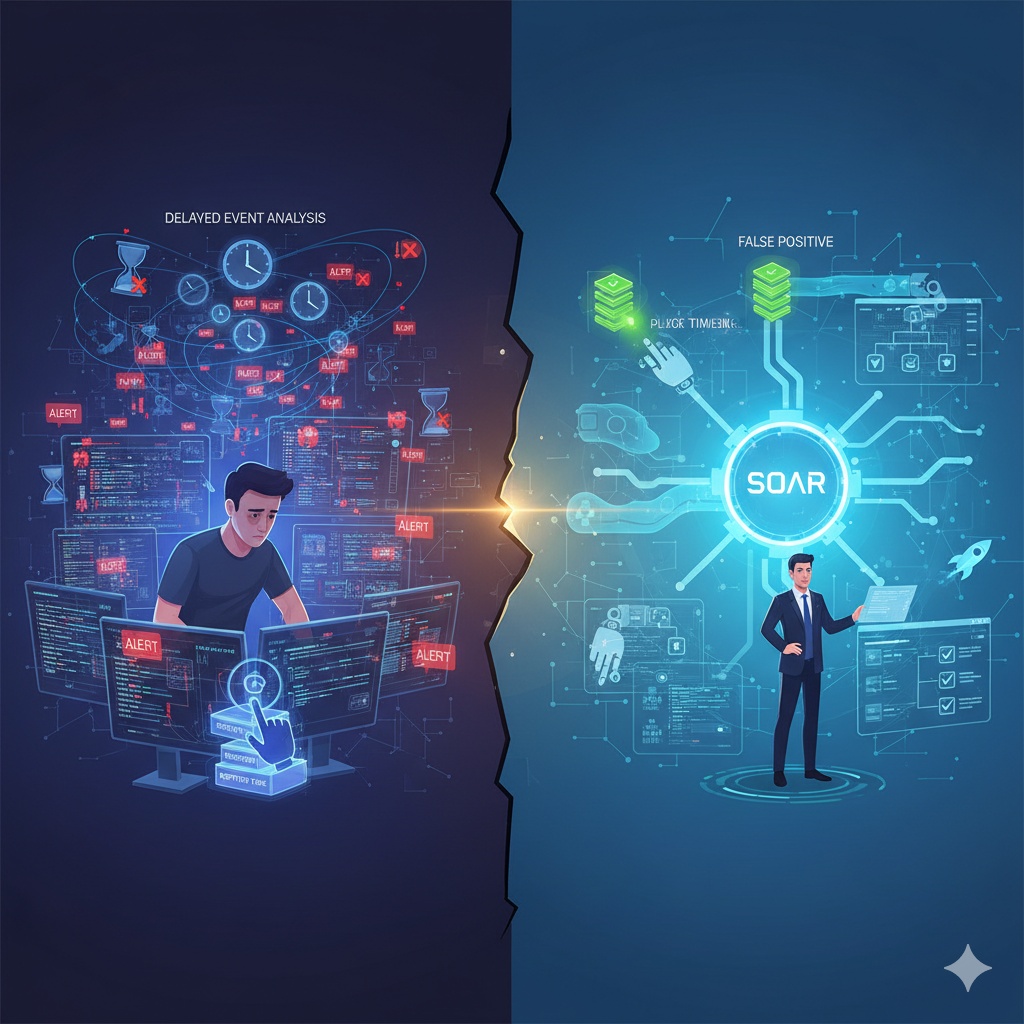
🤯 1. Alert Fatigue: “This is an alert, that’s an alert!”
Numerous security devices (firewalls, IDS/IPS, EDR, etc.) generate alerts whenever a potential threat is detected. The problem is the sheer volume of these alerts. In particular, ‘false positives’, which are threats identified incorrectly, account for a significant portion.
- Problems:
- Desensitization and Burnout: Analysts who have to check hundreds or thousands of alerts every day gradually become desensitized to them. The moment they think, “It’s probably another false positive,” they can miss a truly important threat. 🚨
- Difficulty in Identifying Critical Threats: Sifting out ‘real alerts’ that indicate actual attacks from a flood of fake alerts is like finding a needle in a haystack.
- Time Waste: A significant portion of an analyst’s valuable time is spent processing false positives, preventing them from focusing on crucial threat analysis or proactive threat hunting.
Just like the story of the boy who cried wolf, continuous false alarms can lead to a fatal outcome where no one pays attention when a real wolf appears.
⏳ 2. Delayed Event Analysis: “Missing the Golden Hour”
When a security alert occurs, comprehensive analysis is required to determine if it’s a real threat and what impact it might have. The second problem is that this process takes too long.
- Problems:
- Lack of Context: It’s difficult to paint a complete picture of an attack with fragmented alerts alone. To understand how an attacker infiltrated, which systems they accessed, and what data they tried to exfiltrate, analysts must manually collect logs and data from various systems and analyze their correlations. 🧩
- Dispersed Data: The necessary information is scattered across multiple security solutions and systems, taking a lot of time to collect and normalize the data.
- Increased Attacker Dwell Time: The longer the analysis is delayed, the longer attackers can remain inside the network and cause more damage. This means missing the ‘golden hour’ of an attack.
For every hour of delayed analysis, attackers can take another step closer to a company’s most critical assets.
🔁 3. Repetitive Tasks: “When will I get to do creative work?”
A significant portion of a SecOps analyst’s work consists of predictable and repetitive tasks.
- Key Repetitive Tasks:
- Initial Alert Triage: Evaluating risk levels and assigning responsible parties whenever a new alert occurs.
- Information Gathering: Looking up basic information needed for threat analysis, such as IP address reputation checks and malicious hash value confirmations, from external sites.
- Report Generation: Creating reports on regularly occurring events or processing details.
These simple, repetitive tasks hinder an analyst’s growth and reduce job satisfaction. Skilled analysts should focus on creative work, such as finding unknown threats or establishing security strategies, using their advanced expertise, but often this is not the reality. 🤖
✨ The Key to Solution: Automation and Orchestration through SOAR
So, how can we solve these difficult problems? Recently, many companies have found the answer in SOAR (Security Orchestration, Automation, and Response) platforms.
- Solving Repetitive Tasks with Automation:
- Automate repetitive information gathering tasks like IP reputation checks and malware analysis, reducing analysis time to seconds.
- Automatically process and close simple, low-risk alerts, allowing analysts to focus only on critical threats.
- Solving Delayed Analysis with Orchestration:
- Integrate multiple security solutions (SIEM, EDR, firewall, etc.) to make data collection and analysis flow seamlessly.
- For example, if an alert occurs in SIEM, SOAR can automatically retrieve detailed information about the endpoint from EDR and block the related IP on the firewall, handling a series of processes in an instant. 🚀
- Solving Alert Fatigue with Playbook-Based Response:
- Process alerts using standardized procedures based on predefined threat response scenarios (playbooks).
- This allows for faster and more consistent filtering of false positives and standardizes response quality, which previously relied solely on analyst experience.
Conclusion
The three major challenges faced by SecOps teams – alert fatigue, delayed analysis, and repetitive tasks – can no longer be solved solely by the sacrifice and effort of analysts. It is now time to introduce smart automation and orchestration technologies to maximize the efficiency of security operations and create an environment where our analysts can truly focus on critical threats. 🛡️
How is your organization addressing these issues? Please share your valuable insights in the comments!
Tags: SecOps, Security Operations, Cybersecurity, Alert Fatigue, SOAR, Automation, Orchestration, Information Security, Security Analyst
Leave a Reply