Hello! 👋 This is DD, making IT information easy to understand.
Online shopping, subscription services, easy payments… we can’t talk about our lives without cards anymore. As convenient as this has become, you’ve probably worried at least once, “Is my precious card information really safe?”
Companies must comply with various ‘security regulations (compliance frameworks)’ to protect customer data safely, but there are so many types that it’s often confusing what’s what. 😅
In particular, PCI DSS, GDPR, HIPAA, and SOC 2 are the most frequently mentioned regulations in the security field. Today, I’ll clearly explain what each of these four is and how they differ!
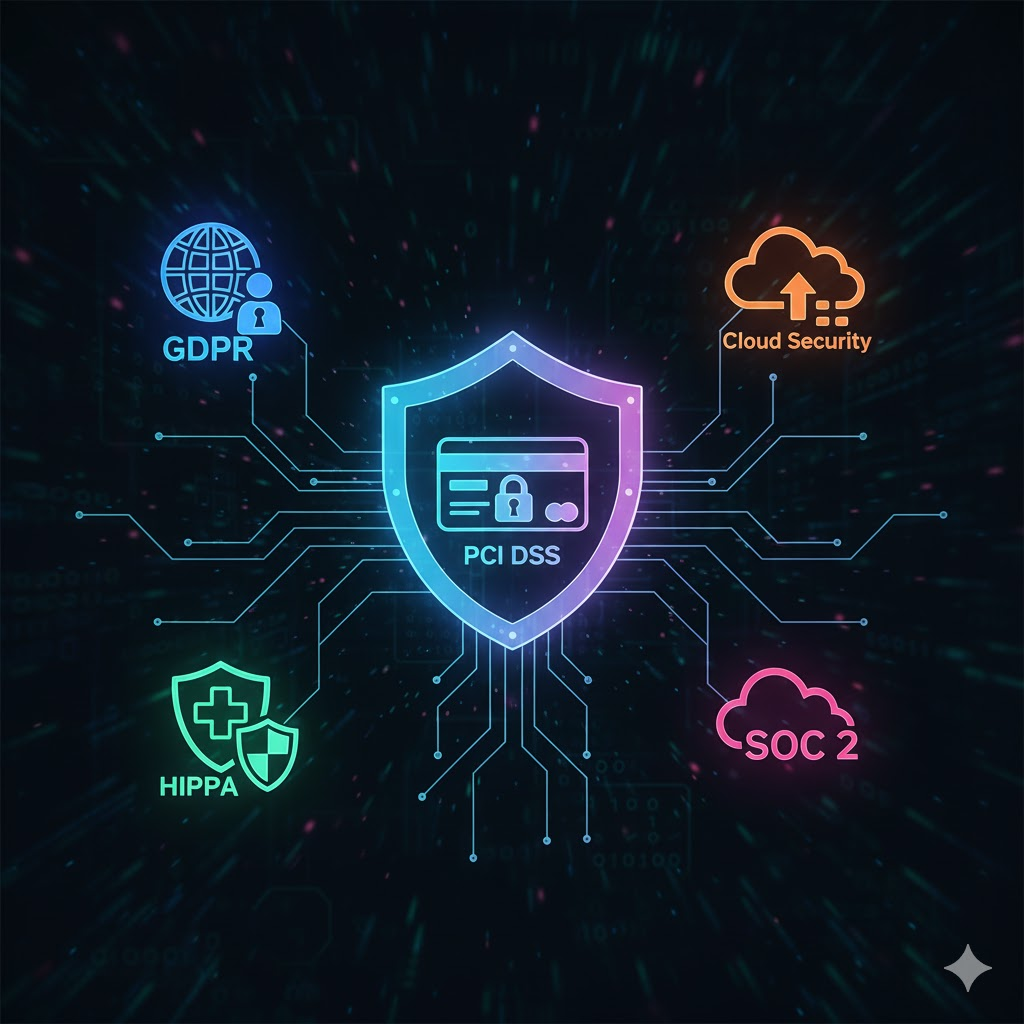
💳 PCI DSS: The ‘Absolute Standard’ for Credit Card Information Security
PCI DSS (Payment Card Industry Data Security Standard)
First, this is the answer to today’s core question: “The regulation focused solely on credit card data security.”
- Who is it for? 🤔 It applies to all companies that store, process, or transmit credit card information. This includes shopping malls, payment gateways (PGs), hotels, airlines, and any other entity that accepts customer card payments, without exception.
- What does it protect? 🛡️ It focuses exclusively on protecting Cardholder Data. This includes card numbers, cardholder names, expiration dates, and CVC codes.
- What is its core objective? 🎯 To protect card information from hackers and maintain the trust of the entire payment system. To achieve this, it sets forth 12 strict security requirements (e.g., network firewall configuration, data encryption, access control) and assesses whether companies adhere to them.
In a nutshell! 💬 You can easily think of PCI DSS as “the blueprint for a fortress-like vault for credit card information.”
🇪🇺 GDPR: I am the ‘Owner’ of all my personal information!
GDPR (General Data Protection Regulation)
GDPR is the ‘General Data Protection Regulation’ created by the European Union (EU). It is also known as “the strongest personal data protection law.”
- Who is it for? 🤔 It applies to all companies worldwide that process the personal information of EU citizens. Even a Korean company must comply if it has EU customers.
- What does it protect? 🛡️ It protects all types of personal information that can identify an individual, not limited to credit card information. This includes names, email addresses, physical addresses, phone numbers, and even IP addresses or cookie information.
- What is its core objective? 🎯 To prioritize and guarantee the rights of data subjects (that’s us!) when companies collect and use personal information. It specifies rights such as consent for data processing and the right to erasure (right to be forgotten).
In a nutshell! 💬 GDPR carries a powerful message: “My data user manual! Nothing without my permission!”
🏥 HIPAA: My Sensitive Health Information is ‘Confidential’
HIPAA (Health Insurance Portability and Accountability Act)
As its name suggests, HIPAA is a U.S. federal law specialized in ‘medical and health information’.
- Who is it for? 🤔 It applies to all organizations in the U.S. that handle patient health information, such as healthcare providers and health insurance companies. This includes hospitals, pharmacies, and partner companies that provide related IT systems.
- What does it protect? 🛡️ It protects all medical-related personal information, referred to as Protected Health Information (PHI). This includes highly sensitive information such as medical records, prescriptions, and health insurance information.
- What is its core objective? 🎯 To prevent unauthorized disclosure or misuse of patient health information and to thoroughly ensure the privacy and security of that information.
In a nutshell! 💬 HIPAA can be described as “the ‘confidential medical chart’ storage regulation for my health records.”
☁️ SOC 2: “You can trust our company” Quality Assurance Certificate
SOC 2 (Service Organization Control 2)
SOC 2 is slightly different in nature. Rather than a law protecting specific data, it is more of an audit report that demonstrates how securely a service provider manages customer data.
- Who is it for? 🤔 It applies to all service companies that store and process customer data, such as cloud services and SaaS companies. (e.g., AWS, Google Cloud, Salesforce, etc.)
- What does it certify? 🛡️ It objectively certifies, through an external auditor, that the company controls customer data securely according to five principles: security, availability, processing integrity, confidentiality, and privacy.
- What is its core objective? 🎯 To transparently show the company’s security systems and operational capabilities so that customers (primarily other businesses) can trust the service provider with their data.
In a nutshell! 💬 SOC 2 is “our company’s ‘security quality assurance certificate’ verified by external experts.”
📊 A Quick Comparison of the 4 Security Regulations
| Category | PCI DSS | GDPR | HIPAA | SOC 2 |
| Main Target | Card payment processing companies | Companies processing EU citizen data | US healthcare organizations | Cloud/SaaS and other service companies |
| Protected Data | 💳 Credit card information | 👤 All personal information | 🏥 Health information (PHI) | ☁️ Overall customer data |
| Core Objective | Payment system security | Protecting data subject rights | Patient information privacy | Proving service reliability |
Do you understand the distinctions clearly now?
No matter what service you use or what business you conduct, there are invisible efforts like these to protect our valuable data! I hope my article today has helped you understand complex security regulations a little better. 😊
Tags: PCI DSS, GDPR, HIPAA, SOC 2, Security, Compliance, Personal Data Protection, Data Security, Information Protection, Credit Card Security
Leave a Reply