In AI agents, a harness is an execution structure that connects a model to tools, allowing it to carry out tasks, while a guardrail refers to controls that inspect and restrict inputs, outputs, and actions to ensure they adhere to defined policies. A harness focuses on how a task proceeds, whereas a guardrail focuses on the conditions under which a task is permitted to proceed.
These two terms often overlap in actual products. A harness might include a tool approval function, and a guardrail tool might even control the flow of conversation. Therefore, approaching this solely as a choice between two product categories can easily lead to overlooking the responsibilities of individual components.
This article clarifies the characteristics of these two concepts, how they work together, and easily confused terminology, all within the context of AI agents. Product features are based on official documentation confirmed as of October 1, 2026, and customer report examples and architectural diagrams are design examples created for illustrative purposes.

1. Even the same model can proceed with tasks in different ways
Consider the request: “Analyze last month’s customer inquiries, create a report, and send it to the relevant person.” Just because a language model can write report sentences doesn’t mean the entire task is immediately completed. It requires processes to determine where to read inquiry data, which tools to call, where to store intermediate results, and to confirm successful transmission.
When a model suggests calling a tool, such as “inquiry search,” the actual program executes that tool. The program then returns the search results to the model, and the model uses those results to determine the next action or final response. This iteration is called an agent loop. The official Claude Agent SDK documentation also describes a structure that provides tools, agent loops, and context management together. Claude Agent SDK Overview
Here, context refers to the information the model references for its current decision-making. This includes the original request, conversation history, tool usage instructions, and search results. Since there’s a limit to the amount of information a model can reference at once, for long tasks, deciding what to retain and what to summarize also becomes part of the execution structure.
The term “harness” is used to describe such task structures around a model. However, not all documents refer to the same scope. Some documents focus on the iterative structure connecting model calls and tool execution, while some products refer to an execution environment that bundles file management, memory, approval, and sub-agents.
Therefore, when you hear “a harness has been introduced,” it’s good to check the included features. The actual operational scope changes depending on whether it only provides tool execution or also offers recovery after task interruption.
2. What a Harness Does: Connects, Remembers, and Continues
The core of a harness lies in connecting a model’s single-shot responses into multi-step tasks. The following is a functional breakdown useful when examining implementations. It is not a standard that all harnesses must provide all the items below.
Tool Execution and Next Step Connection
A harness informs the model about available tools and connects the tool name and arguments requested by the model to the actual execution code. It also plays a role in passing execution results and errors to the next model call. Whether a task is finished, requires additional calls, or the iteration should be stopped is determined by the application and the harness’s design.
In the report example, if search results are insufficient, it can search again under different conditions; if sufficient, it can proceed to summarization. Conversely, if tool errors persist, it can be configured to stop after a predefined number of retries. Without such termination conditions, the same request could be repeated, consuming time and cost.
Task State and Context Management
Saving report drafts, completed steps, remaining steps, and tool results makes it easier to continue tasks. However, the fact that something is saved is different from accurately reading the necessary content for the next model call. The storage location, retrieval timing, and what to retain for summarization must be designed together.
In Anthropic’s long-running task example, they divided the process into an initial environment setup phase and subsequent incremental work phases, utilizing progress logs, Git history, and feature lists. This is a concrete example of a harness design that allows the next session to understand the current state even if the context changes. It does not mean that the same file configuration should be applied to all tasks. Effective harnesses for long-running agents
Providing Execution Environment and Observation Points
File systems, code execution environments, user approval, and sub-agent connections can also be included in a harness. For example, Deep Agents describes file systems, context management, sub-agents, and human intervention as key features. Deep Agents Official Overview
In operation, records are also needed to track this flow. It should be possible to know which model call led to which tool execution and where a failed step occurred. However, the function of logging execution history and the function of actually blocking risky behavior must be checked separately. The presence of “transmission attempt” in logs alone cannot be taken as proof that transmission was controlled.
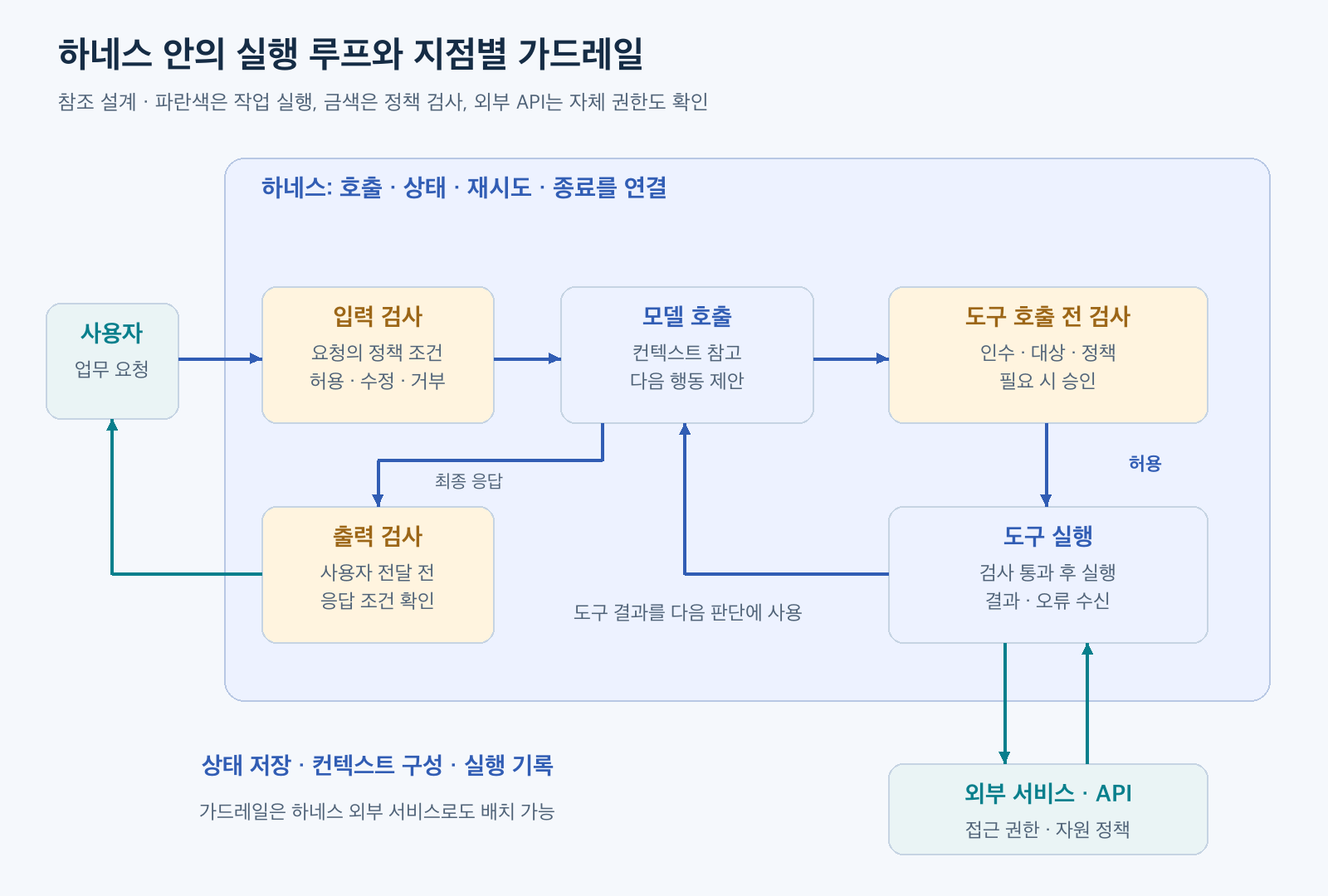
Figure 1. Reference design with execution structure and policy inspection points placed together. Reconstructed based on official documentation from Deep Agents, NeMo Guardrails, and Claude Agent SDK Permission Control. This diagram does not represent the exact internal structure of any specific product.
3. What a Guardrail Does: Inspects, Decides, and Enforces
A guardrail does not refer to a single inspection method or product name. In this article, it broadly refers to controls that apply application policies to the execution flow. Depending on the product, it might only mean content inspection, or it might include tool execution or conversation flow control.
For example, it can modify inputs containing personal information, prevent parts of a searched document from being passed to the model, or block unauthorized tool calls. Quality checks, such as verifying if results are in a defined JSON format, are also sometimes grouped under the name “guardrail.” Therefore, “security guardrails” and “output format guardrails” cannot be assumed to address the same risks.
NeMo Guardrails describes five types: input, conversation, retrieval, execution, and output. Specifically, execution guardrails apply to the inputs and outputs of custom tools, and conversation guardrails influence the next action or response flow. Understanding guardrails only as a filter for forbidden words in the final answer will lead to overlooking this scope. Types of NeMo Guardrails
Detection Results Must Be Reflected in Actual Execution
Discovering sensitive information in a report is detection. Deciding whether that report can be sent externally is a policy judgment. Not executing the transmission tool or changing it to “pending approval” is enforcement. One module might perform all three roles, or multiple services might divide them.
For example, if a personal information detector returns “sensitive information present,” but the transmission code ignores that result, the inspection was performed, but the data leakage prevention policy was not applied. Conversely, if the detection results are used to mask the information, then re-inspected, and only the approved results are transmitted, then detection and enforcement are linked.
Rules and Model Judgments Have Different Characteristics
Whether a tool name is allowed, whether the requested amount is within limits, or whether required fields are present can be checked by code rules. Whether a request is sensitive in context or falls outside a specific business scope can be handled using classification models or LLMs. A design combining both is also possible.
Rule-based checks operate consistently for the conditions written but do not solve cases where conditions are missing. Model-based checks can handle context but require measuring false positives and false negatives. A false positive is incorrectly blocking a legitimate request, and a false negative is allowing a request that should have been blocked. In either approach, rather than judging the level of protection by name alone, it’s necessary to confirm the inspection target and the action upon failure.
4. The Difference Between the Two Emerges in ‘Task Progression’ and ‘Policy Application’
The following table provides a role-centric comparison to understand various implementations. Individual products may offer both functionalities.
| Comparison Criterion | Harness | Guardrail |
| — | — | — |
| Central Question | In what order should the task continue? | Should this input, output, or action be allowed? |
| Main Target | Model calls, tool execution, state, task lifecycle | Content, tool arguments and results, policy violation conditions |
| Key Features | Iterative execution, context configuration, state saving, retry/termination | Inspection, masking, blocking, restriction, approval request connection |
| Scope of Application | Execution structure of the entire task | Necessary points such as input, retrieval, tools, output |
| Metrics to Examine | Task success rate, recovery success rate, latency, cost | False positives/negatives, bypass possibility, inspection scope, blocking latency |
| Relationship to Each Other | Can call guardrails and reflect results in execution | Policies can be applied within the harness or by external services |
To see the differences concretely, let’s follow the customer report example again. The following process is a design example for explanation, not the default behavior of a specific SDK.
- Request Reception: The application verifies the user and business scope, receives input inspection results, and starts the task.
- Data Retrieval: The harness executes the search tool. The search service returns only documents the user is authorized to view and applies inspections to the returned content if necessary.
- Report Generation: The harness passes the allowed data to the model. The generated draft is inspected for sensitive information and required output conditions.
- Transmission Request Review: The model’s proposed recipients and attachments are verified immediately before actual transmission. If required by policy, the user is prompted to approve the specific transmission content.
- Execution and Completion Confirmation: Only approved requests execute the transmission tool, and tool results are logged. If execution fails, it does not respond as successful.
Here, the harness connects the five steps. The guardrail is responsible for the inspections and restrictions in between. Access permission checks by the transmission service are separate controls for which that service is responsible.
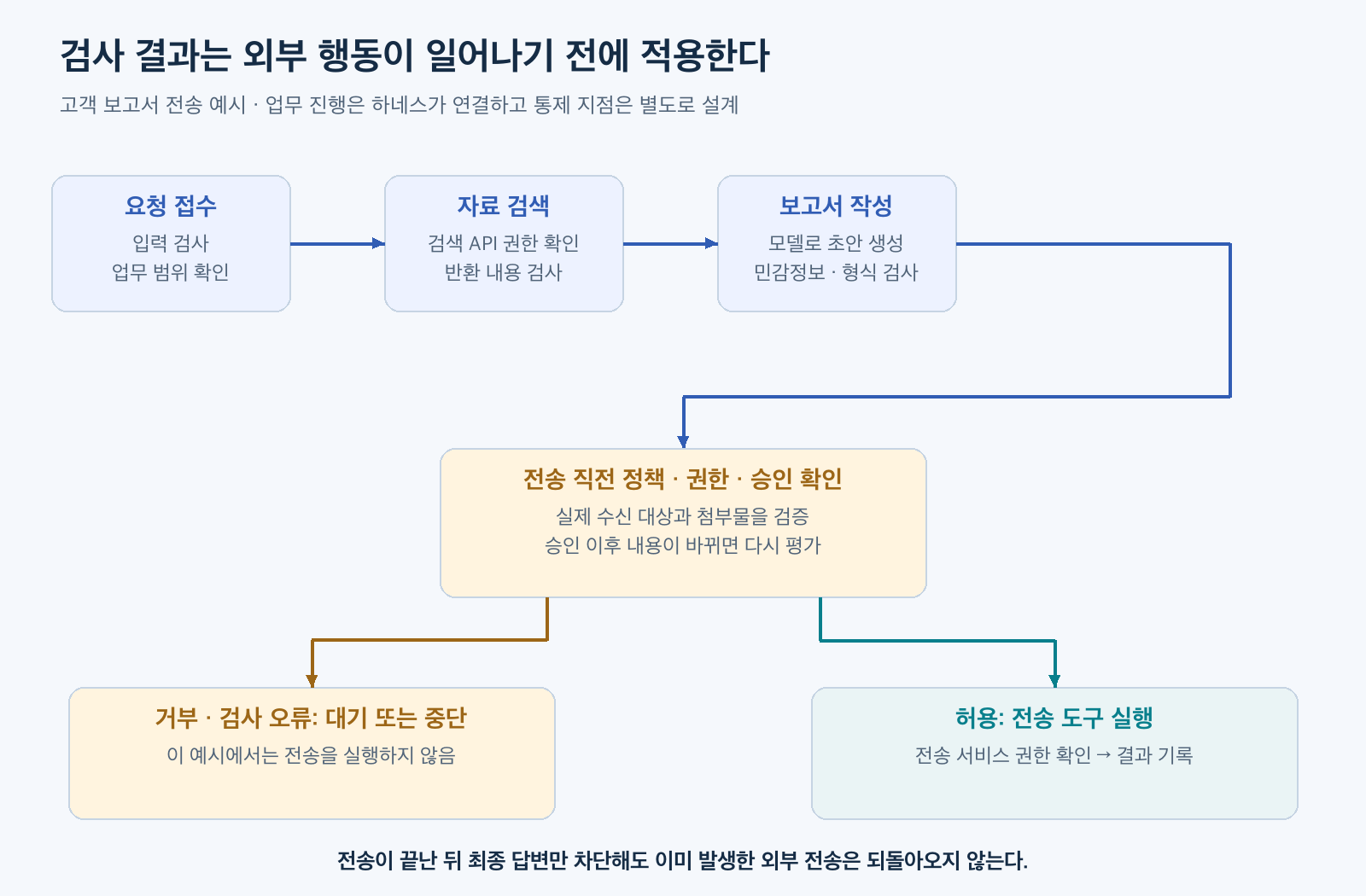
Figure 2. Example design applying inspection results before external transmission. Reconstructed based on official documentation from NeMo Guardrails and Claude Agent SDK Permission Control. Approval status and error handling methods should be defined according to business policies.
Blocking the Final Answer is Different from Blocking Tool Execution
If a report has already been sent, blocking only the “Sent” response will not undo the external transmission. Actions that change actual system states, such as data modification or message sending, require the necessary judgment to be completed before the action is executed.
If the design involves executing inspection and generation simultaneously for performance, it’s crucial to check what tasks can proceed before inspection is complete. Temporarily generating text has a different impact than confirming a change operation via an external API. For streaming responses, content delivered to the user before inspection is complete cannot be recalled by a subsequent block.
In actual implementation, the order of calls is more important than the names of hooks or callbacks. Claude Agent SDK’s permission documentation explains the order in which hooks, permission rules, etc., are evaluated before tool execution, showing that calls decided in earlier stages may not reach certain callbacks. It is necessary to check which paths undergo inspection in the documentation for the installed version. Permission Evaluation Order
5. Five Points Where Terminology is Confused
A Harness Does Not Always Mean an Agent Executor
In software, “harness” can also mean a structure set up to execute or test a certain target. For example, an evaluation harness is an evaluation tool that connects datasets, model execution, and score calculation. EleutherAI’s lm-evaluation-harness is also a language model evaluation framework. Just because a name includes “harness” does not mean it can be classified as a product for executing business agents. EleutherAI Official Repository
Frameworks, Runtimes, and Harnesses Have Overlapping Boundaries
It’s convenient to understand a framework as emphasizing components and abstractions used for development, a runtime as the underlying basis for stateful execution, and a harness as a configuration equipped with the necessary tools and execution methods for a task. However, this is a distinction for reading documentation and not a fixed hierarchy applicable to all products.
LangChain, in its documentation, distinguishes LangChain as a framework, LangGraph as a runtime, and Deep Agents as a harness. At the same time, it describes a harness as a framework with various built-in functionalities. Thus, one product can fall into broader categories. Runtimes, frameworks, and harnesses
Guardrail is Used Both for the Purpose of a Safety Device and for Specific Functions
It’s difficult to interpret “there is a guardrail” as meaning that personal information protection, hallucination reduction, tool permissions, and output formats are all controlled. An response that passes JSON format inspection can still contain incorrect facts, and a tool request without harmful expressions can still access unauthorized data.
In documentation, it is clearer to use expressions that specify the target and condition, such as “personal information inspection of output” or “restriction of recipients for transmission tools.” This reveals what is actually implemented under the broader name “guardrail.”
A Harness’s Approval Function Can Also Act as a Guardrail
If a harness provides a function to obtain user approval before a tool call, then one function of the execution structure also performs a policy control role. Calling this a harness function and describing it as a guardrail can be simultaneously correct.
Conversely, tools like NeMo Guardrails also handle conversation flow and action selection. Therefore, rather than drawing a strict line that a harness only executes and a guardrail only filters strings, it’s more accurate to check which component is responsible for decisions at which stage.
Sandboxes and Permission Systems Should Be Viewed Separately
A sandbox is an isolation mechanism that restricts the scope of environments, such as files or networks, that execution code can access. A guardrail can be responsible for inspecting whether requests or results satisfy policies. While using both functions together can address different boundaries, one existence alone should not be assumed to imply the presence of other functions.
For example, even if report generation code runs in an isolated environment, if the transmission API is granted excessive permissions, a separate problem remains. Conversely, inspecting transmission text does not automatically reduce the file access scope of the execution process.
| Expression Seen in Documentation | What to Check First |
| — | — |
| Agent harness | What does it provide among tool execution, state, context, and recovery? |
| Evaluation / test harness | Does it perform actual business tasks, or evaluate model/code results? |
| Guardrail | What does it inspect, and which actions actually stop if it fails? |
| Runtime / framework | Does it refer to an execution base, or development components? |
| Sandbox / permissions | Which resources and actions are restricted at which layer? |
6. In Actual Design, Responsibilities are Documented Rather Than Product Names
When drawing an architectural diagram, simply using two boxes labeled “Harness + Guardrail” does not convey enough information. For the report example, inspection targets and execution responsibilities can be documented as follows:
- Data Access: The search API returns only documents authorized for the user. Access permission checks are not replaced by masking after retrieval.
- Generated Content: The draft is inspected and, according to policy, sent for modification, rejection, or review. Modified results are also re-checked against required conditions.
- Tool Execution: Actual recipients and attachments are verified immediately before transmission. If the approved content and the content to be executed differ, approval is re-evaluated.
- Task Management: Limits are set for time, cost, and number of repetitions, and for tasks where duplicate execution is problematic, such as transmission, re-attempts check for duplicate processing.
- Operational Records: The applied policy version, inspection results, and actual execution status are linked and recorded. Personal and confidential information are not unnecessarily logged.
This list does not claim specific product features but rather provides design items that can be used to divide responsibilities. In a team’s system, it should be indicated which items are handled by the harness and which by the API server or policy service.
Validation can also be divided into two directions for clarity. A harness checks if a task can be completed, if it correctly resumes after interruption, and if it handles tool failures. A guardrail checks if legitimate requests pass, if forbidden requests stop before actual execution, and what happens if the inspection service is unresponsive.
For critical operations like external transmission, the design can be to wait or stop if inspection results are not obtained. For functions with minor impact, different failure policies can be chosen. These choices must be explicitly stated per service to predict whether a pass or block action will occur in case of failure.
7. Summary: Harness is Progression Structure, Guardrail is Policy Control
A harness connects models, tools, context, and task states, enabling an agent to continue its work. A guardrail inspects inputs, outputs, and actions at necessary points and applies policies. In actual systems, a harness may include guardrails, or separate policy services or APIs may handle some controls.
When terminology is ambiguous, three things should be checked: What is the structure that executes? What is the control that inspects? Who reflects the inspection results into actual actions? Answering these three questions allows even products with overlapping functionalities to be compared based on their responsibilities and boundaries.
Good design documentation does not end with just the names “harness” or “guardrail.” It shows both the path for task progression and the points where unauthorized actions are stopped. This structure is necessary to assess functionality, operational stability, and protection scope within the same framework.
Leave a Reply