Hello! 👋 Have you ever found yourself scratching your head when reading IT tech blogs or discussing DevOps and SRE, encountering unfamiliar terms like SLI, SLO, and SLA? This post is for those who think, “I know service quality is important, but what do all these terms actually mean?”
Today, we’ll explore the Service Quality Trio: SLI, SLO, and SLA, key indicators of service stability. Forget complex concepts for a moment and listen to the story of our local pizza shop. 🍕 You’ll understand all the concepts perfectly in no time!
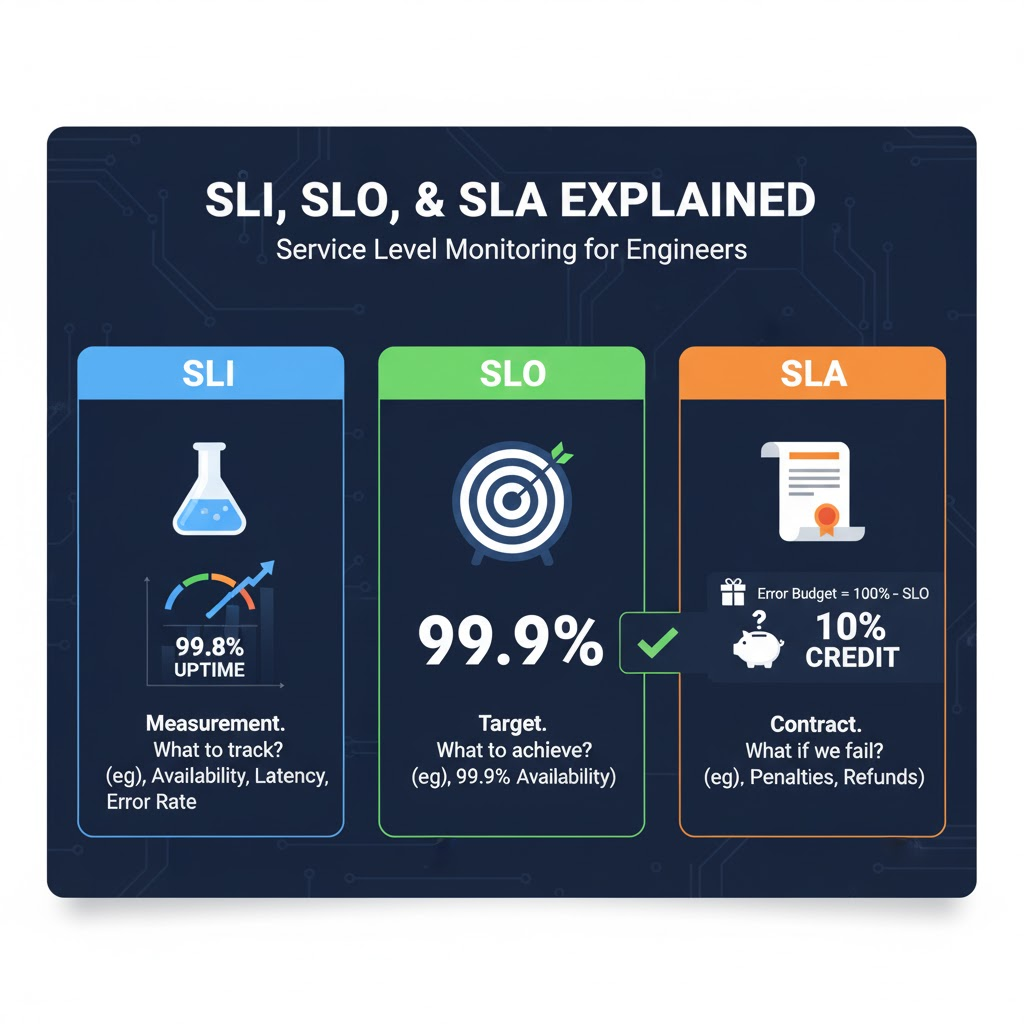
📈 Introducing the Service Quality Trio: SLI, SLO, and SLA!
These three terms are not isolated concepts but are closely interconnected. It’s easy to understand them as a flow: measuring service quality (SLI), setting goals (SLO), and then making a commitment to customers (SLA). Shall we meet them one by one?
1. 🔬 SLI (Service Level Indicator)
The most fundamental SLI can be thought of as a ‘dashboard showing the health of a service.’ It is the metric itself used to quantitatively measure the quality of our service.
- 🤔 Key Question: “What should we measure?”
- 🏥 Analogy: A hospital’s thermometer, blood pressure monitor
- Role: Objectively shows the current state with specific numbers.
Key SLI Examples:
- Availability: How long has the service been operating normally?
- Measurement Method: (Number of successful requests / Total number of requests) * 100
- Latency: How long did it take for the user to receive a response after sending a request?
- Measurement Method: API request processing time (ms)
- Error Rate: How many requests failed out of the total?
- Measurement Method: (Number of 5xx errors / Total number of requests) * 100
SLI provides a benchmark that allows us to say, “Our service’s average response time is 150ms,” rather than vaguely stating, “Our service is fast.”
2. 🎯 SLO (Service Level Objective)
SLO is the specific target we aim to achieve based on the SLI measured above. Rather than a publicly disclosed promise, it is an internal quality goal that development and operations teams must adhere to.
- 🤔 Key Question: “At what level should the measured value be for users to be satisfied?”
- 🌡️ Analogy: Setting a target temperature like, “Let’s always maintain the indoor temperature at 24 degrees Celsius!”
- Role: Provides clear goals, rather than vague ‘improvements,’ to guide the team’s direction.
Key SLO Examples:
- “Monthly availability (SLI) must be 99.9% or higher.” (Four Nines)
- “95% of website access requests must be processed within 300ms.”
- “The error rate (SLI) for payment APIs must be maintained below 0.1%.”
SLO can be described as setting the “minimum acceptable threshold where users do not experience discomfort.”
3. ✍️ SLA (Service Level Agreement)
SLA is a formal contract with customers outlining what responsibilities we will bear if we fail to meet the goals (SLO) we have set. It is a legally binding promise that includes compensation plans for unforeseen circumstances.
- 🤔 Key Question: “What should we do for customers if we fail to meet the goals?”
- 📜 Analogy: A contract stating, “If the target temperature is not met, we will refund 10% of the cooling charges.”
- Role: Builds customer trust in service quality and serves as a mechanism to protect the business.
SLA Example:
- “If monthly availability falls below 99.9% (SLO), 10% of the next month’s service fee will be refunded.”
Typically, SLAs are set with slightly more lenient figures than the internal SLOs to protect the business.
🍕 Easy to Understand! The Story of Our Local Pizza Shop
If you’re still confused, focus on this pizza shop story!
- 🔬 SLI (Indicator): Measures the ‘actual delivery time’ from the moment an order is placed until the pizza is delivered to the customer, one by one. (e.g., 25 minutes, 32 minutes, 18 minutes…)
- 🎯 SLO (Internal Objective): To maintain the shop’s quality, the owner sets an internal goal: “95% of all delivery orders must be completed within 30 minutes!” To achieve this, they continuously improve kitchen workflow and the delivery system.
- ✍️ SLA (Customer Agreement): The flyer advertises, “If not delivered within 40 minutes, the pizza is free!” This promise assures customers of service quality. (They’ve allowed a 10-minute buffer compared to the internal 30-minute goal!)
How about that? Can you now clearly visualize the relationship between the three?
👑 Do You Know the Core of SLO: ‘Error Budget’?
When you set an SLO, a very powerful tool emerges: the ‘Error Budget’.
- Error Budget = 100% – SLO
If our service’s availability SLO is 99.9%, the error budget becomes 0.1%. This translates to approximately 43 minutes over a month (30 days).
These 43 minutes are the ‘acceptable downtime’ for our service. Within this budget, the development team can take risks by deploying new features or temporarily take the service offline for system maintenance.
What if an outage occurs and this entire error budget is exhausted? 🚨 At that point, a strong data-driven decision can be made to halt all new feature development and focus solely on service stabilization. In other words, the error budget is the best tool for intelligently balancing ‘the speed of innovation’ and ‘service stability’.
Conclusion
Now, SLI, SLO, and SLA will no longer be difficult codes to decipher.
- Measuring our service’s health with SLI,
- Setting user-satisfying goals with SLO, and
- Promising reliability to customers with SLA.
These three concepts are the key to transforming service management from relying on vague intuition to a data-driven, scientific domain. We hope you apply the concepts learned today to your services to create a happy experience for both users and development teams!
Tags: SLO, SLI, SLA, SRE, DevOps, Service Level Objective, Error Budget, Observability, Monitoring
Leave a Reply