Hello! Today, we’re going to deeply compare the long-standing stalwart of Linux networking, Netfilter (iptables), with the new superstar of the cloud-native era, eBPF.
When operating Kubernetes environments, you often hear phrases like “iptables is a bottleneck” or “we should switch to Cilium (eBPF).” But why exactly is eBPF considered better? Simply saying ‘it’s faster’ isn’t enough.
Today, we’ll delve into the reasons from the perspectives of performance, architecture, and Time Complexity. 🧐
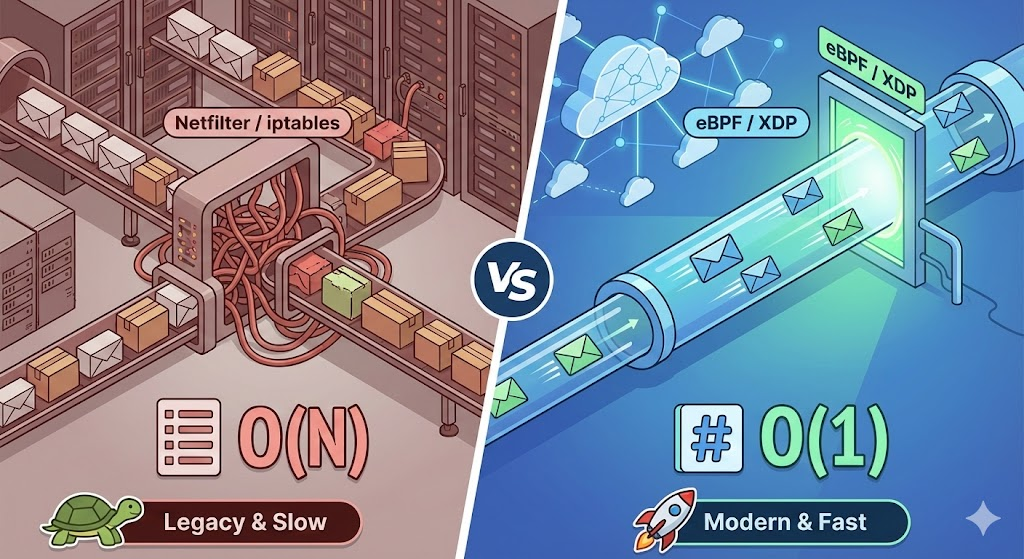
1. The Core of Performance: Differences in Processing Location and Method 🏁
The first thing we’ll look at is the location where packets are processed.
🐢 Netfilter (iptables/nftables)
Netfilter is like a “roadside checkpoint.”
- A packet arrives at the Network Interface Card (NIC).
- The kernel allocates memory (sk_buff) and the packet travels up the network stack (TCP/IP).
- After traveling up for a while, rules are checked at designated hook points.
- Even if a packet needs to be blocked, the memory allocation and context switching costs have already been incurred.
⚡ eBPF (XDP/TC)
eBPF, especially XDP (eXpress Data Path), is like “blocking traffic before it enters the highway.”
- Packets are inspected as soon as they arrive at the NIC driver (at the lowest layer).
- Unnecessary packets can be dropped even before the OS allocates memory (Early Drop).
- It runs as native machine code via a JIT (Just-In-Time) compiler, resulting in overwhelmingly fast processing speeds.
In summary: eBPF bypasses unnecessary kernel overhead and processes packets via the fastest path.
2. Time Complexity: The Battle of O(N) vs O(1) ⏱️
This is the highlight of today’s post. Let’s look at how performance changes as the number of services (rules) increases, from an algorithmic perspective.
📉 Netfilter: O(N) – “Sequential List Scan”
iptables manages rules in the form of a Linked List.
- Method: When a packet arrives, it is compared one by one, sequentially, from rule #1 to rule #N.
- Problem: It’s fast with 100 rules, but what if Kubernetes services increase to 10,000 rules? Each packet requires 10,000 comparison operations.
- Result: Performance degrades linearly in proportion to the number of rules.
📈 eBPF: O(1) – “Instant Lookup (Hash Map & Trie)”
eBPF uses efficient data structures (Maps).
- Hash Map (Exact Matching): Used when changing a Service IP to a Pod IP.
- You input a key (IP), and the value (target) immediately pops out.
- Whether there are 10 rules or 100 million, the lookup speed is the same at $O(1)$ (constant time).
- LPM Trie (Network Range Matching): Used for CIDR (192.168.0.0/16) matching.
- It’s not $O(log n)$! It only has a depth equal to the length of the IP address (number of bits, IPv4=32).
- Since the search depth is fixed regardless of the number of rules (N), this also guarantees practical $O(1)$ performance.
Analogy
– Netfilter: An airport staff member checking thousands of prohibited item lists one by one.
– eBPF: A barcode reader instantly showing pass/block results as soon as it scans.
3. Flexibility and Observability 🔍
🛠️ Flexibility (Programmability)
- Netfilter: Only fixed configurations are possible. To implement complex logic, you might need to recompile the kernel.
- eBPF: You write code in C or Rust (Programming) and load it into the kernel. You can change logic during runtime, parse specific protocol headers, and program the kernel as desired.
🔭 Observability (Glass Box)
- Netfilter: You only see logs indicating whether a packet was allowed or blocked. (Black Box)
- eBPF: You can peer into kernel internal function calls, disk I/O, memory usage, and even data before encrypted communication. This is revolutionary for complex microservice troubleshooting. (X-Ray)
4. Safety: No More Kernel Panics 🛡️
You might think, “Running code inside the kernel? Isn’t that risky?” However, eBPF has a powerful safety mechanism called the Verifier.
- Before the code is loaded into the kernel, it’s checked for infinite loops and safe memory access.
- If it appears even slightly risky, execution is rejected.
- This completely prevents the ‘kernel panic (BSOD) if coded incorrectly’ problem that traditional Kernel Module methods had.
Summary and Conclusion 📝
| Feature | Netfilter (iptables) | eBPF (Cilium, etc.) |
|---|---|---|
| Time Complexity | $O(N)$ (Slows down with many rules) | $O(1)$ (Fast even with many rules) |
| Data Structure | Linked List | Hash Table, Array, Trie |
| Processing Location | Mid-network stack (Heavy) | Driver level (Light) |
| Main Use Case | Traditional Firewall | Large-scale Cloud Networking, Enhanced Observability |
In conclusion,
If your service scale is small and changes are infrequent, Netfilter is excellent. However, in dynamic environments like Kubernetes, where IPs change frequently and services grow to thousands, eBPF, with its $O(1)$ performance and deep observability, is becoming a necessity, not just an option.
Stop suffering from long iptables rule lists. It’s time to move into the world of eBPF! 🌊
Leave a Reply