Hello! I’m here to talk about the hottest topic in IT infrastructure: ‘The Great VMware Exodus’.
VMware, once the absolute monarch of data centers and virtualization itself. However, in recent years, especially after Broadcom’s acquisition, the atmosphere has completely changed. Countless companies and IT managers are packing their bags, saying, “We can’t take it anymore!” and looking for alternatives.
What exactly is happening? Why are they leaving the robust VMware castle for the uncertain wilderness? Let’s delve into the decisive reasons in detail. 🕵️♂️🔎
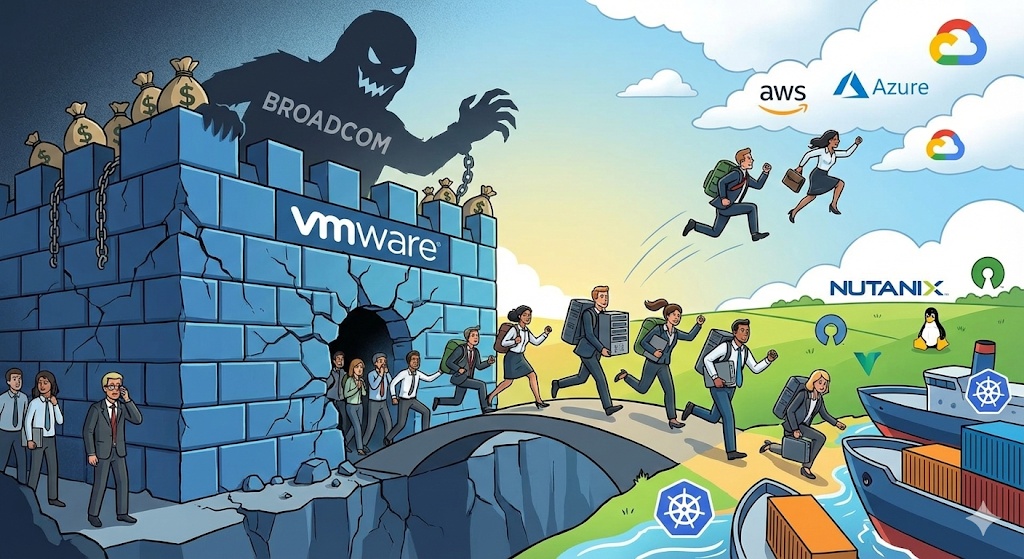
1. The Eye of the Storm: Broadcom’s Acquisition and the ‘Cost Shock’ 💰😱
The biggest and most direct cause is Broadcom’s acquisition of VMware, completed at the end of 2023. Broadcom is notorious (?) in the IT industry for “cost reduction and profit maximization after acquisition.” As expected, their strategy was ruthless.
- Abolition of Perpetual Licenses: This was the biggest shock. Previously, there were licenses you could buy once and use forever, but now it’s been forcibly switched to a subscription model, requiring monthly/annual payments.
- Mandatory Bundling and Price Increases: The era of picking and choosing only the necessary features is over. Broadcom has bundled products into massive packages like ‘VMware Cloud Foundation (VCF)’ or ‘vSphere Foundation (VVF)’. Customers are forced to buy expensive, unnecessary features. Some customers complain that their license costs have jumped 3 to up to 10 times. 📈
- Unpredictable Budget: For companies, the situation where IT budgets can suddenly jump several times over is a huge risk. This ‘uncertainty’ has pushed them to hit the escape button.
2. “Small Customers Are Not Customers?” Collapse of the Partner Ecosystem 💔
Broadcom’s strategy is clear: “Focus on top-tier enterprise customers (approx. 600 companies) that generate revenue.”
- Exclusion of Small and Medium-sized Businesses (SMBs): The countless SMBs, excluding the top-tier customers, have effectively been sidelined from ‘management’. It’s become difficult to get support, and their price negotiation power has disappeared.
- Termination of Partner Contracts: Contracts with numerous small and medium-sized partners (resellers) who sold and provided technical support for VMware products have been unilaterally terminated or made extremely stringent. Customers have lost the trusted technical partners they relied on. 😥
3. Changing Times: “It’s No Longer Just a VM World” (The Rise of Kubernetes) 🐳☸️
In fact, even before the cost issues, VMware’s position was gradually shaking. The paradigm of IT infrastructure had changed.
- From Virtual Machines (VMs) to Containers: Modern applications are developed based on light and flexible containers (e.g., Docker) instead of heavy VMs. And the de facto standard for managing these containers is Kubernetes (K8s).
- VMware’s Awkward Position: VMware also entered the Kubernetes market with a product called ‘Tanzu’, but because its origin is VM-centric, it’s often criticized as heavy and complex. For companies aiming for a cloud-native environment, VMware has begun to feel less like an ‘essential’ and more like ‘legacy’ (an old relic).
4. The Lure of Powerful Alternatives: “It’s Better Than You Think Outside” 🏞️🚀
In the past, there was a strong perception that “there are no alternatives to VMware,” but that’s no longer the case. While VMware faltered, its competitors grew tremendously.
- Public Cloud (AWS, Azure, GCP): More and more companies are completely abandoning on-premise (in-house server rooms) and moving to the cloud. Cloud providers are actively supporting VMware migrations to attract customers. ☁️
- Nutanix: One of VMware’s strongest competitors. It offers its own hypervisor (AHV) for free and actively embraces customers tired of VMware’s complex licensing policies.
- Open Source KVM-based Solutions (Proxmox, Red Hat): Cost-sensitive companies are turning to free (or very inexpensive) open-source virtualization platforms like Proxmox VE. Also, new approaches like Red Hat’s OpenShift Virtualization, which runs VMs on Kubernetes, are gaining attention. 🐧
📝 Conclusion: Monopoly Breaks, Era of Diversity Begins
VMware will not collapse immediately. Top-tier enterprises may have no choice but to pay high prices for now.
However, what is clear is that “VMware’s sole dominance” has ended. Broadcom’s aggressive monetization strategy awakened dormant customers, and companies have now realized how dangerous it is to be locked into a specific vendor.
The current ‘exodus’ is not just about cost savings; it might be a painful but essential process of change towards a more flexible and modern IT infrastructure. Which path will your company choose? 🤔
Leave a Reply