Hello! For the past 10 years, the absolute truth in the IT industry has been “Cloud First”. Whether it was a startup or a large enterprise, buying servers directly was treated as an outdated relic.
However, the recent trend is unusual. Successful companies are leaving public clouds like AWS and Azure and packing their bags to return to their own data centers (On-Premise). This phenomenon is professionally known as ‘Cloud Repatriation’.
Why are they abandoning convenient and innovative cloud services and longing for the “sound of air conditioning in the server room” again? Let’s delve into the shocking reasons and economic truths. 🕵️♂️💸
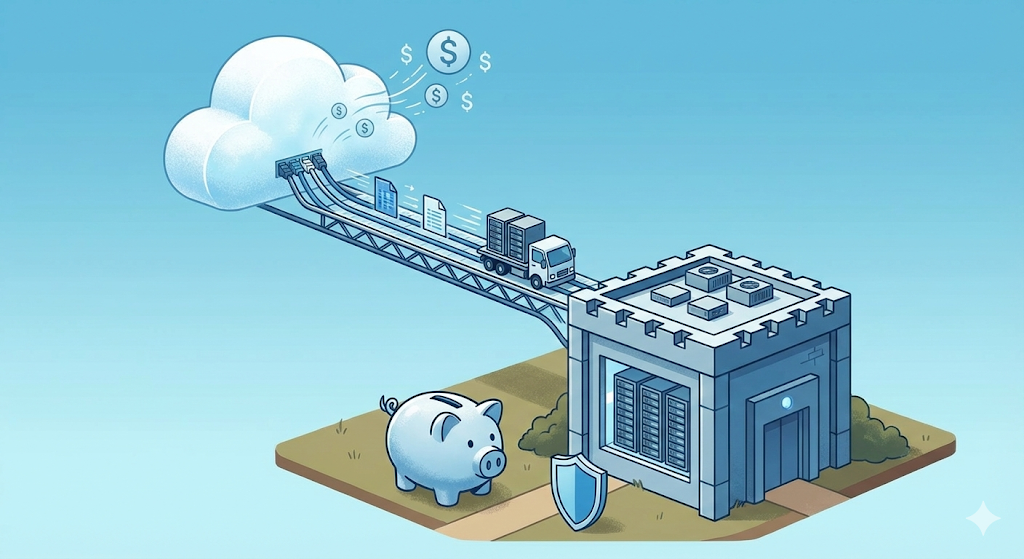
1. “Rent is more expensive than buying a house” – Unbearable Cost Bills 💸💥
The most decisive reason is, of course, money (Cost).
- Hotel vs. Own Home: The cloud is like a ‘hotel’. It’s great for a short stay, but if you live in a hotel for 10 years, you’d spend enough money to buy several houses.
- Paradox of Success: In the early stages of a business, the cloud is cheap. However, the moment a service succeeds and traffic exceeds a certain level, cloud costs increase exponentially.
- Cost Savings: In fact, 37signals, which operates Basecamp, announced that by exiting the cloud, they would save approximately 10 billion KRW ($7M) over the next five years, turning the industry upside down.
2. “My data, but I have to pay to take it out?” – The Trap of Egress Costs 🚧
One of the malicious pricing policies of cloud providers is network transfer fees (Egress Fee).
- Free to enter, paid to exit: They don’t charge you to upload data to the cloud. But when you move that data out or transmit it to customers, they collect enormous tolls.
- Netflix Dilemma: For companies with a lot of streaming or large file transfers, these costs become a ‘bill bomb’. Bandwidth that would be virtually free with a private network has to be bought at a premium in the cloud.
3. The Counterattack of Hardware Performance – “Now we are cheap and good enough” 🖥️⚡
Unlike 10 years ago, the performance and manageability of on-premise equipment have dramatically improved.
- NVMe and 100G Network: Just by plugging in high-performance SSDs and network equipment available on the market, you can outperform the expensive instance performance of AWS.
- Evolution of Open Source: In the past, expensive commercial software had to be purchased, but now, with open-source tools like Kubernetes (K8s), Ceph, and MinIO, you can operate infrastructure flexibly ‘like a cloud’ even in your own data center. This means you don’t necessarily need the AWS console.
4. Vendor Lock-in Fear – “Escape the Slave Contract” 🔗🔐
Using proprietary features (Managed Services) like AWS Lambda, DynamoDB, and SQS makes development convenient. But at that moment, you become their hostage.
- Immovable: If your code is tied to specific cloud features, you can’t move to another provider even if costs double later, because you’d have to rewrite all the code.
- Reclaiming Sovereignty: Cloud repatriation is like a ‘declaration of independence’ to break free from technological dependence and regain control of our infrastructure.
🔎 Case Study: 37signals’ The Big Exit
The case of 37signals, led by DHH (David Heinemeier Hansson), the creator of ‘Ruby on Rails’, is legendary.
- Situation: Annual cloud costs in the billions of KRW.
- Decision: “We are not a company with fluctuating traffic like Netflix. For stable traffic, the cloud is a luxury.”
- Execution: Exited AWS, purchased Dell servers, and moved into a co-location center.
- Result: Total server purchase costs were cheaper than one year of cloud costs. Performance also became faster.
📝 Conclusion: The Cloud is Not a ‘Master Key’.
Of course, not every company needs to return to on-premise.
- ✅ When to use the cloud: Early-stage startups, unpredictable traffic, urgent global region expansion. (Investing in uncertainty)
- ✅ When to consider on-premise (or hybrid): When the business is stable, traffic is predictable, and cost optimization is the top priority. (Investing in certainty)
Ultimately, the era of “mindless cloud adoption” is over. Now is the time to find “Right-Sizing” infrastructure that fits your needs. A cool-headed calculator is needed more than blind trends. 🧮🤔
Is your company currently living in a ‘hotel’ or do you own your ‘home’?
Leave a Reply