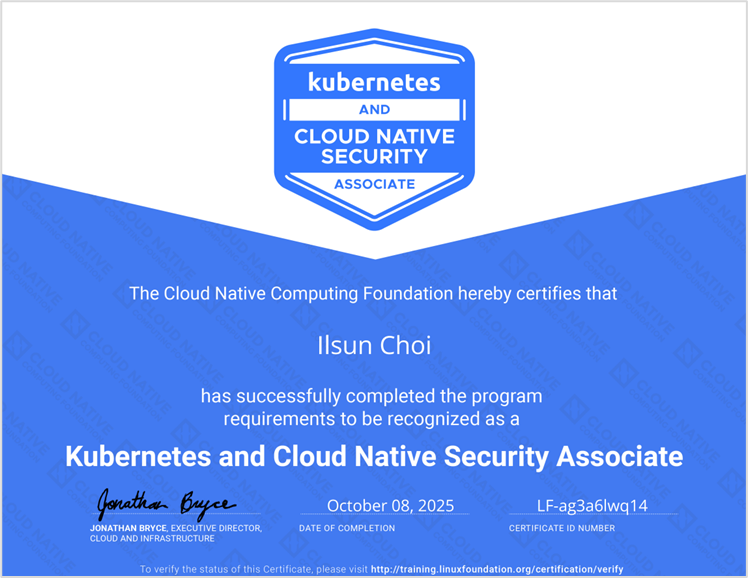
Hello! This is gasbugs, back with the fourth step on the journey to the ‘Golden Kuberstronaut’, a review of obtaining the KCSA (Kubernetes and Cloud Native Security Associate) certification. 🥳
Riding the momentum of passing KCNA in one day, I achieved the feat of passing this KCSA with a high score of 91 points by investing just one day! The fundamentals solidified through CKA and CKS, along with AI-powered learning methods, shone brightly once again. However, it was by no means an easy exam. While KCNA asked for broad and shallow knowledge, KCSA was a test that delved very deeply into the specific field of security, truly verifying the path to becoming an ‘expert’.
Now, I’ll share my vivid experience in detail!
🧠 1. Secret Weapon: CKS Knowledge + Gemini AI Question Generation
My learning strategy was clear this time too. It was to reorganize my knowledge to fit the KCSA exam type, based on the in-depth knowledge I had accumulated while preparing for CKS (Certified Kubernetes Security Specialist), utilizing AI.
Honestly, without CKS experience, passing in one day would have been impossible. Although KCSA has ‘Associate’ in its name, the depth of the questions was directly related to the core security concepts covered in CKS.
As with KCNA, my learning partner this time was Gemini. I used the following prompt to create and solve over 100 expected questions covering the entire exam scope.
> “I have a basic knowledge of CKS. Please create about 20 multiple-choice questions for the KCSA Kubernetes and Cloud Native Security Associate exam, covering the entire exam curriculum. 영어로.”
Through this process, I was able to train myself to transform the practical knowledge of CKS I already had into the multiple-choice conceptual questions required by KCSA. For example, in CKS, you might directly write Network Policy in YAML, whereas in KCSA, it might ask, ‘Which Network Policy setting is correct in this situation?’
🛡️ 2. KCSA Exam Experience: Asking for ‘Understanding’ Beyond Simple Memorization
The KCSA exam was one that constantly asked ‘why’ in security. There were many questions that could only be solved by accurately understanding not just commands or functions, but also the principles by which each security element operates and why it is necessary. The ‘unusual’ topics I encountered in the exam are as follows. (To comply with terms and conditions, I will not reproduce the questions themselves, but will focus on explaining the core concepts.)
① Supply Chain Security & Threat Modeling
- Beyond simple image scanning, it asked for an understanding of frameworks like NIST 800-161 to protect the entire software supply chain. It wasn’t just ‘you need to sign images,’ but rather, a depth that asked, ‘why is that central to supply chain security?’ ⛓️
- You needed to understand the MITRE ATT&CK® for Containers matrix and be able to connect specific attack techniques to their corresponding stages (Tactics). This requires the ability to analyze system vulnerabilities from an attacker’s perspective, not just simple defense.
② Operating Principles of Kubernetes Internal Security Mechanisms
- Admission Controller Webhook Processing Order (Mutating → Validating): A fundamental understanding of why Mutating Webhooks should run before Validating Webhooks was required.
- Pod Security Standards (PSS): Beyond simply knowing the three levels of PSS (Privileged, Baseline, Restricted), it asked about practical application methods, such as prerequisites for applying PSS to a cluster or its relationship with namespace labels.
- PKI (Public Key Infrastructure): It verified whether you accurately understood why communication between Kubernetes components is based on PKI, i.e., the importance of establishing mutual trust through TLS authentication. 🔑
- ClusterRole and ClusterRoleBinding: Clearly distinguishing the differences between these two resources and knowing which combination to use to grant cluster-wide permissions to a specific user was a basic requirement.
③ In-depth Analysis of Container Runtime and Isolation Technologies
- gVisor vs. Firecracker: Both technologies provide stronger isolation than standard container runtimes, but their methods differ. While gVisor intercepts system calls via a userspace kernel, Firecracker utilizes lightweight virtual machines (MicroVMs). Questions comparing the architectural differences and resulting pros and cons of these two were impressive. 🔬
- Kubelet’s Node Authentication Method: It required an accurate understanding of the process by which Kubelet registers and authenticates itself with the API server (Node Authorizer, TLS Bootstraping). This is a crucial process for establishing the most basic trust relationship in cluster security.
④ Practical Troubleshooting Scenarios
- gcr.io image registry communication failure: It presented potential causes that could occur in real-world environments, such as proxy environments, firewall policies, and network policies, and asked for an approach to problem-solving. 🌐
✨ 3. Overall Review: Highly Recommended to Challenge After CKS!
In my KCNA review, I paradoxically suggested that ‘it’s good to try CKA/CKAD first,’ but for KCSA, I’ve become convinced that ‘it’s better to take it after experiencing CKS.’
KCSA is not an exam where you solve problems directly in a practical environment like CKS, but each question contains practical security knowledge and experience covered in CKS. Without a deep understanding of security concepts, it will be very difficult to discern the correct answer among the choices.
Don’t be complacent with the word ‘Associate’. It is a deep and meaningful certification that truly penetrates the core of cloud-native security. Through this exam, I was able to systematically organize scattered security knowledge and view Kubernetes security from a broader perspective.
Now, my ‘Golden Kuberstronaut’ journey is also heading towards the halfway point. Please look forward to and support my next journey! I hope everyone has an enjoyable cloud-native journey! 🎉
Tags: KCSA, Kubernetes, Cloud Native Security, Certification Review, Kubernetes Certification, CKS, CNCF, Cloud Native, Information Security, Passed in One Day
Leave a Reply