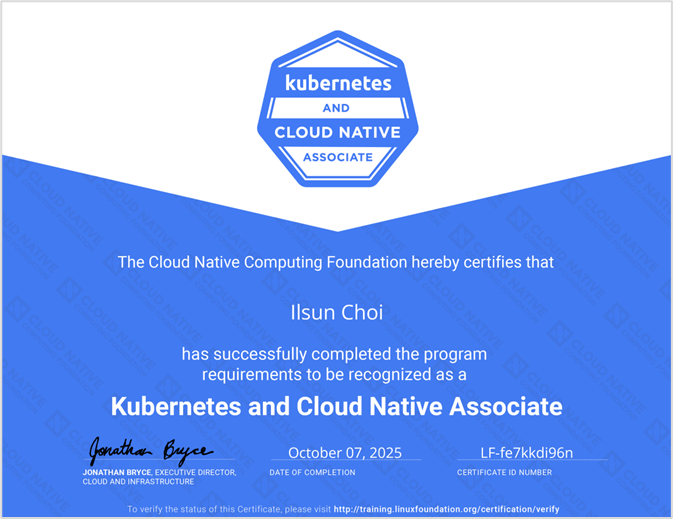
Hello everyone! Following my CKA certification renewal review, I’m sharing my experience of obtaining the KCNA (Kubernetes and Cloud Native Associate) certification, the third leg of my journey towards becoming a ‘Golden Kuberstronaut’.
If CKA and CKAD allowed me to experience the depth of Kubernetes, this KCNA was a valuable opportunity to broadly understand the entire cloud-native ecosystem. This exam was a particularly special experience for me because I passed it on my first attempt with a score of 89, well above the 75-point cutoff, after a short preparation period of just one day. I will now elaborate on how my unique learning method, utilizing CKA/CKAD knowledge and AI, led to this result!
🧠 1. CKA/CKAD Knowledge + AI = Maximum Efficiency, One Day Preparation
To be honest, I didn’t invest a lot of time in preparing for the KCNA exam. I already had a sufficient understanding of Kubernetes architecture and core objects from preparing for CKA and CKAD. However, since KCNA tests fundamental concepts across the broad cloud-native ecosystem, including not just Kubernetes but also Prometheus, Fluentd, CI/CD, etc., it was essential to review the concepts once more and familiarize myself with the question types.
My secret weapon here was Gemini.
> “I have a basic knowledge of CKA and CKAD. Please create about 20 multiple-choice questions for the KCNA exam, covering the entire exam curriculum.”
I requested Gemini as above and generated about 100 practice questions covering the entire KCNA exam scope. By solving these problems, I was able to quickly absorb detailed concepts I hadn’t paid attention to (e.g., types of container runtimes, the role of service mesh, basic principles of cloud-native security, etc.) and grasp the bigger picture of why each technology emerged to solve specific problems.
If CKA/CKAD are ‘skill’ exams focused on practical application, KCNA is closer to a ‘knowledge’ exam focused on concepts. Therefore, for those already familiar with Kubernetes like myself, I am confident that using AI to review a wide range of concepts in a short amount of time can achieve maximum efficiency.
💻 2. KCNA Exam Experience: Broad and Shallow, Yet Accurate
The KCNA exam is conducted in a completely different manner than CKA/CKAD. All questions are presented and solved within the PSI secure browser, without a separate remote desktop environment. Most questions are multiple-choice, and it was crucial to accurately distinguish the subtle differences between each option.
The main characteristics I observed during the exam are as follows:
① Questions about the Fundamentals of Kubernetes: Beyond simply how to deploy a Pod, there were many fundamental questions about why Kubernetes is needed. For example, questions that required a precise understanding of the necessity of container orchestration, the advantages of declarative APIs, and the roles of each component in the control plane and worker nodes (etcd, kube-scheduler, kubelet, kube-proxy, etc.) were prevalent.
② Understanding the Entire CNCF Ecosystem: In addition to Kubernetes, questions about the concepts of major projects within the CNCF (Cloud Native Computing Foundation) were consistently asked. (OPA, Prometheus, Tracing, Grafana, ArgoCD, Flux, etc.)
- Observability: Questions were asked about the respective roles of tools like Prometheus (monitoring) and Fluentd (logging).
- Networking: There was a question comparing the role of CNI and the characteristics of representative CNI plugins (e.g., Calico, Flannel).
- CI/CD: It assessed understanding of why continuous integration and deployment are important in a cloud-native environment, and what value related tools (e.g., ArgoCD, Jenkins X) provide.
③ Accurate Use of kubectl Commands: Although it’s not a practical environment, many questions asked which kubectl command should be used in specific situations. For example, questions like ‘What is the command to check a Pod’s logs?’ or ‘What is the command to check a Deployment’s version?’ required precise memorization of commands and their usage.
④ Importance of Time Management: With 60 questions to solve in a total of 90 minutes, you shouldn’t spend more than an average of 1 minute 30 seconds per question. It’s important to skip confusing conceptual questions initially and quickly solve the ones you know. Practicing time allocation by solving 100 practice questions was a great help to me.
🔥 2-1. Sharing Unexpected and Unique Exam Questions!
In this exam, I was impressed by the inclusion of content closer to real-world practice, which is not often mentioned in previous reviews. The unique questions I remember are as follows:
- kubectl rollout status: This command is used to monitor the real-time deployment progress of resources like Deployments until they are successfully completed.
- kubectl api-resources: A question was asked about the purpose of this command, which checks the list of all available API resources in a cluster. It seemed to assess whether one knows how to check resources extended by CRD (Custom Resource Definition).
- Cloud Provider Integration Questions: I was a bit surprised by questions asking about concepts related to scaling policies for cluster node-level autoscaling in cloud provider environments (AWS, GCP, Azure, etc.) or serverless pricing models (e.g., similar to AWS Lambda). This indicates that an understanding of not only Kubernetes but also the infrastructure environment where Kubernetes operates is required.
- Security Policy vs Security Context: A question was asked that clearly distinguished between these two concepts. It required precise knowledge that Security Context defines security settings at the individual Pod or container level, whereas Pod Security Policy (now being replaced by Pod Security Admission) is a broader concept that enforces cluster-wide Pod security policies.
✨ 3. Overall Review: The First Step into Cloud Native, But Don’t Underestimate It!
I believe KCNA is the best introductory certification that allows you to draw a map of the vast world of cloud-native before moving on to CKA/CKAD. For someone like me who has already obtained CKA/CKAD, it served as an opportunity to systematically organize scattered knowledge and broaden my perspective across the entire CNCF ecosystem.
However, in my personal opinion, it might paradoxically be a good strategy to obtain CKA or CKAD first before preparing for KCNA. CKA/CKAD are hands-on exams, so the content is clear, and there are many resources available, making it somewhat easier to set goals and study. KCNA, on the other hand, has many conceptual questions asking ‘why?’ based on the practical knowledge and experience gained from CKA/CKAD. Therefore, there are definitely tricky aspects if you approach it as an ‘easier’ lower-level certification.
Of course, there were easy questions, but I felt that about 15-20 challenging questions were asked, which could determine passing or failing. How many of these you answer correctly will likely be the key to passing.
If you are new to the cloud-native field, KCNA will provide you with a clear roadmap of what and how to study in the future. Simply understanding why Kubernetes is powerful and how the numerous open-source projects surrounding it operate organically will make your future journey much smoother.
I hope my ‘one-day pass using AI’ strategy and the unique exam questions I’ve shared will be a small inspiration for your KCNA preparation. I wish everyone success in obtaining their certification! 🎉
Leave a Reply