This article is a translation of the following blog post.
Original: https://cloudnativenow.com/features/the-4-levels-of-gitops-maturity/
The 4 Levels of GitOps Maturity
August 30, 2021 | Containers, GitOps, GitOps Maturity, Kubernetes Author: Paul Fremantle
GitOps is rapidly becoming the ‘gold standard’ for operating and deploying Kubernetes applications and clusters. The objective measure of GitOps success is primarily determined by DevOps-related metrics. These DevOps metrics include velocity, deployment frequency, and recovery time. These metrics are closely linked to business competitiveness and success. In other words, organizations that can deliver software better will have better competitiveness.
What has been lacking is an approach to help teams understand how to effectively use GitOps for their organization. This can serve as a benchmark to determine the extent to which GitOps best practices and operational efficiencies have been adopted, and how much more needs to be adopted. To this end, the recently created
GitOps Maturity Model
presents a four-stage approach that organizations typically go through when adopting GitOps. It can serve as a guide, starting from single cluster and application management, and progressing to managing large-scale deployments across hundreds or thousands of clusters.
According to Martin Fowler, author at Thoughtworks, a maturity model is “a tool to help individuals or groups assess their current effectiveness and identify what capabilities they need to acquire next to improve their performance.” In this context, the GitOps Maturity Model is a simple model that allows organizations to determine where they are in their GitOps adoption journey. This model covers everything from the most basic stage (i.e., storing definitions in Git and pushing them to a CI system without continuous reconciliation) to the most advanced stage (the ability to rely on GitOps to scale deployments across thousands of clusters).
Leveling Up
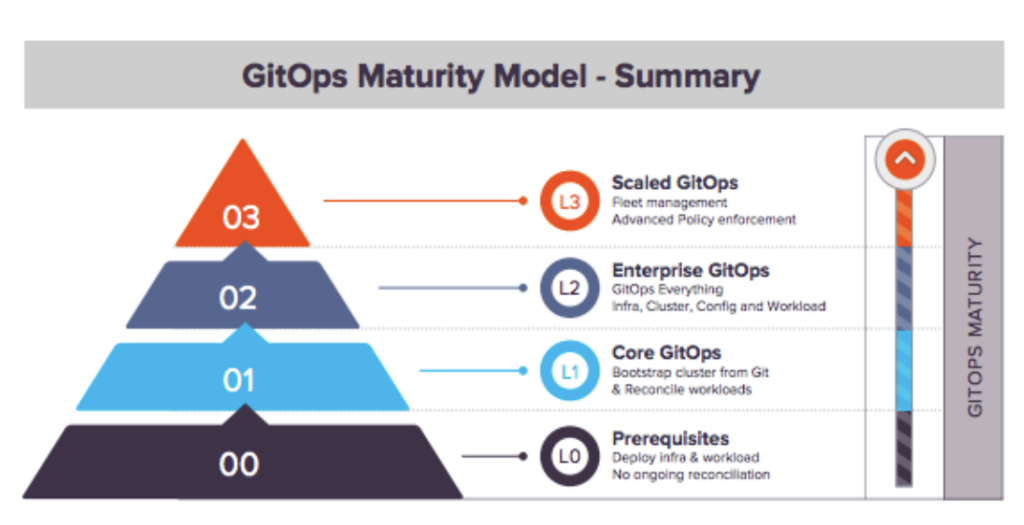
The four stages of evolution represented by the GitOps Maturity Model and the process organizations go through to gain value are as follows:
- Level 0: The organization is moving to cloud-native and containerized infrastructure and storing deployment configurations in Git, but
continuous reconciliation
is not happening. Teams at this stage can enjoy some benefits such as increased infrastructure provisioning speed, repeatability, and immutability. - Level 1: At this stage, GitOps is used to deploy applications, and
reconciliation and drift detection
ensure that running applications are continuously synchronized with the
desired state
stored in Git. Through a secure GitOps delivery pipeline, automation and standardization can be implemented, significantly increasing deployment frequency, operational visibility, and auditability, while reducing costs and Mean Time To Recovery (MTTR). - Level 2: The organization applies GitOps concepts of process standardization, automation, control, and security across the entire environment, including cluster creation and management. This provides benefits to the entire infrastructure and applications, allowing teams to work more autonomously. Platform operations teams can scale the number of clusters without increasing team headcount, while adhering to governance, risk, and compliance protocols.
- Level 3: Organizations begin to manage
fleets of clusters
with GitOps to ensure consistency, clear policy enforcement, and speed in large-scale environments. Organizations at this stage can have cross-cloud vendor choice, advanced policy models, large-scale deployments, and visibility and control over thousands of clusters.
Moving Beyond the Basics
In addition to assessing where an organization is on its GitOps journey, the maturity model is a useful tool for determining the next steps to improve DORA metrics. DORA metrics have been proven to correlate closely with business goals and competitiveness. In fact, in many cases, GitOps has been shown to help organizations enter the “elite” level of DORA metrics. In this way, a clear link is established between the technical benefits of GitOps and business performance.
This does not mean that all organizations must take the same path. Some organizations may want to jump directly to higher levels, while others may decide that they do not need to go to higher levels. However, it is clear that the true benefits of GitOps begin at Level 1.
Development teams can easily achieve Level 1 (“Application GitOps”) using open-source GitOps tools. This allows application developers and DevOps professionals to quickly configure applications and continuously deploy and reconcile them from Git repositories to any Kubernetes cluster. For example, Weave GitOps uses Flux to implement drift detection, image automation, and reconciliation, ensuring that clusters accurately reflect a specific branch or folder in Git.
For larger organizations, platform teams can use enterprise open-source tools to create and manage numerous clusters across multiple regions, zones, or multi-cloud environments. This relies on Cluster API (CAPI), which is supported by many cloud providers including AWS, Azure, Google, and VMware. Changes to cluster configurations are also reconciled in the same way as applications in Level 1. Each development team can continuously deploy and reconcile their workloads to these clusters (i.e., Level 2 includes all the benefits of Level 1).
Only a few large organizations have moved to the next stage, implementing ‘Fleet management’ by defining multiple clusters with identical configurations. A prime example is Deutsche Telekom’s Das Schiff project, designed to consistently and effectively deliver 5G workloads to thousands of edge clusters using GitOps. However, not all organizations have requirements like those in Level 3.
Bringing It All Together
GitOps consists of a highly collaborative process that uses Git repositories as the “Single Source of Truth” for dynamic support of CD pipelines. The benefits of GitOps are numerous and are now becoming more widely understood. It is also emerging as the standard Kubernetes operating model among major vendors in the technology sector. Amazon, Codefresh, GitHub, Microsoft, and Weaveworks, among others, are collaborating within the CNCF’s GitOps Working Group on the principles and technical aspects of GitOps and supporting its adoption.
One of the main reasons GitOps is gaining so much attention is that it sits at the intersection of people, process, and technology. Because it is based on well-known processes that already work effectively with various teams within an organization, it integrates well into organizational and team culture.
The GitOps Maturity Model can be seen as the next step in supporting GitOps: helping organizations plan a more structured approach to adopting GitOps. Whether your organization follows these exact four stages or not, understanding the general progression is useful. It helps you understand why deployment methods evolve through this journey and what benefits you gain by increasing GitOps maturity.
Leave a Reply