AI fluency is the ability to collaborate with AI appropriately for the situation. It encompasses the capacity to decide what to delegate, communicate requirements, review results, and take responsibility for shared outcomes. It’s important to distinguish between AI’s ability to respond fluently and the user’s competence in utilizing AI effectively.
For example, when creating introductory educational materials with AI, you cannot distribute them simply because the sentences are smooth. You must verify what learners need to learn, if the material is appropriate for their level, if examples and answers are correct, and if the information is permissible to include. Designing the workflow to include these judgments is one way to understand AI fluency.
This article explains AI fluency based on Anthropic’s official educational materials, verified on October 15, 2026, and the 4D Framework. While 4D is a useful educational tool, it is not presented as the sole international standard or a certified competency exam. All examples of educational material creation are synthetic and do not represent evaluations of specific individuals’ competencies or actual user conversations.

Featured Image: AI-generated conceptual diagram. Does not represent actual class/user work screens or certification systems.
1. From the Ability to Write Good Prompts to Managing the Entire Task
If “using AI well” is understood only as the ability to write long prompts or get quick results, review and responsibility can be overlooked. Even with the same draft, the usable outcome differs depending on what parts were personally verified and what was left unconfirmed.
Anthropic’s training program describes AI fluency as effective, efficient, ethical, and safe AI collaboration. The four competencies are Delegation, Description, Discernment, and Diligence. In this article, we will explain them as task delegation, requirement communication, critical review, and responsible utilization, respectively. Official 4D Framework
| Competency | Initial Question | Outcome in Educational Material Example |
|---|---|---|
| Delegation | What tasks are for humans, and what tasks are for AI? | Learning Objectives · Role Assignment |
| Description | How to communicate desired outcomes and process? | Audience · Scope · Format · Constraints |
| Discernment | Do the results and workflow meet requirements? | Evidence Comparison · Revisions |
| Diligence | Under what conditions can this material be shared? | Information Usage Scope · AI Contribution · Review Responsibility |
This table is not a scoring rubric for an official exam but a summary applying the concepts to a synthetic case. Completing these four items once does not mean proficiency in all tasks. The content to be judged varies depending on domain knowledge, tool access rights, and data sensitivity.
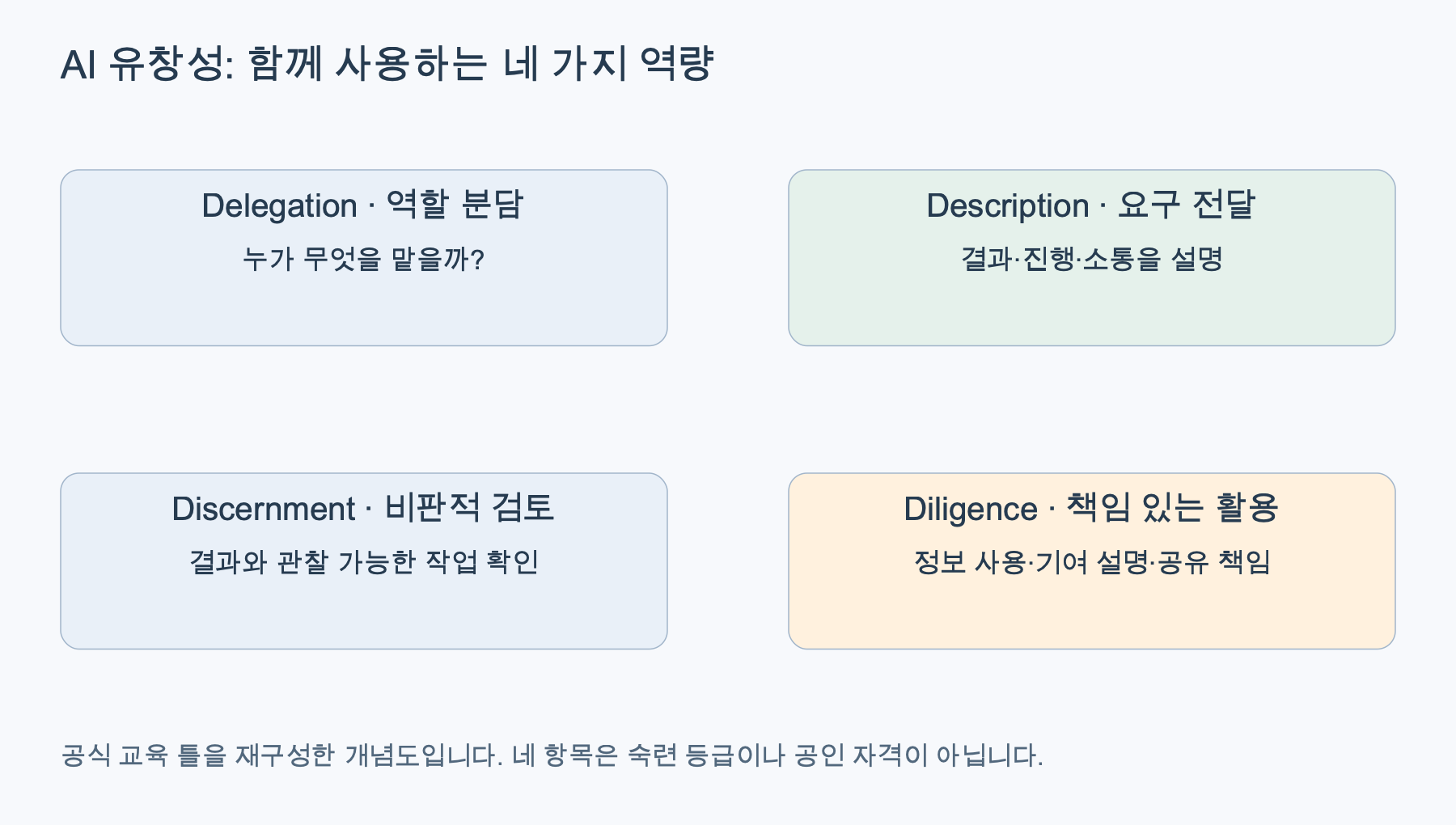
Figure 1. Conceptual diagram illustrating the questions addressed by the four competencies in AI collaboration. Reconstructed based on the official 4D educational materials. It is not a system of proficiency levels or certification.
2. Delegation: Define Outcomes, Then Divide Roles
Delegation is the competency of deciding what tasks to do yourself, what to do with AI, and what to delegate entirely to AI. The official course covers understanding problems and goals, understanding the capabilities and limitations of AI tools, and distributing tasks. Official Explanation of Delegation
Let’s consider a synthetic example: creating a “20-minute data visualization educational material for beginners.” The learning objectives are to distinguish the uses of bar graphs and line graphs, read units and axes, and choose a graph based on a hypothetical table. These objectives and the lesson level are determined by a human first.
AI can be tasked with generating outline candidates, simple explanations, and draft practice problems. The human’s verification points include whether the scope is not too broad for the lesson time, if the reasons for graph selection are correct, and if the answers to problems can be determined solely from the material. The final decision to distribute to learners is also reserved.
It’s not necessary to perfectly describe all success conditions from the outset. If points where the audience might struggle or appropriate examples are still unclear, you can first task AI with exploring outline and short example candidates. Distinguish between exploratory drafts and distributable results, and organize the discovered conditions as criteria for the next stage.
Verifying the tool’s capabilities is also part of role assignment. Expecting a tool that cannot read files to answer based on attached documents, or expecting graph execution verification in an environment without execution capabilities, will lead to misaligned collaboration. If necessary features are absent, tasks must be divided, or the parts to be verified by a human must be adjusted.
Delegating all tasks is not the goal. For a single precise calculation, cross-checking with a calculator is better, and for already confirmed lesson requirements, it’s better for a human to provide them clearly. Choosing which tool can handle a specific part most reliably is also part of role assignment.
3. Description: Explain Deliverables, Process, and Collaboration Etiquette
Description is the competency of clearly communicating requirements. The official course distinguishes between Product (description of deliverables), Process (approach to work), and Performance (behavior and communication during collaboration). Interpreting Performance as a model’s benchmark score would alter its meaning. Official Explanation of Description
In the case of synthetic educational materials, simply saying “explain it easily” doesn’t define who will learn what. By communicating the learner’s level and goals, material length, data to be used, and how to handle unverified facts, criteria for reviewing the results are established.
목표: 그래프를 처음 배우는 사람이 막대·꺾은선그래프의 쓰임과
단위·축의 역할을 구분하도록 20분 교육 자료 초안을 만들어 주세요.

자료: 아래의 가상 월별 수량만 사용하세요. 실제 조직 사례가 아닙니다.
1월 10개, 2월 15개, 3월 12개입니다.

결과물: 학습 목표, 설명 순서, 짧은 예시, 연습문제 3개,
정답과 이유, 검토가 필요한 항목을 구분해 주세요.

진행: 먼저 목차를 제안하고 검토를 기다리세요.
제공하지 않은 출처·실험 결과·학습 효과 수치를 만들지 마세요.

소통: 모호한 요구는 질문하고, 설명이 길어지면 먼저 범위를 좁혀 주세요.
파일 저장·외부 공유는 요청하지 않았습니다.
This request is not a guarantee of good results but an example of specifying collaboration conditions. Even if the format is correct, the content might be wrong, so further review is necessary. Conversely, if essential conditions are missing, you can identify what requirements to add before blaming the outcome.
Longer requests do not necessarily mean better communication. Essential conditions and preferences should be distinguished, and conflicting requirements must be resolved. For example, the condition “detail all chart types to complete beginners in 20 minutes” would require adjusting the volume and depth.
4. Discernment: Verify Sentences, Evidence, and Observable Actions Together
Discernment is the competency of critically evaluating not only the deliverables but also the approach and behavior during collaboration. The official course reviews the quality of results (accuracy, appropriateness, relevance), errors or omissions in the work approach, and how feedback is responded to. Official Explanation of Discernment
If synthetic material is returned, verify facts before focusing on elegant sentences. An increase from 10 to 15 is a 5-unit increase, and the growth rate is 50%. Writing “50 percentage points increase” mixes different units. This calculation is a cross-check for explanation and not an observed instance of AI actually making such an error.
Next, compare problems and answers. “What is appropriate to show quantity changes over time?” and “What is appropriate to compare sizes by item?” have different question objectives. Instead of always making one type of graph the correct answer, review if there are reasons for selection based on the purpose of expression and data.
When verifying evidence, distinguish between whether the link provided by AI exists and whether that link supports the claim. A title might seem relevant, but the content might not be in the body. If a source cannot be verified, it needs to be marked as pending verification or the claim should be removed.
Review of the work process is also based on observable evidence. If a file is said to be generated, check if the actual file exists; if code is said to be executed, check the scope of the results. Do not assume that all hidden internal thoughts of the model can be seen, or treat a lengthy explanatory sentence as actual execution evidence.
Even if the official material is correct, whether learners can understand it is a separate matter. If the scope is too broad or unfamiliar terms appear all at once, the order of explanation should be changed. Both factual review and audience suitability review must be conducted to approach distributable material.
5. Revert Issues Found in Review to the Next Requirement
AI fluency is not just about the skill of crafting perfect prompts in one go. Collaborative design, where desired outcomes are further refined by reviewing drafts, is also possible. Anthropic’s course also covers the feedback loop connecting Description and Discernment as a separate topic. Description–Discernment loop
In the educational material example, you can first explore two short drafts with different explanation styles. One starts with concept definitions, the other with a problem of choosing a hypothetical graph. By reading these, you agree on desired examples and criteria, such as “start with a problem but explain units first, and introduce only one new concept per paragraph.”
The organized criteria are reused as a starting point for the next section or material. However, they must be readjusted if the target audience or purpose changes. Draft Exploration → Feedback → Agreement on Examples and Criteria → Reuse Criteria for Next Task → Result Verification is the iterative method applied in this case and does not represent the sole procedure defined by the framework.
In the synthetic case, instead of saying “write it better,” you can convey review results. This means defining the scope, such as “revise by distinguishing between growth rate and percentage points, modify problem 2 so the answer can be determined solely from the table values, and delete unverified learning effect figures.”
After revision, it’s not enough to just look at the changed parts. Verify if the table values are intact, if the explanation and answer are still correct, and if any deleted claims do not remain in the conclusion. The standard for the work is not just the last answer but a consistent final deliverable.
Having the same AI re-verify its own answer can assist in review but does not replace independent cross-checking. This is because it might repeat the same premises or overlook the same errors. Numbers should be calculated separately, evidence should be read from the original text, and necessary expert judgments should undergo review by the relevant field.
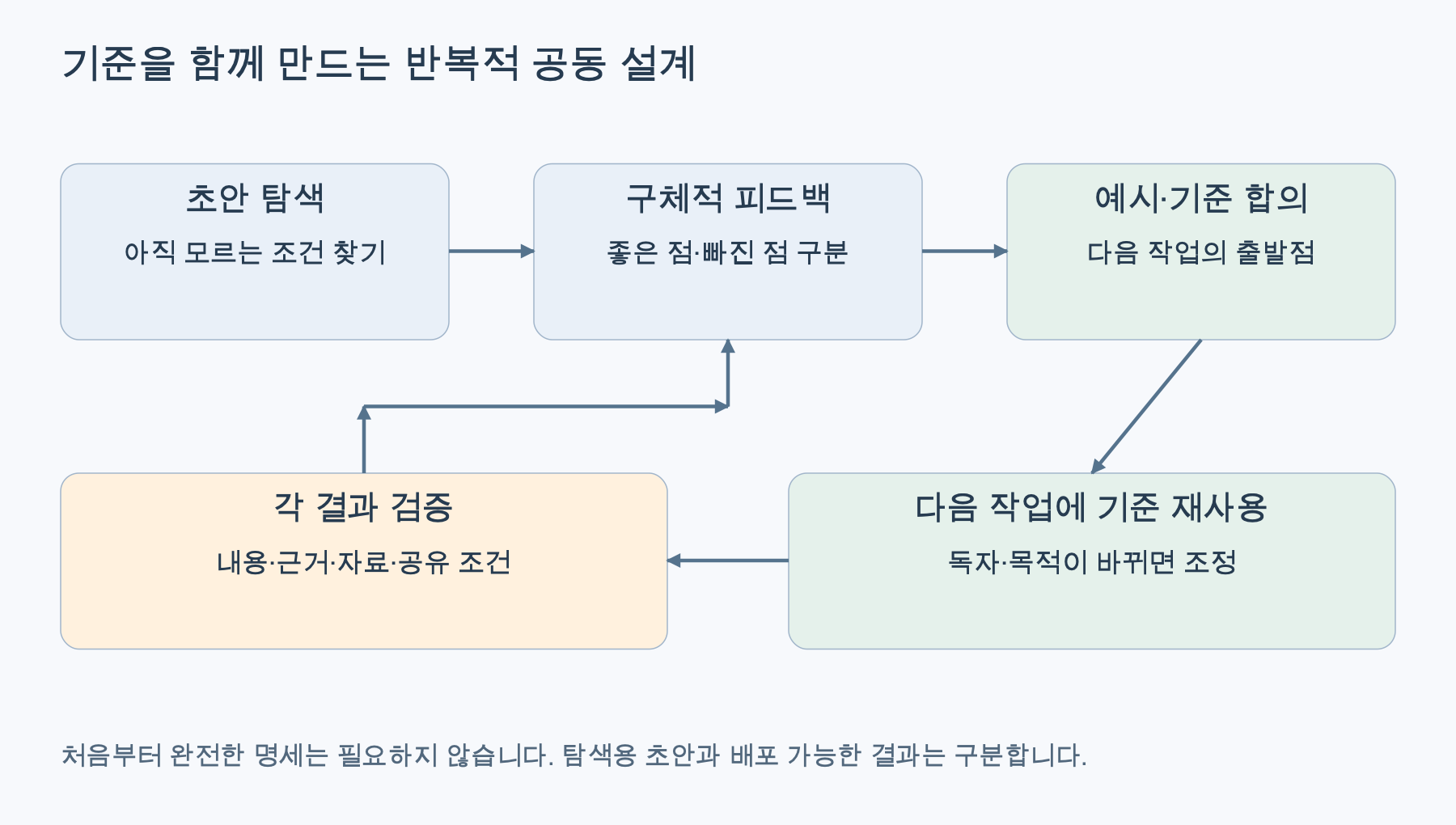
Figure 2. Flow in synthetic educational materials where requirement communication, result review, and revisions are repeated, leading to separate sharing review. Reconstructed based on official feedback loop materials and Diligence explanation. The fact of frequent iteration alone does not guarantee accuracy or approval for sharing.
6. Diligence: Define Responsibilities from Creation to Post-Sharing
Diligence is the competency that addresses the responsibility, ethical, and safety aspects of AI collaboration. The official course explains Creation (examining which AI to work with and how), Transparency (honestly describing AI’s contribution), and Deployment (taking responsibility for the results to be used). Official Explanation of Diligence
In the educational material example, the scope can be defined from the outset to use only synthetic data. It should not be assumed that simply removing names from actual student records or internal evaluation data is sufficient. The possibility of identifying individuals or organizations when multiple pieces of information are combined, and the authority to transmit or redistribute such data to AI, must be considered together.
Before sharing completed materials, verify sources and usage conditions. Discovering a publicly available image does not automatically confirm that it can be freely reproduced. AI-generated explanations must also be reviewed to ensure they accurately cite other people’s materials and do not present unreferenced examples as actual research findings.
The scope of disclosing AI contributions should be determined according to the requirements of the class, organization, or medium. Instead of simply stating “AI used,” explaining what assistance was received (e.g., outline, draft, sentence refinement) and who reviewed what helps readers understand the results. It is incorrect to claim full verification or expert review if it did not actually occur.
Even after distribution, there must be a person responsible for receiving error reports and a method for correction. Explaining that the output was created by AI does not justify leaving incorrect numbers or learning content as is. Decisions regarding public availability, target audience, and final content remain a separate responsibility.
7. Practice Can Start with a Revision History of a Single Document
To master AI fluency, it’s useful to compare the beginning and end of small tasks rather than one long conversation. For the synthetic educational material mentioned earlier, this would involve keeping the learning objectives, role assignments, initial requirements, issues found in review, revised versions, and unconfirmed items as a single package.
For example, if the final material has three objectives, compare whether each objective is actually covered by the explanations and practice problems. It’s more important to ensure no critical objectives are missed than to have all content detailed. This check is a self-practice for educational design and should not be interpreted as a certified evaluation score.
While time saved can be recorded, calculating the time taken to quickly produce unverified results as performance overlooks review costs. It’s more useful to separate the time spent on drafting and on review/revision, and to record what errors were found and what could not be verified. This article does not contain actual time-saving measurements.
Even with different tools, objectives and review criteria can be maintained. However, file reading, searching, execution, and external transmission capabilities and usage conditions vary by tool, so do not assume that the same prompt will perform the same task. If the tool changes, roles and evidence to be verified must also be readjusted.
8. Fluency Is Not a One-Time Decision to Trust or Distrust AI
When working with AI, you continuously judge what parts can be delegated and what parts need verification. The 4D framework is an educational tool that helps examine these judgments through delegation, description, discernment, and diligence. The fact that one has memorized the framework and the ability to appropriately perform tasks in a specific field must be verified separately.
The completion criteria for synthetic educational materials are not determined solely by sentence fluency. They must be appropriate for the audience and objectives, have reviewed figures and answers, be able to explain the materials used and AI contributions, and have defined responsibilities for sharing. Practicing both the judgment of delegating tasks to AI and the judgment of accepting the results is the starting point for AI fluency.
References
Anthropic Official Claude Academy materials verification date: October 15, 2026. The Korean explanations and synthetic educational material examples constitute the structure of this article.
Leave a Reply