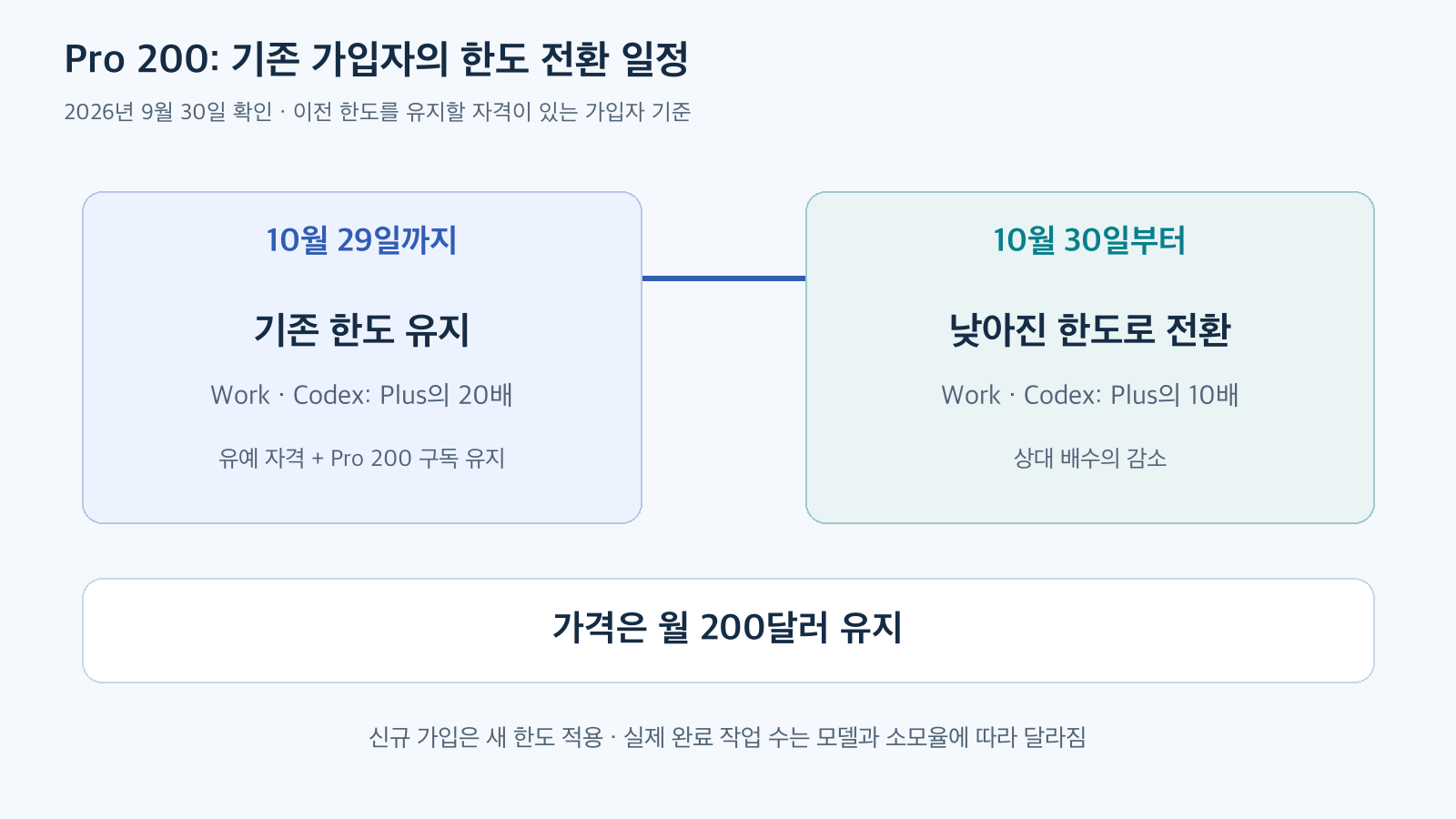
ChatGPT Pro 200 is a personal subscription plan costing $200/month. The core change is maintaining the price while reducing the relative usage multiplier for ChatGPT Work and Codex from 20x to 10x compared to Plus. Eligible existing subscribers will retain their previous limits until October 29, 2026, after which they will switch to the new limits. OpenAI Pro Help · Manager’s Multiplier Explanation
Therefore, the explanation that “Pro 200’s basic usage is halved” has a basis. However, “halved” here refers to the relative usage limit of the plan. The actual number of development tasks that can be completed, the number of GPT-6 Pro chats, and the additional credit balance should be interpreted using different criteria.
This article cross-referenced official help documents, announcements, and manager statements as of September 30, 2026. Compensation credits and some detailed figures were also checked against publicly disclosed email transcripts, but distinguished from information directly verified on the official site. Key differences lie in the use of compensation, the consumption rate of Ultrafast, and how tasks delegated by dot to other products are deducted.

1. What has been confirmed: Official documents vs. email announcements
OpenAI’s help document states that Pro 200 is again accepting new subscriptions with reduced usage limits, and eligible existing subscribers will maintain their previous limits until October 29. Thibault Sottiaux, the manager for Codex and ChatGPT, directly mentioned the previous 20x and new 10x multipliers in his announcement. Official Help · Original Announcement
However, the phrases “62,500 credits, expires December 31, GPT-6 Pro weekly chats changed from 200 to 100” were not all listed in the public help documents reviewed. These figures were confirmed in publicly disclosed email transcripts from recipients. Transcripts are not authentication materials of the same level as announcements posted on official sites, nor have the original headers of the sent emails been verified.
The general direction of the email content aligns with official announcements. However, there is no basis to conclude that the allocated credits have already been applied to all accounts, or that new subscribers will receive the same compensation. The schedule becomes clear when distinguishing between new subscriptions and the grace period for existing subscribers. New Pro 200 is offered with reduced limits, and existing subscribers eligible to retain previous limits are granted a temporary grace period. The official help document describes eligible subscribers as those who had Pro 200 active at the time of qualification, or within 7 days prior. Conditions for re-subscription are also specified if the subscription expired during that period. The grace period is conditional on maintaining the Pro 200 subscription and does not automatically provide Pro 500 or Ultrafast. The exact time of qualification is not provided in the public help document. Existing subscriber application conditions Figure 1. Grace period and transition schedule for existing subscribers. Reconstructed based on Pro Help and manager’s multiplier announcement. The day after the October 29 grace period ends in the official document is marked as the transition date. For example, an eligible subscriber who has been using Pro 200 and a new subscriber paying the same price might have different included usage during the grace period. Therefore, when explaining the changes, it is more accurate to say “the relative multiplier changes from 20x to 10x after the grace period ends for eligible existing subscribers” rather than “all Pro 200 immediately changes to half.” “Pro” is both a plan name and a term used to refer to advanced reasoning options in chat. Because of this, it’s hard to tell which limit “Pro usage” refers to. The chat limit for GPT-6 Pro and the task limit for Work·Codex are also distinguished in the official help document. GPT-6 Pro limit explanation A reduction in limits may not equate to a reduction in task throughput. The manager’s announcement explained that the usage of the new Pro 200, when converted to API expenditure value, is half of the previous, and stated that model efficiency and price improvements would be reflected in subscription value. This is the provider’s perspective explaining the rationale for the change. Manager’s original explanation In actual tasks, the model, inference intensity, input context, tool calls, and number of retries affect consumption. OpenAI also explains that Work and Codex usage is calculated based on the size and complexity of the task. Even for the same request “fix this bug,” modifying a small function and repeatedly testing multiple services consume different amounts. Work·Codex Pricing·Usage Document Let’s do a hypothetical calculation to understand the difference. This is not an example representing actual plan credit figures.
Item
Confirmation Result
Conditions for Interpretation
—
—
—
Pro 200 price maintained, limit reduced
Confirmed in official help
$200/month, eligible existing subscribers retain previous limit until Oct 29
Work·Codex 20x → 10x
Confirmed in official manager announcement
Relative multiplier based on Plus
GPT-6 Pro weekly 200 → 100
Stated in received email transcript
Weekly limit for chat model, separate from Work·Codex
62,500 credits, worth $2,500, expires end of year
Stated in received email transcript
Eligibility for account-specific distribution and actual application are separate
Pro 500 $500/month, Ultrafast
Confirmed in official help, speed document
The figure of 25x compared to Plus is stated in the email transcript
5-hour limit not reintroduced
Confirmed in official manager announcement
Does not mean weekly limit is also removed
All dot tasks outside deduction scope
Scope needs to be narrowed
Work·Codex tasks initiated or managed by dot use the respective limits
2. Who does October 30 apply to?
3. If the limit is halved, will the number of tasks that can be completed also be halved?
| Assumption | Available Budget | Average Consumption per Successful Task | Number of Tasks that can be Completed |
| — | — | — | — |
| Before Change | 100 units | 2 units | 50 tasks |
| Budget halved, task efficiency same | 50 units | 2 units | 25 tasks |
| Budget halved, consumption per task also halved | 50 units | 1 unit | 50 tasks |
The key is that the third row does not automatically hold true. If a new model completes results of the same quality with fewer retries, it can partially offset the reduction. Conversely, if working with the same model, settings, and consumption rate, the reduced budget will mean less leeway.
GPT-6.1 Sol is introduced in the official guide as a model offering performance close to Astra at a lower cost. It is available in Work and Codex and is a separate model option from the current GPT-6 Pro in general chat. This explanation can be a basis for model selection but is not an actual measurement result that the cost per task will decrease by a specific ratio across all codebases. Release Announcement · Model Availability
When comparing, it is better to select similar tasks from the same repository and record success status, test results, time taken, and actual usage together. Counting only the number of requests makes a long task and a short task appear as one same task.
4. Where can 62,500 credits be used?
The publicly disclosed email transcript states that existing subscribers will receive a one-time grant of 62,500 usage credits, with a stated value of $2,500, expiring on December 31, 2026. It instructs users to check under Settings → Usage. This much is from the publicly disclosed received notice. This article has not confirmed the completion of credit distribution to individual accounts or any exceptional conditions. Official Guide to Personal Credits
Therefore, the following three should be calculated separately:
- Included limit in subscription: This is the basic amount available per renewal cycle.
- Additional usage credits: This is the remaining balance used for supported features after exhausting the basic limit.
- OpenAI API billing: This is a separate billing system for calls made with API keys.
It cannot be assumed that having credits automatically increases the weekly message limit for GPT-6 Pro chat. There is no basis to calculate them as API payment balance or as an amount to cover monthly subscription fees. The official help document also distinguishes between usage credits and the dollar-denominated ChatGPT wallet. Difference between Credits and Wallet
The expiration date is also a point to check. While the general purchased credits help document states validity for 12 months after purchase, this email transcript specifically provides a deadline of December 31. The general rules for purchased credits should not be applied to this one-time grant to extend the expiration date.
The practical value of this compensation depends on the supported tasks to be performed during the remaining period and their consumption rate. Interpreting $2,500 divided by $200/month as “12.5 months of subscription” mixes different billing structures. When assessing long-term costs, it is necessary to also consider the basic limits after the one-time grant has been exhausted.
5. Pro 500 and Ultrafast: Comparing usage and speed separately
Pro 500 is listed in the official help document as a $500/month plan and includes Astra Ultrafast. The usage figure of 25x compared to Plus is confirmed in the publicly disclosed email transcript. A simple comparison with Pro 200’s new 10x shows a relative limit of 2.5x, and the monthly price in dollars is also 2.5x. This calculation is a multiplier comparison excluding the value of other features. Pro Plan Help · Ultrafast Official Document
For example, if the test waiting time is longer than the time the model takes to generate a response, the overall time reduction from generation acceleration alone will be limited. Conversely, if waiting for long responses is blocking work, the value of acceleration can increase. This is also a matter to be judged by looking at the time composition of individual tasks.
Pro 500’s broader limits and Ultrafast’s higher consumption rate can apply simultaneously. Rather than assuming that choosing a higher-tier plan always means completing more tasks, it is more accurate to compare which model to use, at what speed, and how much.
6. What is excluded from dot’s usage?
dot is an always-on agent based on GPT-6 Astra. It has its own cloud computer and browser and can perform long-duration tasks. Officially included in Pro, but subject to regional, age, and gradual rollout conditions, so it may not appear on all accounts simultaneously. Meet dots
The most important distinction in usage explanation is between conversations with dot and tasks that dot initiates or delegates to Work·Codex for management. Official documents state that conversations with dot are not included in ChatGPT usage limits, but Work·Codex tasks initiated or managed by dot are deducted from each product’s usage as usual. It also explains that in-depth tasks have separate included limits. Therefore, the interpretation that “using dot allows unlimited Codex usage” is not valid. dot’s Usage Rules
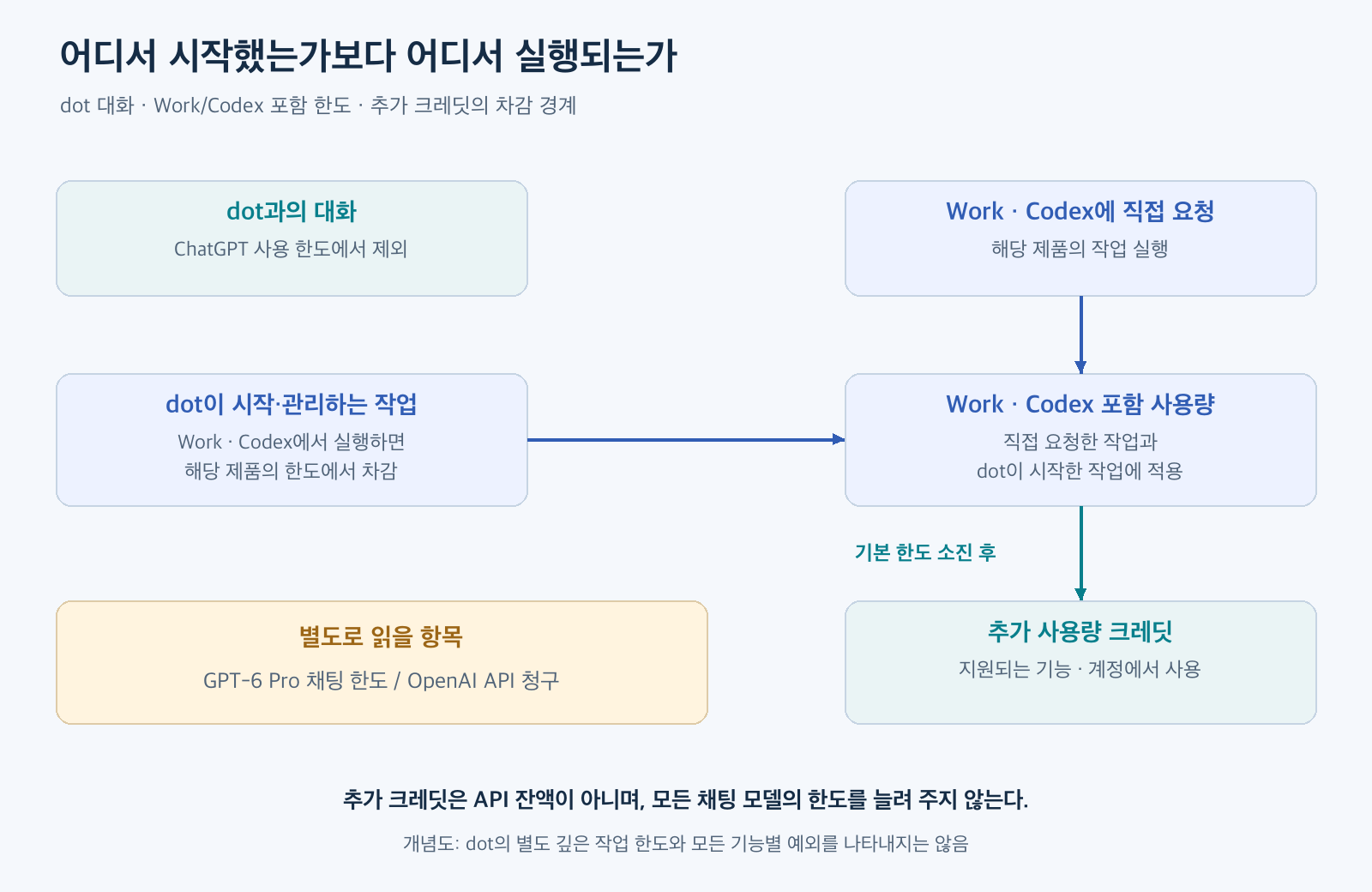
Figure 2. Conceptual diagram distinguishing where requests originate and where usage is calculated. Reconstructed based on dots, Work·Codex Pricing, and Official Guide to Personal Credits. This diagram does not represent all detailed features of dot.
For example, a conversation asking dot for progress and dot initiating a repository analysis/modification task in Codex have different deduction criteria. When calculating actual development budgets, it is easier to understand by checking which product the task is executed in rather than the agent’s name.
7. If you use Codex a lot, what criteria should you use to decide?
To evaluate this change, it helps to divide current tasks into three categories: first, repetitive tasks that can be completed sufficiently with lower-cost models; second, tasks requiring Astra’s deep inference; and third, time-sensitive tasks where additional usage is paid for fast generation. The impact of the same limit change varies depending on the proportion of these three categories.
The records needed for decision-making are not complicated. You should record the model and speed mode used over a week, the point at which limits were reached, additional credit usage, and major tasks completed. This approach focuses on consumption per completed task and waiting time rather than just the number of requests. Balances and limits can be checked on the Codex usage screen.
Meanwhile, the promise not to reintroduce the 5-hour limit means that weekly allocations can be used intensively when desired. It does not mean that weekly limits disappear or that credits are provided unlimitedly. Both the manager’s announcement and the current pricing document provide grounds for interpreting this difference. Manager’s Announcement · Current Usage Document
In summary, the change from 20x to 10x for Pro 200 and the end of the grace period for existing subscribers are officially substantiated. The exact quantity and expiration of compensation credits and weekly chat limits are stated in publicly disclosed email transcripts, but the actual distribution to individual accounts has not been confirmed. Ultrafast requires considering both generation speed and consumption rate, and Work·Codex tasks executed by dot also use the respective limits.
The criterion for choosing a plan is how much actual work can be completed with the basic limits after the change. Calculating one-time compensation, model efficiency, and speed options separately makes it easier to compare whether to maintain the subscription, use additional credits, or choose a higher-tier plan.
Leave a Reply