“If an adversary is listening to all conversations, how can you and I create a secret known only to us?”
In 1976, two geniuses provided an answer to this paradoxical question.
>

>
What This Article Covers
- Historical background of Diffie-Hellman (DH)
- Intuitive operating principle understood through the paint analogy
- Mathematical foundation: modular exponentiation and the discrete logarithm problem
- Implementing key exchange directly with Python code
- Man-in-the-Middle (MITM) attack and the evolution to ECDH
- Practical applications in environments like TLS and SSH
Introduction — How to Share a Secret Key Before Meeting
Surprisingly, the biggest headache in cryptography isn’t the “encryption algorithm” itself. The real challenge is how to securely share the key to be used for encryption.
Before 1976, for two people to communicate secretly, they had to either meet in person beforehand to share the same key, or have a trusted courier deliver a piece of paper with the key written on it. Think of Cold War spy movies.
But what about in the age of the internet? How can a server and a client who have never met, on a public network where all communication can be eavesdropped, create a secret key known only to them?
The solution to this seemingly paradoxical problem was the Diffie-Hellman Key Exchange algorithm, proposed by Whitfield Diffie and Martin Hellman. It was an invention that laid the foundation for modern internet security and earned them the Turing Award in 2015.
The Paint Analogy — Understanding DH in 5 Minutes
Before diving into the mathematics, let’s look at the paint analogy, which explains DH most intuitively.
- Alice and Bob publicly agree on a yellow paint. The adversary also sees this.
- Alice mixes her secret color (red) into the yellow to create orange, and sends it to Bob.
- Bob also mixes his secret color (blue) into the yellow to create green, and sends it to Alice.
- Alice mixes her secret color (red) into the received green → Yellow+Blue+Red
- Bob mixes his secret color (blue) into the received orange → Yellow+Red+Blue
As a result, both Alice and Bob end up with the same color. However, the eavesdropper only saw yellow, orange, and green. Since it is virtually impossible to separate the original secret colors from paint that has already been mixed, the eavesdropper cannot know the final secret color.
This one-way property, “easy to mix but hard to separate,” is the essence of DH.
Mathematical Principle — Modular Exponentiation and the Discrete Logarithm Problem
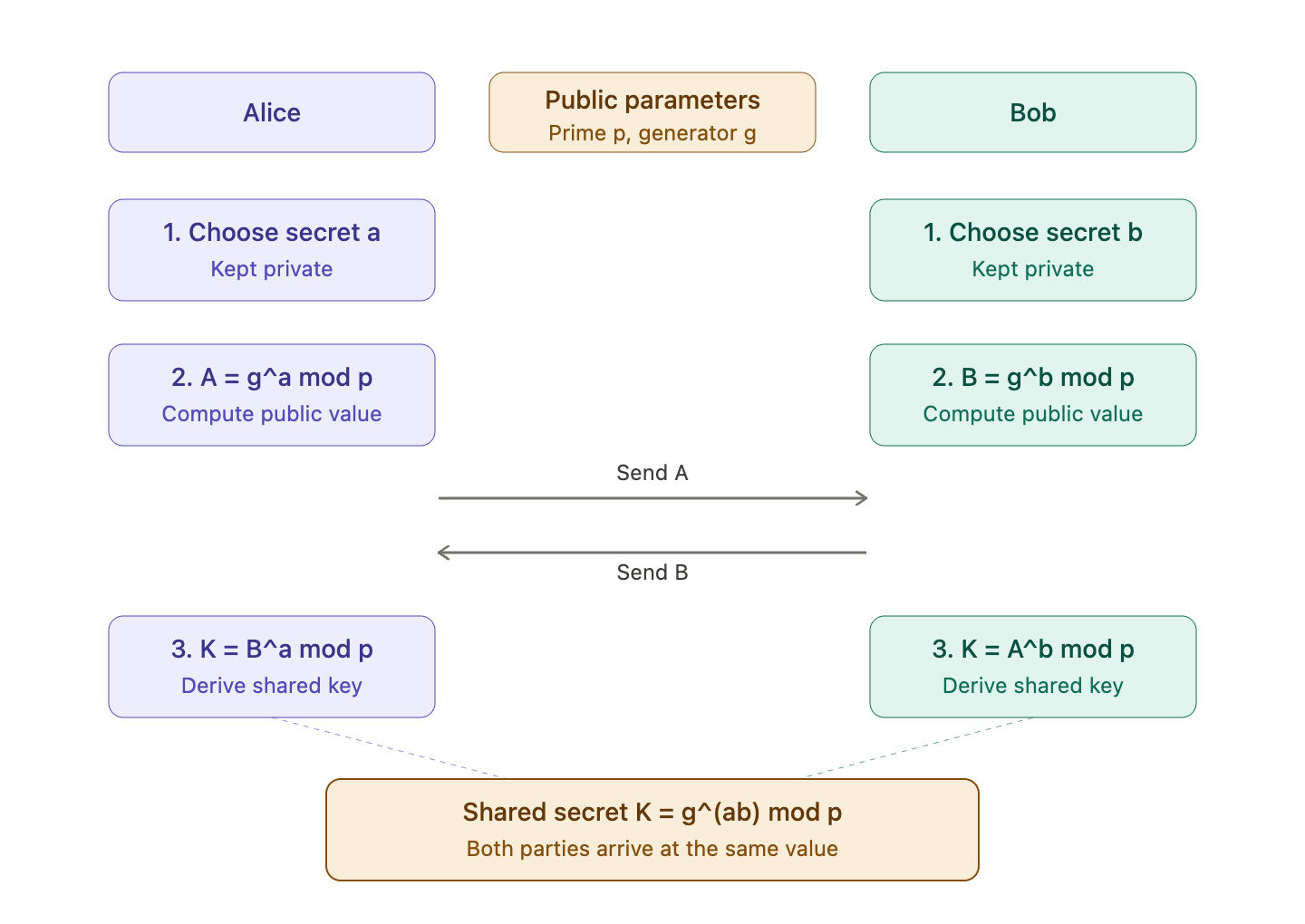
Translating the paint analogy into mathematics, we get the following:
Public Parameters (values known to everyone)
- A large prime number p
- A primitive root g of p (generator)
Key Exchange Procedure
- Alice chooses a secret value a, calculates the public value A = g^a mod p, and sends it to Bob.
- Bob chooses a secret value b, calculates the public value B = g^b mod p, and sends it to Alice.
- Alice calculates K = B^a mod p.
- Bob calculates K = A^b mod p.
The value obtained by both parties is exactly the same: g^(ab) mod p. This becomes the shared secret key known only to them.
An eavesdropper knows p, g, A, and B, but would need to calculate a by inverting A = g^a mod p. This problem is called the Discrete Logarithm Problem (DLP), and for a sufficiently large p (usually 2048 bits or more), it cannot be solved in a realistic amount of time.
This is similar to the intuition behind RSA, where multiplication is easy but prime factorization is hard. DH utilizes the asymmetry that “exponentiation is easy, but its inverse (discrete logarithm) is hard.”
Implementing It Directly with Python
To solidify the intuition, let’s try it with small numbers.
# Educational example — absolutely not for production use
p = 23      # Public prime (2048 bits or more in practice)
g = 5       # Public generator

# Alice's secret value
a = 6
A = pow(g, a, p)   # g^a mod p
print(f"앨리스가 공개하는 값 A = {A}")

# Bob's secret value
b = 15
B = pow(g, b, p)   # g^b mod p
print(f"밥이 공개하는 값 B = {B}")

# Calculate shared secret key for each
K_alice = pow(B, a, p)   # B^a mod p
K_bob   = pow(A, b, p)   # A^b mod p

print(f"앨리스의 공유 키: {K_alice}")
print(f"밥의 공유 키:     {K_bob}")
assert K_alice == K_bob
When executed, you can confirm that both parties obtain the same key, 2.
In practice, you should not implement this directly but use verified libraries. The following is an example of performing secure DH key exchange with the cryptography library.
from cryptography.hazmat.primitives.asymmetric import dh
from cryptography.hazmat.primitives import hashes
from cryptography.hazmat.primitives.kdf.hkdf import HKDF

# 1) Generate public parameters (usually generated once by the server and reused)
parameters = dh.generate_parameters(generator=2, key_size=2048)

# 2) Alice and Bob each generate key pairs
alice_priv = parameters.generate_private_key()
bob_priv   = parameters.generate_private_key()

# 3) Exchange public keys and derive shared secret
shared_alice = alice_priv.exchange(bob_priv.public_key())
shared_bob   = bob_priv.exchange(alice_priv.public_key())
assert shared_alice == shared_bob

# 4) The raw secret is not used directly; a symmetric key is derived using KDF
derived_key = HKDF(
    algorithm=hashes.SHA256(),
    length=32,
    salt=None,
    info=b"handshake data"
).derive(shared_alice)
One important point here is that the raw shared secret generated by DH should not be used directly as a symmetric key. Its distribution might not be uniform, so it must be refined using a Key Derivation Function (KDF) like HKDF before use.
⚠️ Caveats — DH is Not a Panacea
1. Vulnerable to Man-in-the-Middle (MITM) Attacks
DH does not verify the identity of the other party. If an attacker, Mallory, intercepts communication between Alice and Bob, the following occurs:
- Alice ↔ Mallory: Shared key K1 established
- Mallory ↔ Bob: Shared key K2 established
- Mallory decrypts all messages with K1 → inspects/modifies content → re-encrypts with K2 and forwards
Therefore, in practice, it is essential to authenticate the other party’s identity using digital signatures, certificates (PKI), or pre-shared keys. In TLS, server certificates fulfill this role.
2. Weak Parameters are Fatal
The Logjam attack, disclosed in 2015, exploited the fact that many servers were using short 512-bit DH parameters. Additionally, if sufficiently random secret values a and b are not used, it exposes systems to guessing attacks. It is safe to use secure prime groups of at least 2048 bits (such as ffdhe groups from RFC 7919).
3. Static DH vs. Ephemeral DH (DHE)
Static DH, where a key pair is generated once and reused continuously, means that if the secret key is ever compromised, all past communications can be decrypted. In contrast, DHE (Ephemeral DH), which generates a new key pair for each session, provides Forward Secrecy. This is why TLS 1.3 only allows DHE or ECDHE.
4. Vulnerable to Quantum Computers
The Discrete Logarithm Problem can be solved in polynomial time by Shor’s algorithm. If sufficiently powerful quantum computers emerge, DH will be broken. NIST’s ongoing Post-Quantum Cryptography (PQC) initiative, particularly the hybrid approach combining ML-KEM (formerly Kyber) with DH, is becoming the next-generation standard.
ECDH — Smaller, Faster, Stronger
Implementing the same idea on elliptic curves is ECDH (Elliptic Curve Diffie-Hellman).
| Item | Traditional DH | ECDH |
| Underlying Problem | Discrete Logarithm (DLP) | Elliptic Curve Discrete Logarithm (ECDLP) |
| Equivalent Strength Key Size | 2048 bits | 256 bits |
| Operation Speed | Slower | Faster |
| Bandwidth | Larger | Smaller |
Achieving the same security strength with much shorter keys, ECDHE (Ephemeral ECDH) has become the standard almost everywhere, including modern TLS 1.3, SSH, and the Signal protocol.
✅ Summary / Conclusion
- Diffie-Hellman is the first public-key algorithm that allows parties to agree on a secret key over an insecure channel.
- Its core principles are the symmetric result of g^(ab) mod p and the computational difficulty of the Discrete Logarithm Problem.
- DH only handles key exchange; it does not authenticate the other party. It must be used with signatures and certificates for security.
- In practice, DHE/ECDHE using ephemeral keys is the standard, responsible for TLS’s Forward Secrecy.
- For the next steps, it’s recommended to explore TLS 1.3 Handshake, Signal Protocol’s X3DH, and the post-quantum key exchange ML-KEM (Kyber).
Leave a Reply