#
Hello! 💻 Today, we’re going to dive a little deeper into a technology we’re all too familiar with: VPNs. Specifically, we’ll be comparing and analyzing the two giants of VPN protocols that have become central to security in the era of remote work and cloud computing: IPsec and WireGuard.
If you thought, “VPNs are just for connecting and using, right?”, then through this article, you’ll clearly understand why many developers and system administrators are enthusiastic about WireGuard, and how this choice impacts your network speed and security. 😉
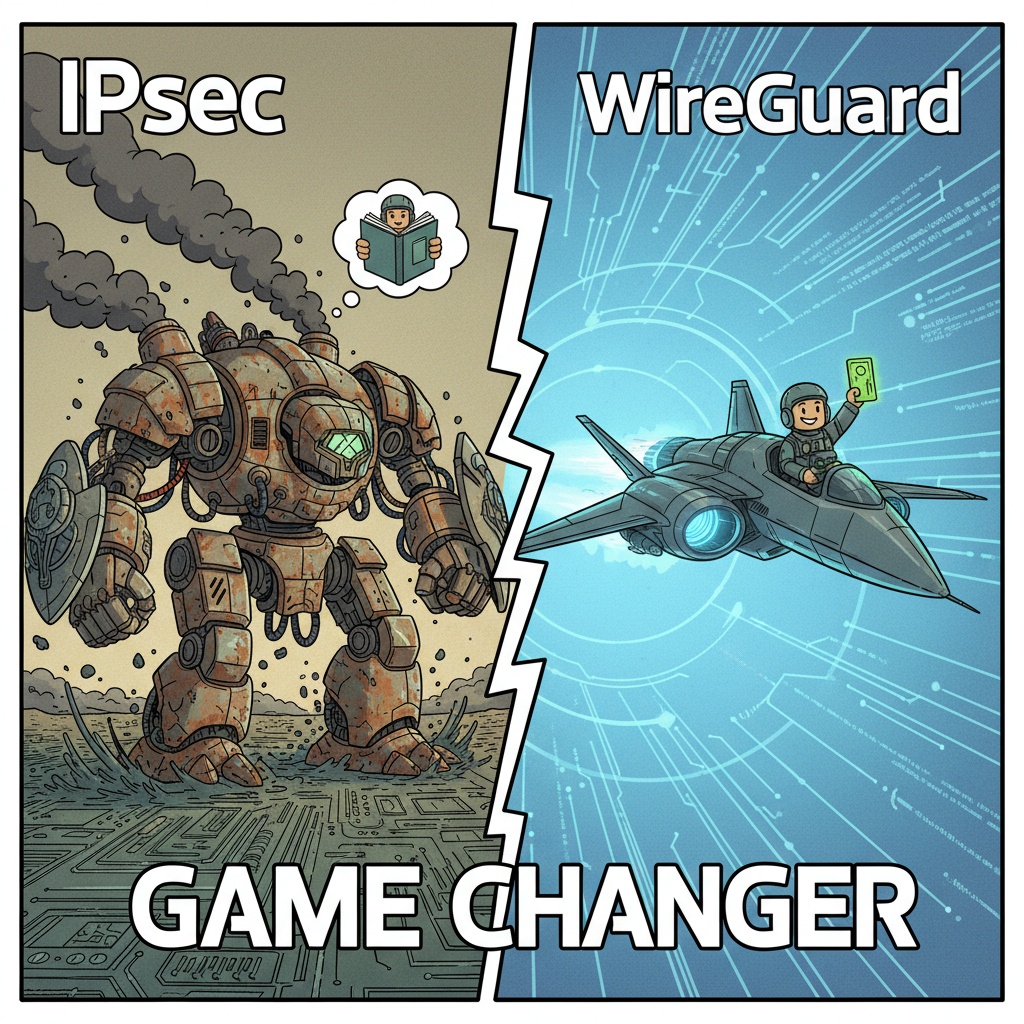
👑 The Traditional Strongman, IPsec: Reliable but Heavy Armor
First, let’s learn about IPsec (Internet Protocol Security), which has long reigned as the standard in the VPN market.
IPsec is a very powerful and mature ‘suite’ of protocols developed in the 1990s. It’s not a single specific protocol, but rather a combination of several protocols (IKE, ESP, AH, etc.) that work together.
- Pros 👍: Supported by almost all network devices and operating systems, it offers decades of proven stability and robust security options. The term “standard” suits this technology best.
- Cons 🤔: But this power comes at a cost.
- Complexity: Being a combination of multiple protocols, its configuration is very complex and difficult. IKEv1, IKEv2, Phase 1, Phase 2… you’ll encounter countless options during setup, and a small mistake can lead to connection failure or security vulnerabilities.
- Slow Speed: Performance degradation is common due to complex handshake processes and data handling that moves between kernel and user space. Especially in mobile environments where networks frequently change, it takes a long time for connections to drop and re-establish.
To draw an analogy, IPsec is like a heavy, complex medieval suit of armor, prepared for all situations. 🛡️ It’s certainly sturdy, but difficult to put on and take off, and movement is sluggish.
🚀 The Rising Star, WireGuard: Light, Agile, and the Future
Now, let’s introduce today’s protagonist, WireGuard!
WireGuard is a modern VPN protocol born from the realization that “IPsec is too complex and slow!” It’s so well-designed that Linus Torvalds, the creator of the Linux kernel, praised it as a “work of art.”
WireGuard’s core philosophy is ‘simplicity’.
- Concise Codebase: While IPsec and its related implementation code can run into hundreds of thousands of lines, WireGuard consists of only about 4,000 lines of code. This means fewer places for bugs to hide, and it’s much easier for security experts to review and trust the code.
- Latest Encryption Technology: It doesn’t offer the option to choose outdated encryption algorithms. It ‘fixes’ and uses only the latest encryption technologies considered most secure and fast today, such as ChaCha20, Poly1305, and Curve25519. Users don’t need to worry; the default is the optimal security setting.
So, what are the practical advantages of WireGuard over IPsec?
🏆 Head-to-Head: Why WireGuard Wins Decisively
This is the core point. The reasons WireGuard is gaining attention are clear.
C. It offers simpler configuration and generally faster processing speeds and lower latency.
Everything is encapsulated in this one sentence. Let’s look at each point in detail.
1. Amazingly Simple Configuration ⚙️
If you’ve ever been frustrated by the complexity of IPsec configuration, you’ll be impressed by WireGuard’s setup method. It operates on a public/private key basis, allowing you to connect two peers as simply as exchanging SSH keys.
Example: WireGuard Server Configuration (/etc/wireguard/wg0.conf)
# Server-side configuration
[Interface]
Address = 10.0.0.1/24       # Server's virtual IP address
SaveConfig = true
ListenPort = 51820          # Listening port
PrivateKey = [서버의 Private Key] # Server's private key

# Client (Peer) information to connect
[Peer]
PublicKey = [클라이언트의 Public Key] # Client's public key
AllowedIPs = 10.0.0.2/32    # IP to assign to this client and allow communication
Example: WireGuard Client Configuration
# Client-side configuration
[Interface]
Address = 10.0.0.2/24       # Client's virtual IP address
PrivateKey = [클라이언트의 Private Key] # Client's private key

# Server (Peer) information to connect
[Peer]
PublicKey = [서버의 Public Key] # Server's public key
Endpoint = [서버의 공인 IP]:51820 # Server address and port
AllowedIPs = 0.0.0.0/0        # Send all traffic (0.0.0.0/0) through this server
What do you think? No complex negotiation steps or countless encryption option choices; just clearly enter the necessary information, and you’re done. It’s intuitive and simple.
2. Overwhelming Speed and Low Latency ⚡
WireGuard’s superior performance is due to two main reasons:
- Linux Kernel Integration: WireGuard operates as a module directly integrated into the Linux kernel. This means there is almost no Context Switching overhead, which is the unnecessary back-and-forth between user space and kernel space to encrypt and transmit data. Since data is processed directly at the kernel level, latency is reduced, and throughput is dramatically improved.
- Efficient Encryption: As mentioned earlier, modern stream ciphers like ChaCha20 generally show faster performance on general-purpose CPUs compared to AES-CBC, which was commonly used in older IPsec implementations.
As a result, WireGuard offers **higher throughput** and **lower latency** compared to IPsec, consumes less battery, and is much more advantageous for mobile devices. 🔋
🤔 Correcting Common Misconceptions (What’s Not True)
“IPsec is older, so isn’t it more stable and feature-rich?”
Indeed, IPsec has various options and features reflecting the requirements of numerous enterprise environments. However, this ‘diversity’ and ‘complexity’ can also be a weakness. Choosing the wrong encryption combination or making a configuration error can create security holes. WireGuard, on the other hand, takes an ‘opinionated’ approach, enforcing only proven optimal combinations to achieve stronger security through ‘simplicity’.
“Doesn’t IPsec support hardware acceleration, making it faster?”
It’s true that some high-end network devices support IPsec hardware acceleration. However, this performance is dependent on specific hardware. In general server, PC, or mobile environments, WireGuard’s software-based processing is often more efficient and faster.
🗺️ Overall Perspective: When to Choose What?
So, should IPsec be abandoned now? Not necessarily.
- When to consider IPsec:
- When needing to interoperate with older legacy systems or specific network devices (if WireGuard is not supported)
- In regulatory environments that strictly require compliance with very specific encryption standards or policies
- When to choose WireGuard:
- Almost all new VPN deployment scenarios!
- When maximum performance and low latency are crucial (e.g., online gaming, real-time streaming)
- When simple configuration and maintenance are desired
- For modern infrastructure like cloud, container environments, and mobile devices
✨ Conclusion
In conclusion, WireGuard is not just an alternative to IPsec; it’s a ‘game changer’ that is shifting the paradigm of VPN technology. From **incomparably simple configuration, overwhelming performance through Linux kernel integration, to robust security provided by the latest encryption technologies**.
If you’re building a new VPN or dissatisfied with the performance of your existing system, there’s no reason to hesitate. WireGuard is the standard of the future, and that future is already here. 🚀
Leave a Reply