When developing services using generative AI, you’ve probably come across the term RAG (Retrieval-Augmented Generation) at some point. Most AI chatbots, internal document search systems, and customer service solutions currently being built by companies are based on RAG.
So, what exactly is RAG, and why are so many companies adopting it?
In this article, we’ll easily explore everything from the concept of RAG to its operating principles, advantages and limitations, and real-world application examples.
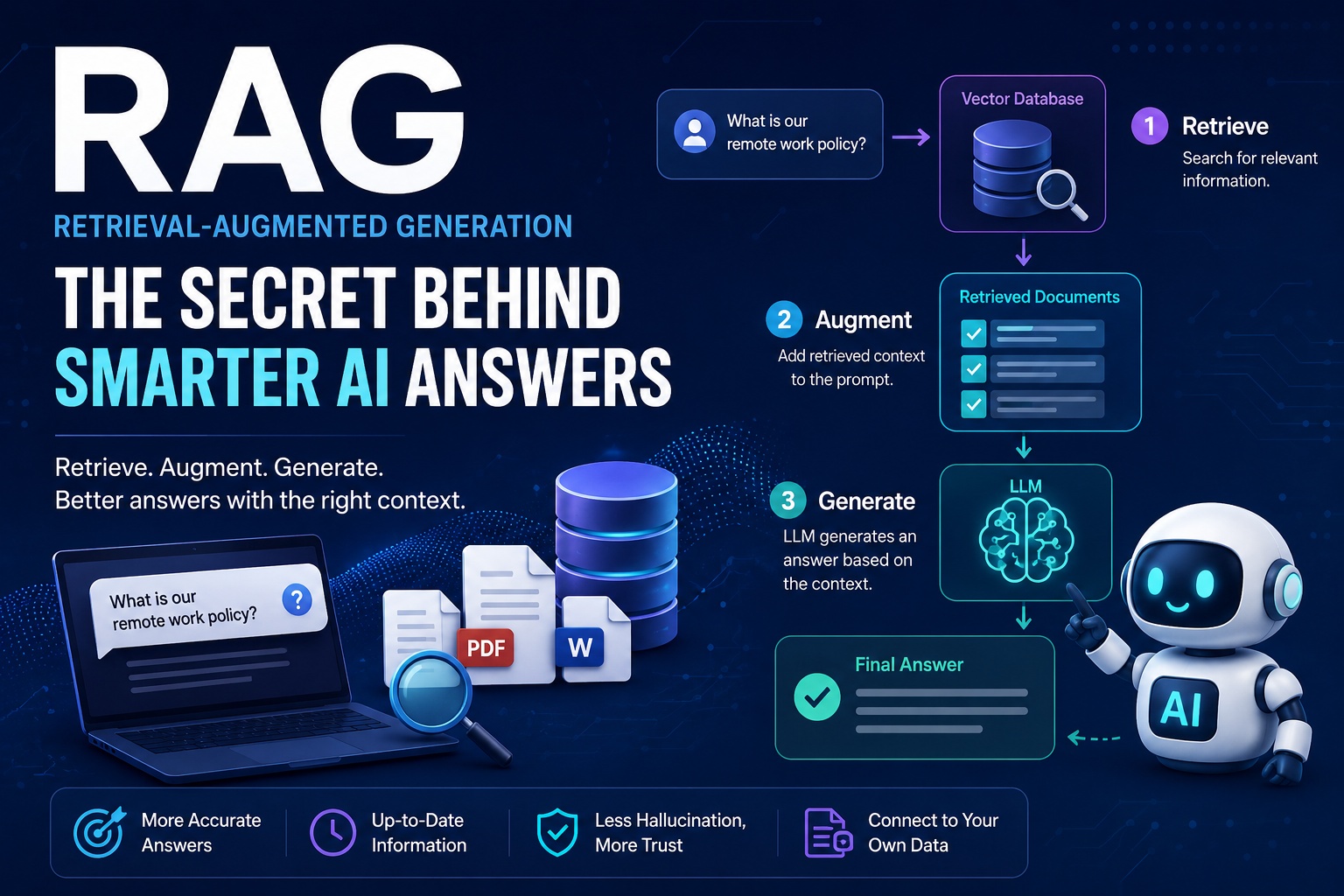
What is RAG?
RAG stands for Retrieval-Augmented Generation, which in Korean is called 검색 증강 생성 or 검색 기반 생성.
Traditional LLMs (Large Language Models) generate answers based on the knowledge they acquired during training. Therefore, it’s difficult for them to accurately answer questions about the latest information after their training cutoff, or about unlearned content like internal company documents.
RAG is a technology that solves this problem by first searching for relevant information before generating an answer, and then generating the answer based on the search results.
Simply put, it means that AI doesn’t just answer from memory, but rather looks up necessary information and refers to it before providing an answer.
Differences Between Traditional LLM and RAG
The answering process of traditional LLMs is very simple.
사용자 질문
      │
      ▼
LLM
      │
      ▼
답변 생성
On the other hand, RAG adds one more search step.
사용자 질문
      │
      ▼
문서 검색(Vector DB)
      │
      ▼
관련 문서 추출
      │
      ▼
LLM
      │
      ▼
최종 답변 생성
This means that by answering based on retrieved documents, RAG can provide more accurate and reliable results.
How Does RAG Work?
1. Convert Documents to Vectors
First, documents such as PDFs, Word files, Markdown, and webpages are divided into small units (Chunks) and then converted into vectors using an embedding model.
These vectors are stored in a Vector Database.
Representative vector DBs include:
- FAISS
- Chroma
- Milvus
- Pinecone
- Qdrant
- Weaviate
2. User Asks a Question
For example, a user asks:
“What are our company’s remote work regulations?”
3. Search for Relevant Documents
The question is also converted into a vector using the same embedding model, and then the most similar documents are searched for in the vector DB.
For example, the following documents might be retrieved:
- HR Regulations
- Remote Work Policy
- Security Policy
4. Pass Retrieved Documents to LLM
The retrieved documents are included in the prompt.
For example, in the following form:
질문:
우리 회사 재택근무 정책은?

참고 문서:
- 재택근무는 주 2일까지 허용
- VPN 접속 필수
- 업무용 PC만 사용 가능

위 내용을 참고하여 답변하세요.
The LLM generates an answer based on these documents.
Why Use RAG?
1. Incorporate Latest Information
LLMs do not know information that emerged after their training was completed.
However, RAG searches for the latest documents, so it can immediately reflect recently changed policies or news.
2. Utilize Internal Company Documents
Most internal company documents are not publicly available on the internet.
RAG can search these internal documents to provide answers, making it widely used in enterprise AI services.
3. Reduce Hallucination
LLMs sometimes generate plausible but incorrect answers for information they don’t know.
This is called Hallucination.
RAG significantly reduces this problem by generating answers based on actual documents.
4. No Need to Retrain the Model
There’s no need to retrain (Fine-tuning) the model every time a new document is created; simply add the document.
This also results in much lower operating costs and easier maintenance.
Real-world Use Cases
RAG is already being utilized in various fields.
- Enterprise internal document search systems
- Customer service AI chatbots
- Technical document search services
- Legal consultation systems
- Medical document search
- Source code search and development support
- Security log analysis
- Incident response systems (AIOps)
For example, IT operations teams might set up AI to search manuals, incident histories, and operation guides to provide guidance on incident causes and solutions.
RAG Also Has Limitations
RAG is not a panacea.
If the quality of the retrieved documents is poor, the quality of the answers will also decline.
Additionally, if documents are chunked too large or too small, search accuracy can decrease, and results also vary depending on the performance of the embedding model and the search algorithm.
Therefore, in actual services, the following factors are considered:
- Appropriate Chunk size
- Chunk Overlap
- Selection of a good embedding model
- Vector DB performance
- Application of Re-ranking
- Hybrid Search (BM25 + Vector Search)
These factors significantly influence the overall performance of the RAG system.
Differences Between RAG and Fine-tuning
Many people confuse RAG and Fine-tuning.
RAG is a method of retrieving external documents to generate answers, while Fine-tuning is a method of additionally training the model itself.
RAG is suitable for utilizing the latest information or frequently changing documents, whereas Fine-tuning is suitable for teaching the model specific tones, work styles, or response characteristics in specialized fields.
In practice, companies often use both technologies together.
Conclusion
RAG is one of the core technologies for applying generative AI to real-world services.
It can significantly improve accuracy and reliability compared to simply using an LLM, and its ability to leverage the latest information and internal company documents has established it as a standard architecture for enterprise AI systems.
If you plan to develop or operate services using generative AI in the future, it is highly recommended to understand the concept and operating principles of RAG. Subsequently, learning detailed technologies such as embedding, vector databases, chunking, and re-ranking will enable you to build even more sophisticated AI services.
Leave a Reply