Hello! Following up on our previous discussion about the concept of GitOps, today we’ll dive deep into practical use cases under the theme: “So, how can GitOps actually be utilized?”
Beyond mere theory, I’ll thoroughly explore how GitOps is transforming businesses in real-world scenarios! 🚀
GitOps goes beyond being just a tool for deploying applications; it changes the paradigm of infrastructure management. Here are 5 key use cases.
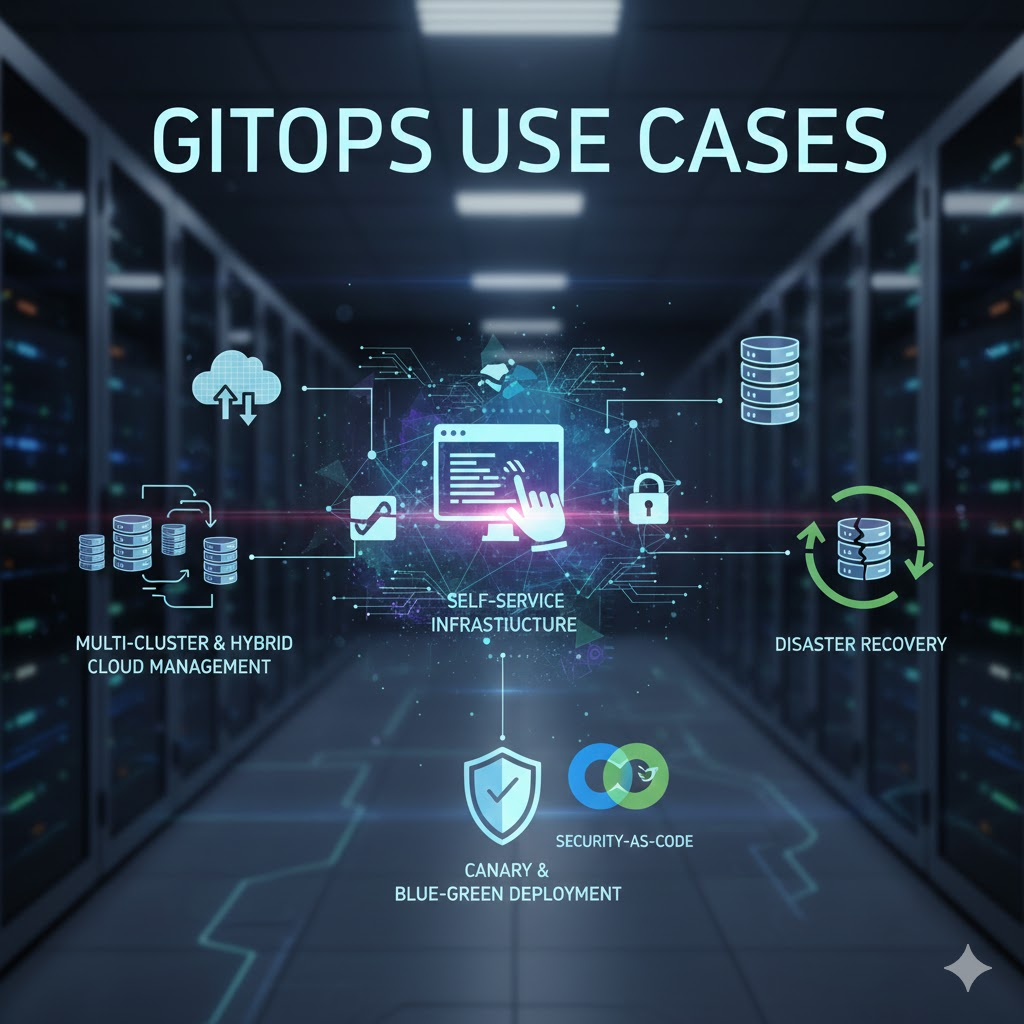
1. Multi-Cluster and Hybrid Cloud Management 🌐
As companies grow, they often use AWS, Azure, and Google Cloud simultaneously, or operate multiple Kubernetes clusters. Manually connecting and configuring each environment in such cases is close to a disaster.
- How to Use: Define the configurations for Production (Prod), Staging, and Development (Dev) environments in a single Git repository.
- Effect: Tools like Argo CD monitor multiple clusters simultaneously and deploy Git changes identically to all clusters. This perfectly resolves configuration drift issues between environments.
2. Self-Service Infrastructure Provisioning 🛠️
The era of developers submitting tickets to the operations team saying “Please create a DB” or “Please open a server” every time they start a new project is over.
- How to Use: Combine Terraform or Crossplane with GitOps. Developers upload the required infrastructure specifications as YAML files to Git and submit a PR (Pull Request).
- Effect: The moment the operations team approves the PR, cloud resources are automatically created. The operations team is freed from repetitive tasks, and developers can focus on their work immediately without waiting.
3. Automated Disaster Recovery (DR) 🔄
What if the worst-case scenario happens and an entire server goes down? With GitOps, it can be resolved without even a single recovery button.
- How to Use: Since all infrastructure and application configurations are recorded in Git, simply create a new cluster and connect the GitOps agent.
- Effect: The agent reads the latest state from Git and instantly reconstructs the environment exactly as it was before. Instead of searching for a “recovery manual,” you can trust the Git history.
4. Enhanced Security and Compliance (Policy as Code) 🛡️
Monitoring who changed infrastructure settings and when is central to security.
- How to Use: Restrict all changes to be made only through Git PRs. Mandate security team approval during the PR process and integrate policy engines like OPA (Open Policy Agent).
- Effect: Security rules such as “root access forbidden” or “specific port opening forbidden” can be automatically checked before deployment. All change history remains in Git commit logs, providing perfect audit trails.
5. Automated Canary and Blue-Green Deployments 🐦
GitOps shines when you want to release new features safely without impacting users.
- How to Use: Use tools like Argo Rollouts. When you modify the image version in Git, the system automatically sends only 10% of traffic to the new version and monitors the error rate.
- Effect: If an error occurs, the system autonomously decides to stop the deployment and roll back to the previous version. There’s no need for humans to monitor deployment status overnight.
💡 GitOps Pre-Adoption Checklist
These are crucial points to consider for successfully implementing GitOps.
- Declarative Environment Setup: Are all your current configurations managed as YAML or code?
- Security Management: How will you securely manage secret information? (e.g., HashiCorp Vault, Bitnami Sealed Secrets)
- Team Culture: Does everyone on the team agree with the principle “all changes must go through Git”?
- Automated Testing: Since GitOps automates deployment, robust CI tests that can catch bugs in the pre-deployment phase are essential.
🏁 Conclusion
GitOps is not just a trending technology; it aims for the stability and speed gained by managing infrastructure like software. Start by applying the cases mentioned above that are most relevant to your team.
By GitOps-ifying even small parts, you’ll soon experience the magic of earlier 퇴근 (leaving work)! 😊
Leave a Reply