Hello everyone! 👋 Welcome to the OWASP Top 10 Conquest Series. Today, we’ll be exploring A06:2021-Vulnerable and Outdated Components, whose name has become even clearer in the 2021 version.
The wonderful service you’ve developed – does it perhaps harbor a time bomb that could explode at any moment? 💣 Rather than writing all the code ourselves, we use countless open-source libraries, frameworks, and modules for convenience. These ‘components’ are the core of today’s discussion. Even if your own code is perfectly written, poorly managed components can pose a critical threat to your entire service. Let’s delve into their risks together, starting now! 🕵️♀️
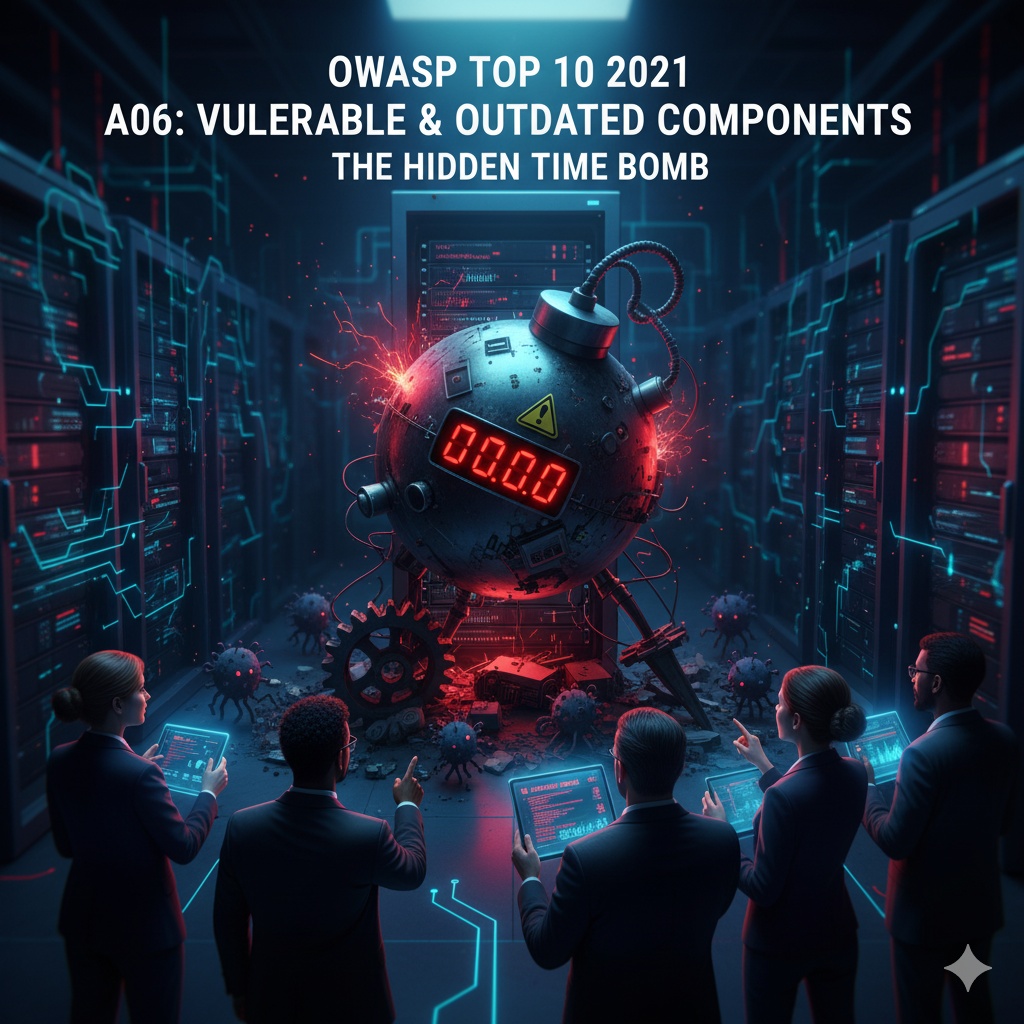
🤔 Vulnerable and Outdated Components? What are they?
“Tinkering away, you build a magnificent robot, but what if its leg parts were already broken?” 🤖💥
Vulnerable and Outdated Components refer to a state where external libraries, frameworks, modules, operating systems, etc. used in an application or system either have known security vulnerabilities or are old versions for which security updates are no longer provided.
It is said that over 90% of the software we create consists of such third-party components. Even if your own code is secure, if a component you’ve used is compromised, your entire service becomes vulnerable. It’s like putting an old, rusty lock on a well-built house. 🗝️
🚨 What Happens When Component Vulnerabilities Explode
Component vulnerabilities can go beyond simple bugs, having an impact far greater than imagined.
- Remote Code Execution (RCE): An attacker remotely executes arbitrary code on the system, completely taking over the server. (Most critical!)
- Data Leakage: Sensitive information is entirely leaked from databases, caches, etc.
- Denial of Service (DoS): Consumes system resources, paralyzing the service.
- Web Shell Upload: An attacker uploads malicious files to the server to secure persistent access.
These attacks were the main culprits behind major security incidents that shook the world, such as the Equifax hack using the Apache Struts2 vulnerability and the Log4Shell vulnerability crisis.
🕵️♂️ Common Cases of Vulnerable and Outdated Components
In what cases might our service be exposed to this risk?
1. Neglecting Unused Components/Features 👻
It’s like a ghost hidden in your code.
- Problem: Libraries/frameworks that were temporarily used during development or are no longer needed remain in the deployed service. Even if unused, if the component has a vulnerability, it can become an attack vector.
- Example: A test library included early in a project is deployed to a production environment, and this library has a remote code execution vulnerability.
2. Using Outdated Libraries/Frameworks ⏳
It’s like fighting with old weapons.
- Problem: Using older versions of libraries or frameworks (e.g., old Spring Framework, Node.js versions, PHP versions, WordPress plugins, etc.) that do not have the latest security patches applied.
- Example: Continuing to use Apache Struts 2.x, for which security vulnerabilities are widely known and patched versions exist, leading to server compromise by an attacker. (This was indeed the cause of the Equifax hack!)
3. Vulnerabilities in Third-Party Integrations 🤝
Even if your house is sturdy, you’re at risk if your neighbor’s house collapses.
- Problem: Your own code is secure, but there are vulnerabilities in external APIs, payment modules, advertising systems, etc., integrated into the service.
- Example: An external payment module used by an online store has an XSS vulnerability, putting customer payment information at risk of leakage.
4. Client-Side Library Vulnerabilities 🕸️
Risks can also arise in the browser.
- Problem: Older JavaScript libraries (e.g., jQuery, AngularJS, etc.) used on web pages have vulnerabilities. This can lead to client-side attacks such as XSS and DOM manipulation.
- Example: A DOM XSS vulnerability is found in an old jQuery version, leading to user session hijacking through specially crafted input values.
🛡️ How Can We Prevent This? (Defense Methods)
The key to protecting services from vulnerable and outdated components is “continuous visibility and management.”
- Component Inventory Management 📝: Clearly identify and document a list and versions of all third-party components (libraries, frameworks, modules, plugins, etc.) used in the application. (Concepts like SBOM – Software Bill Of Materials)
- Utilize Security Vulnerability Databases 🚨: Regularly check public vulnerability databases such as NVD (National Vulnerability Database) and CVE (Common Vulnerabilities and Exposures) to see if new vulnerabilities have been reported for the components you use.
- Use Automated Vulnerability Scanning Tools (SCA, SAST) 🤖:
- SCA (Software Composition Analysis): A tool that automatically identifies vulnerabilities in open-source components being used. It is recommended to integrate it into the build pipeline for continuous scanning.
- SAST (Static Application Security Testing): A tool that analyzes source code to find potential vulnerabilities.
- Maintain Latest Versions and Apply Patches ⬆️: Always update to the latest versions provided by component vendors and establish a process to apply security patches immediately upon release.
- Remove Unnecessary Components 🧹: Components that are unused or no longer needed must be removed from the deployment environment to minimize the attack surface.
- Establish Criteria for Selecting Secure Components ✅: When adding new components, review and select them based on whether security updates are consistently provided, community support is active, and there are no known vulnerabilities.
✨ Conclusion
Vulnerable and outdated components can be the weakest link in our services. This issue requires far more extensive and continuous attention and effort than fixing a line or two of code. From now on, we must develop the habit of checking our service’s component list and asking, “Is this component safe?”
A secure service grows on a strong foundation. We hope that all of us can eliminate hidden time bombs and build robust services! 👷♀️👷♂️
Tags: OWASP, A06, Vulnerable Components, Outdated Components, Security Vulnerability, Open Source Security, SCA, SAST, Patch Management
Leave a Reply