Simplified Technical English (STE) of ASD-STE100 is a controlled English standard that defines the vocabulary and sentence structure for English used in technical documents. ELI5 (Explain Like I’m Five) is an expression asking to explain complex content in a way that even non-experts in the field can understand. Both aim for easy-to-understand writing, but STE focuses on consistently controlling language use, while ELI5 emphasizes creating a foundation for readers to grasp concepts.
For example, suppose you need to inspect files before restoring a cloud backup. For a novice reader, “Why is this inspection necessary?” is important. For a reader performing the actual task, “What values are compared, and under what conditions should the process stop?” is important. Even when dealing with the same facts, the form of explanation changes depending on the document’s role.
This article compares the purpose, audience, terminology, and verification methods of the two approaches, based on the official ASD-STE100 Issue 9 confirmed on October 9, 2026, and the Reddit ELI5 community rules. The cloud example is a hypothetical situation created for explanation, and full STE compliance verification for the English examples was not performed.

1. Even if it’s ‘Easy Writing,’ the Problems to Solve Are Different
There is more than one reason why technical documents are difficult to read. It could be due to unfamiliar concepts, or it could be that instructions for an already known task are open to multiple interpretations. The first problem requires explanations that clarify the background and operating principles. The second problem requires sentences that consistently maintain terminology and operating conditions.
STE was originally developed to solve comprehension problems in aerospace maintenance documents. It controls vocabulary, grammar, and style to ensure that even non-native English speakers can clearly read technical content. Today, its application is not limited to aviation. However, its nature as a standard for explaining technical tasks is much more specific than “a trick to shorten any text.” ASD-STE100 Official Introduction
With ELI5, the starting point is a reader without background knowledge in that field. If they only hear “verify checksum,” they might get stuck on what a checksum is and why it’s compared. In such cases, understanding progresses by defining technical terms, showing what is actually done, and connecting what the results mean.
Therefore, when comparing the two approaches, one cannot only look at how short the sentences are. ELI5 requires checking whether the reader can follow the explanation, while STE requires checking whether it meets defined language rules and terminology usage. Fact-checking is necessary for both approaches.
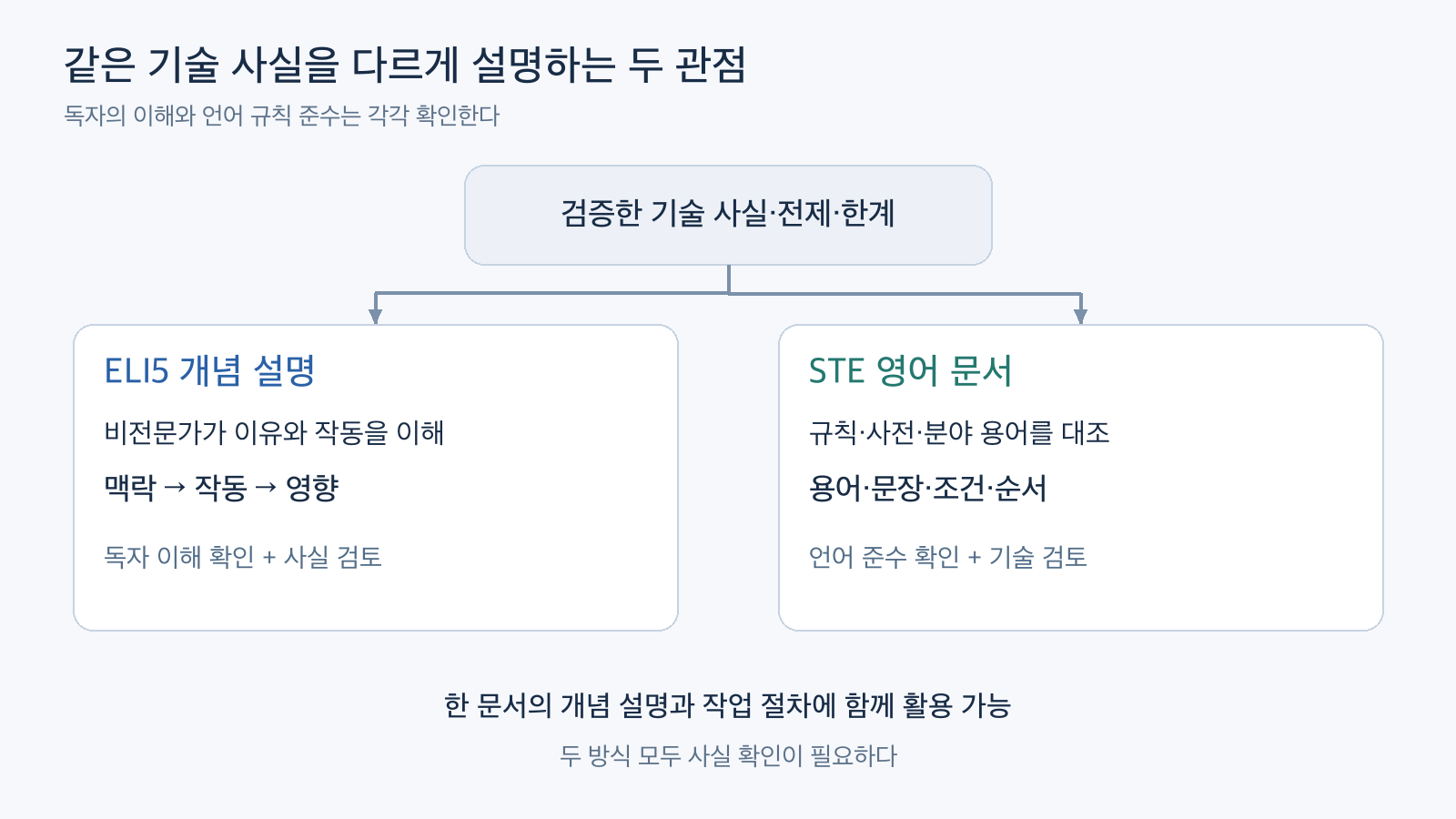
Figure 1. Relationship diagram expressing the same technical facts from two perspectives: reader comprehension and language usage rules. Reconstructed based on official documents such as the ASD-STE100 Official Standard and ELI5 Community Detailed Rules. Both approaches can be used together in different parts of a single document.
2. ELI5 is Not Just for Explaining to Actual Five-Year-Olds
The name ELI5 evokes the image of explaining to a child. However, Reddit’s r/explainlikeimfive detailed rules specify that it is not literally for five-year-olds, but for explaining to people who are not experts in the relevant field. This means that if you are discussing rocket science, a non-rocket scientist should be able to understand it. ELI5 Detailed Rules, Rule 4
This distinction is useful in practice. The ELI5 perspective can be used when explaining accounting concepts to developers, or linguistic standards to security personnel. It’s not about treating the reader like a child, but about considering what they might not yet know about the subject.
Community rules require explanations rather than simple answers in top-level comments directly responding to questions. They emphasize explanations that connect context, how things work, and their impact, based on objective facts, and advise against guessing if one doesn’t know. There is no rule stating that accuracy can be lowered just because easy expressions are used. ELI5 Detailed Rules, Rules 3·5·8
Metaphors are also not a mandatory condition. If the metaphor “file’s fingerprint” helps understanding, it can be used, but it’s better to clarify what values are actually calculated and compared after the metaphor. This article editorially suggests including the conditions that the metaphor might miss. This is to prevent readers from reaching incorrect conclusions based solely on seemingly simple sentences.
Furthermore, a distinction must be made between the general ELI5 explanation method and the operating rules of a specific community. While one can explain from an ELI5 perspective in a Korean blog, it does not mean that it is a post suitable for Reddit. That community separately restricts the language used and post types, and generally does not allow AI-generated comments. The examples in this article are for comparing explanations for a blog. ELI5 Detailed Rules, Rule 3·Notes
3. STE Requires More Verification Than Just ‘Short and Easy English’
The STE standard consists of writing rules and a controlled dictionary. It is not enough to simply use words found in the dictionary. It must also be verified that the words are used with their permitted parts of speech and meanings. Even if an expression is natural in everyday English, it may need to be changed in an STE document. ASD-STE100 Official FAQ, About STE
Not all words necessary for a field can be included in a general dictionary. Therefore, the standard separately addresses technical nouns and technical verbs. In Issue 9, the previous term “technical name” was changed to “technical noun.” Since it is necessary to check both the terminology of the organization or field and the usage conditions of the standard, the explanation that “only a few hundred words in the dictionary are needed” incorrectly narrows the scope. ASD-STE100 Issue 9, Highlights·Section 1
Sentences are also handled differently depending on their purpose. Length rules differ for sentences giving instructions for procedures and sentences explaining content, and in procedures, actions and sequences must be clearly expressed. Even the principle of not cramming multiple instructions into one sentence has exceptions for actions performed simultaneously. If tasks that should be done together are broken down into sequential tasks, the original meaning can change. ASD-STE100 Issue 9, Rules 5.1·5.2·6.3
This article does not provide a trick for determining compliance based solely on word count. Actual application requires the standard’s word counting rules, document type, dictionary, and field-specific terminology. In particular, English sentence length rules cannot be directly translated to Korean word counts and called “Korean STE.”
Even in Korean documents, the principles of unifying terminology, specifying the object of action, and separating conditions and actions can be referenced. However, this is an application to enhance the clarity of Korean technical writing. The fact that a Korean translation appears easy does not prove STE compliance of the original English text.
4. A Side-by-Side Comparison of Purpose, Audience, Terminology, Sentences, and Verification
The following table compares the STE standard with the general ELI5 explanation method. The “reader comprehension check” in the ELI5 column is a practical suggestion from this article and does not imply a separate official certification process.
| Comparison Criteria | ASD-STE100 STE | ELI5 Explanation Method |
| — | — | — |
| Main Purpose | To increase clarity and consistency by controlling the expression of English in technical documents | To explain concepts and operating principles for non-experts to understand |
| Audience | People reading relevant tasks or technical content, also considering non-native English speakers | People with little background knowledge in the field, not limited to actual 5-year-olds |
| Language and Terminology | Verify the meaning and part of speech of approved vocabulary, and conditions for technical nouns and verbs | Explain necessary terms and tailor them to the reader’s knowledge |
| Sentence Structure | Writing rules by document type, verify clarity of actions, conditions, and sequence | Connect context, operation, and impact, and facilitate understanding step by step |
| Role of Metaphor | Focus on directly expressing the object and action of the procedure | Can be used when helpful, not mandatory |
| Verification Method | Review rules, dictionary, and field terminology of the applied version, and separate technical review | Fact-checking and verifying if the reader understands the meaning, conditions, and limitations |
| Judgment to Watch Out For | Short English does not prove STE compliance | Seemingly easy or well-received does not prove accuracy |
Using STE does not mean the reader already knows all concepts. Explaining with ELI5 does not mean that prerequisites for execution procedures can be omitted. It is possible to structure a document by explaining concepts in the introductory part and using consistent terminology and clear instructions in the actual procedures.
5. Let’s Explain the Same Cloud Backup Inspection in Three Ways
The common scenario is a pre-inspection to verify the integrity of a backup file downloaded from the cloud before restoration. Integrity here refers to the property of checking whether the file content has changed from a baseline. AWS also describes a feature for verifying the integrity of uploaded and downloaded data using checksum values. Checking Object Integrity in Amazon S3
The following is not a command or actual operating procedure for a specific cloud product. It is assumed that a separately protected approval record contains the SHA-256 value calculated based on the entire bytes of the backup file, and that the operator can trust that record. SHA-256 is a hash algorithm that calculates a fixed-length value from file content. In this example, the two values are compared using the same algorithm and the same calculation scope.
The facts that all three expressions must preserve are the same: obtain a trusted baseline value, calculate the value of the downloaded file, and compare the two. If they do not match, stop; if they match, this pre-inspection is complete. Passing the inspection alone does not mean the entire restoration is finished or that the file’s safety is guaranteed.
General Technical Explanation
In the pre-restoration inspection, compare the full file SHA-256 value of the backup file stored in the approval record with the full file SHA-256 value of the downloaded file. If the values differ, do not use the file, stop the inspection, and request verification from the responsible person. If the values are the same, record that the integrity pre-inspection is complete.
For experts, this quickly conveys the comparison targets and failure conditions. However, a reader new to hashing might not yet understand “Why can a file be inspected with a calculated value?” The next version provides supplementary explanation for that background.
ELI5 Perspective Explanation
Before using a downloaded backup file, you want to check if its content has changed from the file kept as a baseline. Calculating the file content with SHA-256 gives a value that can be compared. This is often likened to a ‘file’s fingerprint.’ Compare the value from the trusted approval record with the value calculated from the current file. If they differ, stop and check with the responsible person. If they are the same, this inspection is complete.
>
However, ‘matching fingerprints’ does not prove who created the file or that it is free of malicious code. If an attacker can change both the file and the baseline value together, comparison alone may not detect that alteration. Therefore, the premise that the baseline record can be trusted is necessary.
The ELI5 version starts with the reason for the inspection and explains the flow of calculation and comparison. It also limits the scope conveyed by metaphors. If a reader understands “the values are the same, so it’s unconditionally safe,” the explanation should be supplemented, even if written in simple sentences.
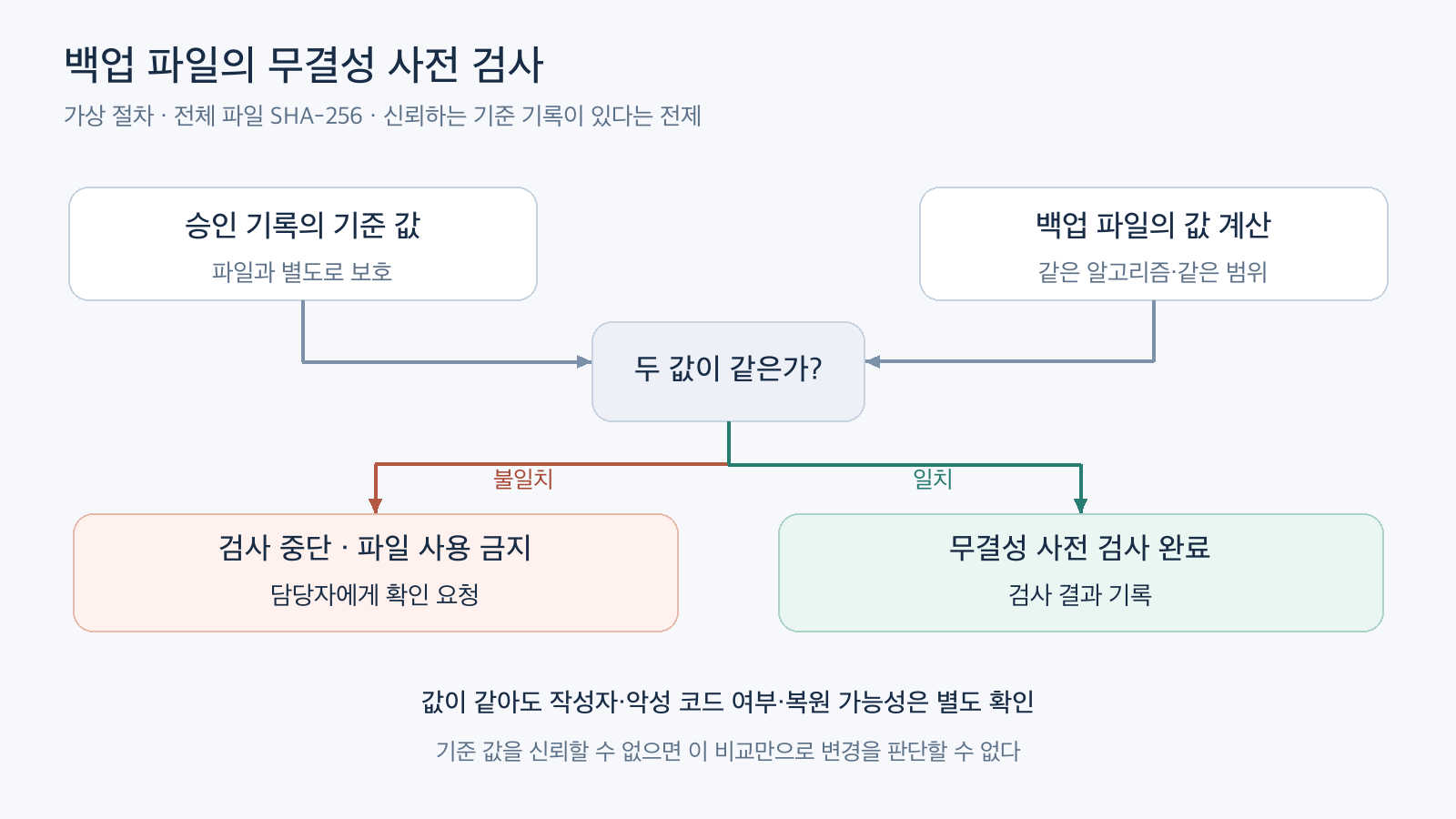
Figure 2. Hypothetical backup integrity pre-inspection. Reconstructed based on official documents such as Amazon S3 Integrity Check Guide. The protection of baseline records and the stop/verify steps are design assumptions of this article and do not represent S3’s internal implementation.
English Instructions Referencing STE Principles
The following is a new English example written for explanation. Full compliance verification, including all usages in the approved dictionary, field-specific terminology, and all writing rules, has not been performed. It is not presented as certified STE or a fully compliant document.
Prerequisite: The operator has obtained the downloaded backup file and its trusted approval record. “backup file,” “approval record,” “SHA-256 value,” etc., are candidate expressions to be defined and reviewed as field-specific terminology before actual application.
1. Read the SHA-256 value in the approval record.
2. Calculate the SHA-256 value of the backup file.
3. Compare the two SHA-256 values.
4. If the values are different, stop this check.
5. If the values are different, do not use the backup file.
6. If the values are different, tell the administrator.
7. If the values are the same, record the result of this check.
The Korean explanation is as follows: Read the value from the approval record, calculate the value of the backup file, and compare the two. If the values differ, stop the inspection, do not use the file, and notify the responsible person. If they are the same, record the inspection result. The calculation scope based on the entire file, as mentioned earlier, is a common premise for this example.
The English example focused on separating actions, referring to the same object with the same expression, and directly stating failure conditions. The repetition of conditions was also written to clearly show the operator which instruction to apply. The observation that sentences are short and the judgment of STE compliance are separate.
To use it as an actual procedure, it is necessary to determine which approval record to read, which tool to use for calculation, how to identify the target file, who the responsible person is, and which procedure to proceed to after a match. Explaining English text in Korean helps understand the content, but it does not replace the review of English terminology and rules itself.
6. In Practice, ‘Understanding’ and ‘Execution’ Can Be Structured Separately
The ELI5 perspective is useful for educational materials for beginners, technical blogs, and inter-departmental explanations. It helps readers first understand why this function is used, what is being checked, and what the results mean. Even then, security prerequisites and important limitations should be included in the explanation.
If multiple authors manage English work instructions, if source texts for translation need to be written consistently, or if document requirements specify STE, then the practical application of the standard can be reviewed. It should also be assessed whether the organization can prepare for terminology management and rule review. This is a selection criterion based on document purpose and does not mean that STE must be mandatorily applied to all cloud operation documents.
For a backup inspection document, a structure that divides the two roles as follows is suggested:
- Conceptual Explanation: Explain why integrity checks are necessary and the limitations of hash comparison in a way that non-experts can understand.
- Operating Procedure: Clearly state the actual tools, target files, approval records, comparison conditions, and stopping methods. If it is an English document requiring STE application, review the relevant rules and terminology.
- Review: Separately verify if the explanation aligns with facts, if the procedure can be performed in a real environment, and if STE-applied sentences meet language rules.
The “fingerprint” used in the conceptual explanation does not need to be used as an actual system term in the operating procedure. In the explanation, metaphors can serve as a stepping stone, while in the procedure, the names of actual values should be used. Readers can then understand the reason and find the correct objects to work with.
Linguistic clarity is also distinct from technical verification. Even if instructions are clear, the inspection will be incorrect if the wrong file is used as a baseline. Even if hash values match, whether the backup is restorable, compatible with the application, or free of malicious content are separate verification targets.
7. Include Expected Results and Verification Scope in AI Prompts
If you only ask AI to “explain like I’m five,” the model will estimate the audience and choose metaphors or details. If you only ask to “change to STE,” it can confidently claim standard compliance while outputting short English. It is better to specifically include the reader’s background, facts to preserve, the purpose of the output, and verification limitations in the prompt.
ELI5 설명 초안 요청

독자는 IT 업무 경험은 있지만 해시와 백업 검사는 처음 배우는 사람이다.
검사하는 이유, 값의 계산과 비교, 결과의 의미 순서로 설명하라.
신뢰하는 기준 기록, 불일치 시 중단, 검사 통과의 한계를 보존하라.
비유가 도움이 될 때만 사용하고 실제 동작과 연결하라.
모르는 제품 동작과 실제 경험을 만들어 넣지 말라.
STE 검토용 영어 초안 요청
원문의 기술 의미, 전제, 작업 순서, 실패 조건을 보존하라.
ASD-STE100 Issue 9의 원칙을 참고해 영어 지시문 초안을 작성하라.
제공한 조직 용어집의 대상 이름을 일관되게 사용하라.
확인하지 못한 사전 용법, 기술 용어, 작성 규칙을 별도 목록에 표시하라.
전체 규칙과 사전을 검증하지 않았다면 준수 완료라고 쓰지 말라.
한국어 해설과 미확인 항목을 영어 지시문과 분리하라.The presence of “verification complete” in an AI’s response alone cannot be considered as verification having occurred. It is necessary to check the actual applied version, authorized standard access, organizational glossary, inspection scope, and review results. When inputting standard texts or customer documents into external AI tools, usage rights and data processing conditions must also be separately confirmed. The fact that an official standard can be obtained for free does not automatically grant redistribution rights. ASD-STE100 Issue 9, Copyright notices·Distribution
The official FAQ describes language checking tools as optional and states that no tool can replace the standard itself. ASD and STEMG do not certify or endorse any inspection tool vendors. ASD-STE100 Official FAQ, Tools and training
Inspection tools can be used as auxiliary means to find vocabulary and formatting issues. However, it is good practice to separately record which rules the tool checked, how organizational terminology was registered, and whether meaning and actual operations were reviewed. This is an operational suggestion to avoid conflating a tool’s pass indication with the author’s technical review as the same result.
8. Final Check Can Be Divided into Two Questions
When reviewing an ELI5 explanation, one can ask, “Can the reader explain why, how, and under what conditions this task is performed?” In the backup example, this means having them recall where the baseline value is obtained, what to do if values differ, and what is not guaranteed even if they match. Points where the reader misunderstands become the basis for revising the next explanation.
In English documents applying STE, one checks, “Does this expression meet the rules, dictionary, and field-specific terminology conditions of the applied version?” After that, it is also reviewed whether the document is technically correct and practically executable. Linguistic compliance and procedural accuracy do not substitute for each other.
The two approaches can be used together to make the same document more readable. This involves designing the sequence to help readers understand concepts and specifying objects and conditions so that operators can perform actions accurately. However, the result of “explained easily” and the result of “verified standard compliance” must each have their own basis.
References
- ASD-STE100 Official Site: Information on the currently published issue and access paths to official materials.
- ASD-STE100 Official Introduction: Purpose, structure, application areas, and current issue of the standard.
- ASD-STE100 Official FAQ: Parts of speech and meaning of vocabulary, technical terms, and scope of inspection tools.
- ASD-STE100 Issue 9 Official PDF: Version dated January 15, 2025. Relevant sections of General introduction, Highlights, Sections 1·5·6·8, and Copyright notices·Distribution were checked.
- r/explainlikeimfive Detailed Rules: Target audience (non-experts), explanation structure, objectivity, prohibition of speculation, and community scope.
- Amazon S3 Object Integrity Check: Checksum-based integrity check for uploaded and downloaded data. The hypothetical procedure in the main text does not imply it is a standard procedure for a specific product.
Leave a Reply