“Should I send my child to a coding academy?” This is the most common question I get after my lectures.
And my answer always leaves parents flustered.
<
>
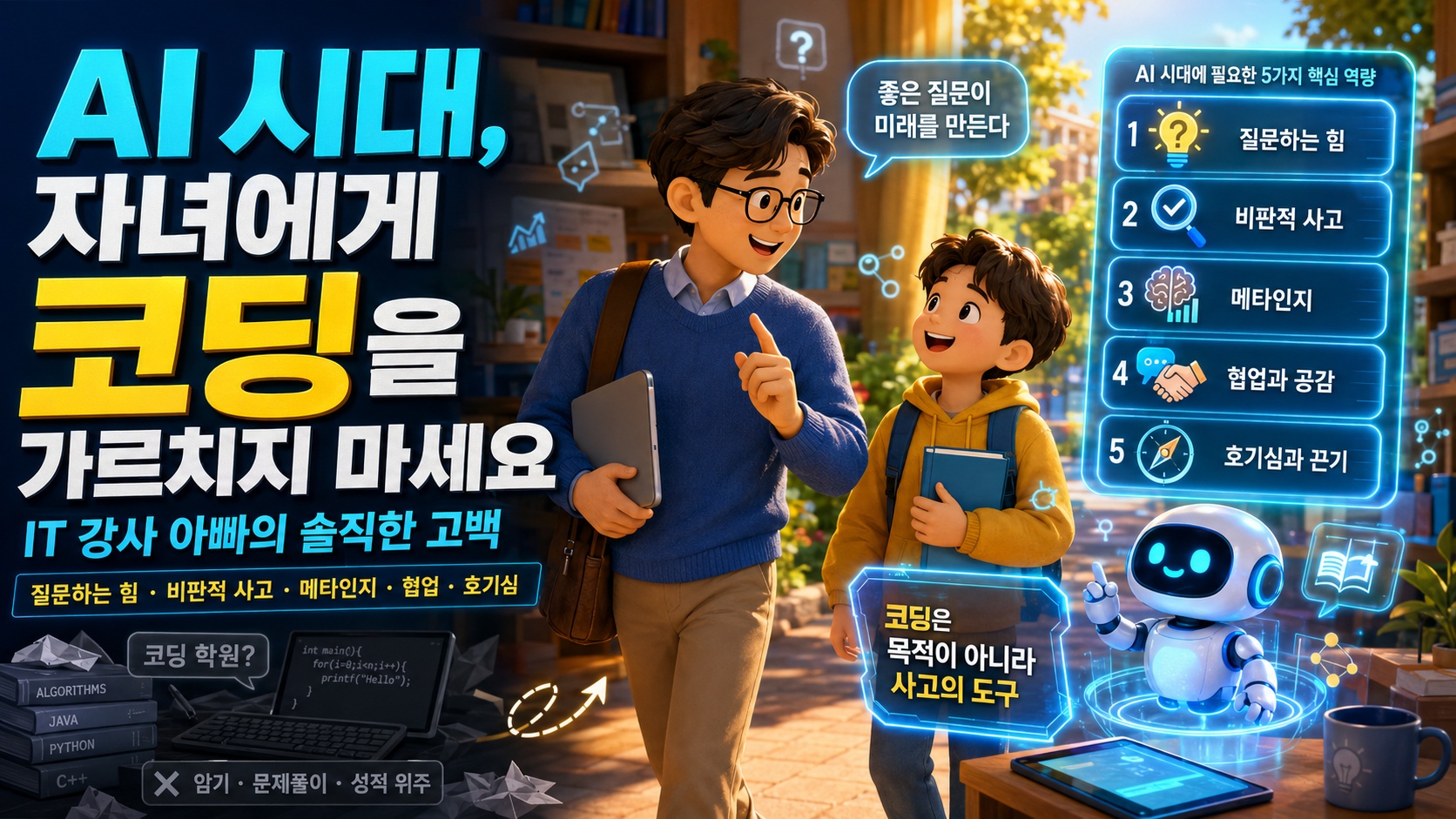
What This Article Covers
- Why coding is no longer a ‘core competency for the future’
- 5 essential skills to truly teach your children in the AI era
- If you still learn coding, how should you approach it?
- Common educational pitfalls parents fall into and their alternatives
The Era of Coding Academies, and Its End
Just a few years ago, the phrase “coding is the way to escape future illiteracy” was popular. Elementary school coding academies, Python books for children, Scratch certifications… parents were eager to put keyboards in their children’s hands.
But what about now? AI tools like ChatGPT, Claude, and Cursor automatically generate missing code, fix bugs, and even suggest architectures. What took a junior developer days, AI finishes in minutes.
I am an IT instructor who teaches cloud and security. I witness changes in the field every day. And as a parent, I have the same concern: “What should I teach my child?”
The answer is not coding.
Why Coding Itself Is Not the Answer
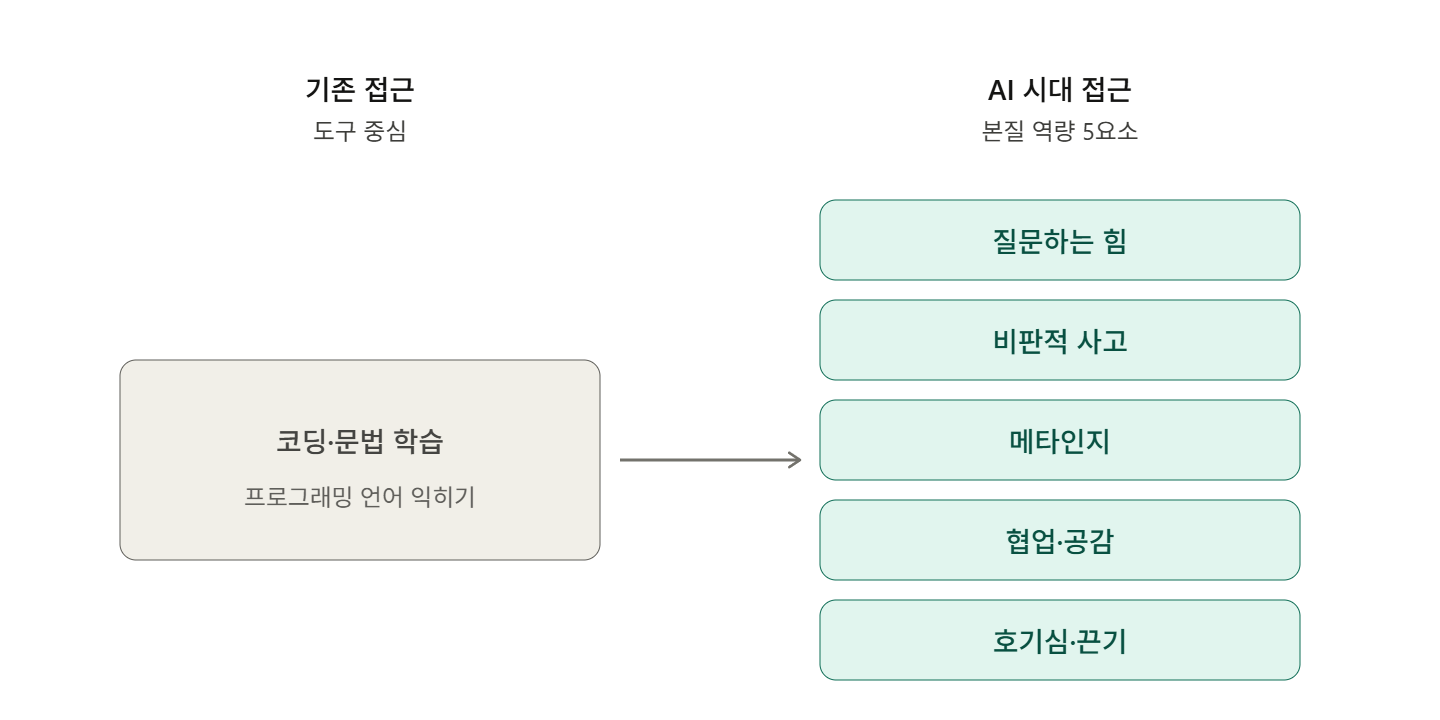
Don’t misunderstand. It doesn’t mean coding is meaningless. However, ‘coding as a manual skill for handling language’ is rapidly losing its value.
Until now, a developer’s core competencies were two-fold:
- The ability to define what to build (problem definition)
- The ability to translate that into code (implementation)
AI is rapidly replacing the second area. However, the first area, that is, defining “what to build and why”, remains human’s responsibility and will become even more important in the future.
In the world your child will face 30 years from now, people who have memorized coding syntax will be common. But those who can ask good questions will be rare.
5 Skills to Teach Your Children in the AI Era
1. The Power of Questioning — Problem Definition Ability
The output from someone who just tells AI “write code for me” and someone who asks “what is the essence of this problem, and what solution is appropriate under what constraints?” is worlds apart.
Good questions lead to good answers. When your child reads a book or watches a video, encourage them to frequently ask questions like “Why do you think that?”, “Are there other ways?”, “What if that’s wrong?”
2. Critical Thinking — The Power to Doubt AI
AI confidently lies. The phenomenon of hallucination is likely to persist even as technology advances.
Your child needs to develop the habit of not blindly trusting AI’s answers and asking “What’s the evidence?”, “Is this information really correct?” This is the core of information literacy, a skill that somewhat faded in the search engine era.
3. Metacognition — Learning How to Learn
The tools of the world change every year. There’s no guarantee that a programming language learned today will be valid in five years. However, “the ability to quickly learn new things” is valid for life.
Metacognition is “the ability to know what I know and what I don’t know.” If your child took a test, don’t just look at the score; analyze together “What parts were confusing? Why were they confusing?”
4. Collaboration and Empathy — The Skill of Working with People
No matter how much AI develops, value creation ultimately happens between people. The ability to understand team members’ intentions, grasp customers’ true needs, and mediate conflicts is the area AI finds most difficult to imitate.
It’s the same in the lecture hall. People who listen well to colleagues and accurately convey their own thoughts grow much faster than those who are merely technically skilled.
5. Curiosity and Persistence — The Power to Delve Deep
Getting superficial answers has become easy. Just ask AI. Therefore, the value of “people who delve deep to understand why” is skyrocketing.
If your child is engrossed in something, give them enough time to go deep into that topic, whatever it may be. Whether it’s insects, LEGOs, or comics, it doesn’t matter. The ‘experience of depth’ itself is an asset.
Should You Still Teach Coding?
Yes, teach it. But, teach it with a changed purpose.
Approach coding not as “job preparation” but as a “tool for logical thinking.” What your child learns when writing code includes:
- The ability to break down problems into smaller units
- The habit of thinking step-by-step
- The persistence to find clues in failure
- The ability to abstract
All of these are skills that remain even if coding disappears.
python
# The first example you can try with your child
# "A program where greetings change based on today's mood"

mood = input("오늘 기분은 어때? (좋아/그저그래/별로): ")

if mood == "좋아":
    print("멋진 하루를 보내고 있구나!  ")
elif mood == "그저그래":
    print("괜찮아, 그런 날도 있어. ☁️")
else:
    print("힘들었구나. 잠깐 쉬어가자.  ")
By creating a small program like this, your child naturally learns concepts like “conditions” and “branches.” You’re not teaching coding; you’re teaching how to think.
⚠️ Pitfalls Parents Easily Fall Into
Pitfall 1. “Because everyone else is sending their kids” Sending your child to a coding academy just because other kids are is the most dangerous. You need to see if your child is interested first.
Pitfall 2. “Let’s get a certificate first” A certificate is a tool, not an end. If you learn coding just to get a certificate, essential thinking skills won’t develop.
Pitfall 3. “AI is dangerous, so keep away” Quite the opposite. Don’t fear AI; teach them how to use it critically and collaboratively. Using it without understanding is the most dangerous.
Pitfall 4. “I can’t teach because I don’t know how” It’s okay if parents don’t know coding. The five skills mentioned above — questioning, critical thinking, metacognition, collaboration, and curiosity — can be fostered sufficiently without coding knowledge. In fact, that is the essence.
✅ In Summary — Nurturing People, Not Tools
Coding is a tool. Tools change with the times. 30 years ago, word processors were cutting-edge; 20 years ago, Excel; 10 years ago, mobile apps; and now, AI is in that position.
What you should teach your child is “the power of thought that remains unshaken by any tool.” That is the power of questioning, critical thinking, and the ability to learn how to learn.
Before sending your child to a coding academy, take a walk with them this evening and ask, “What was the strangest thing you saw today?” That is the true beginning of future education.
Leave a Reply