Have you ever been advised to periodically change the passwords for the services you use? You might think, “It’s a bit annoying…”, but this is a very important habit to keep your accounts safe.
The same applies to encryption keys, which act as the ‘master key’ protecting your data. They shouldn’t be created once and used forever; instead, they must be replaced periodically and immediately in emergency situations. Let’s explore why this is necessary and what standards to follow, easily and in detail, through major domestic and international regulations and standards.
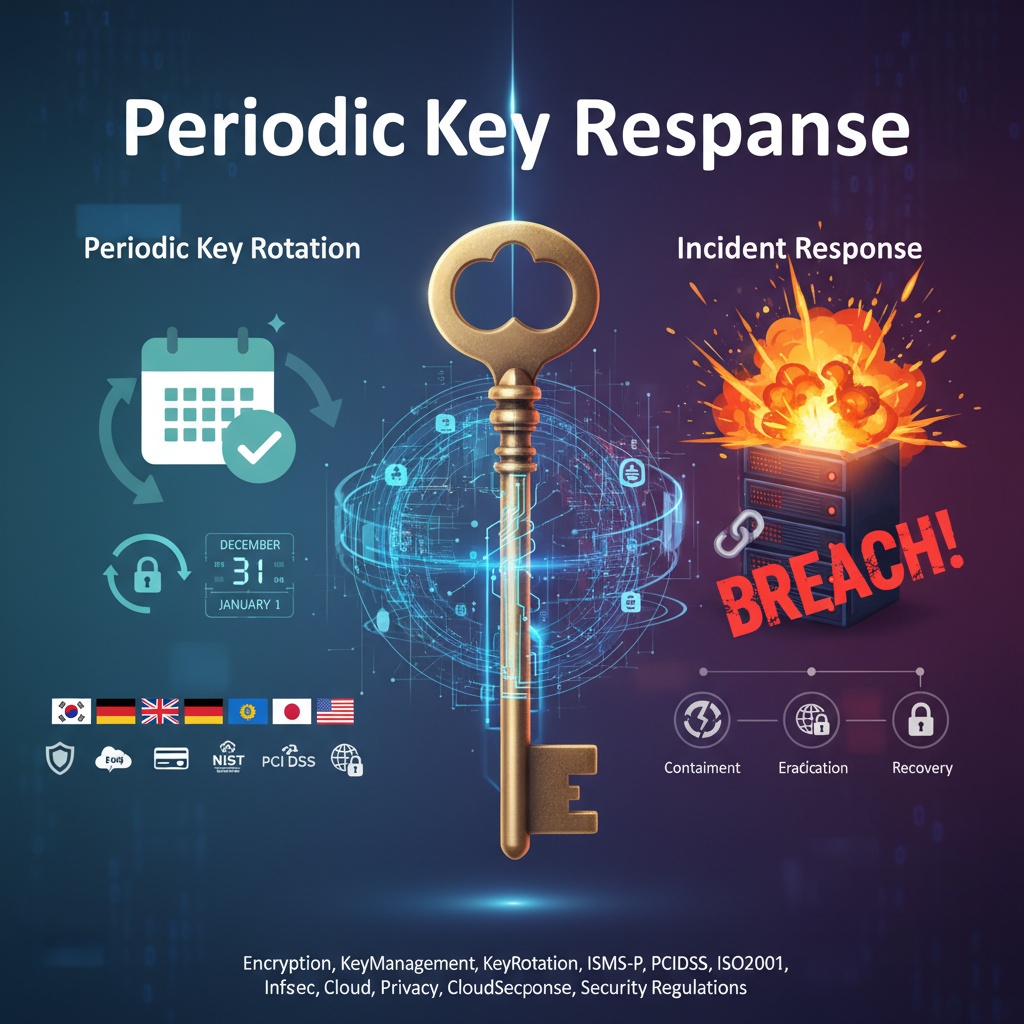
Part 1. Why You Should Periodically Change Your Keys: Encryption Key Replacement 🗓️
If an encryption key is ever leaked, all data encrypted with that key becomes vulnerable. Hackers might even attempt brute-force attacks over time. Periodic key replacement acts as a ‘firewall’ that limits the damage to a specific period, even if a key is leaked. In other words, it’s an essential security measure to minimize the scope of damage.
Due to this importance, various information security regulations and standards emphasize the periodic replacement of keys.
Major Domestic Regulations and Certifications 🇰🇷
- 🛡️ ISMS-P (Information Security and Personal Information Protection Management System Certification)
- Item 12.3.2, “Cryptographic Key Management,” requires secure management of the entire life-cycle of cryptographic keys. This life-cycle must include not only key generation, use, storage, and destruction but also ‘periodic replacement.’
- ☁️ CSAP (Cloud Computing Service Security Certification)
- In the “Encryption and Key Management” domain, it checks whether procedures are in place to set a cryptoperiod for keys and periodically renew them according to this cryptoperiod. This is a very important factor for cloud environment security.
- 🏦 Electronic Financial Transaction Supervision Regulations (Financial Sector)
- To ensure the security of electronic financial transactions, it requires the encryption of information along with the secure management of encryption keys. Detailed regulations specify that keys must be periodically renewed according to key life-cycle management procedures.
Global Standards and Regulations 🌍
- 💳 PCI DSS (Payment Card Industry Data Security Standard)
- This is one of the standards that provides the most specific guidance. Requirement 3.6.4 explicitly requires encryption keys to be replaced at least once a year, or immediately if key compromise is suspected. This is a strong regulation that all companies handling card information must follow.
- NIST SP 800-57 (NIST Recommendation for Key Management)
- Defines the concept of a ‘Cryptoperiod,’ which refers to the secure usage period of a key. It provides detailed guidance on how to determine an appropriate cryptoperiod considering the key type, data sensitivity, and usage environment, and that keys must be replaced before this period expires.
- 📜 ISO/IEC 27001 & 27002 (International Information Security Management System Standards)
- Control A.10.1.2 (Key Management) requires the establishment of policies and procedures for the entire life-cycle of encryption keys. This includes not only key generation, distribution, and storage but also secure replacement and destruction.
Part 2. Emergency! Full Key Replacement in Case of Cloud Breach 🚨
What should you do if your company’s cloud server is hacked? One of the first things to do is to replace all encryption keys currently in use.
This isn’t just because of a single line of law stating “replace all keys in case of a breach.” It’s like the common sense notion that “if your entire bunch of keys is stolen, you must change all the locks in your house.” This is a core principle of incident response processes presented by various security standards.
Why replace all keys? 🤔
When an incident occurs, it’s difficult to be 100% certain about how far the attacker accessed and what they stole. Therefore, you must assume the worst-case scenario. That is, you must respond by assuming that “the attacker may have stolen all authentication information, including encryption keys.”
- NIST SP 800-61 (Computer Security Incident Handling Guide)
- This guide divides incident response into ‘containment, eradication, and recovery’ phases.
- Eradication Phase: This is the process of completely removing the root cause of the attack from the system. At this stage, it is essential to invalidate and replace all authentication information (passwords, API keys, encryption keys, etc.) that the attacker may have stolen. This is when a full key replacement occurs.
- Recovery Phase: When restoring the system to a normal state, data must be recovered and services resumed using the newly replaced, secure keys.
- NIST SP 800-57 (Key Management Recommendation)
- The ‘Actions in Case of Key Compromise’ section states that if a key is compromised or suspected of being compromised, its use must be immediately stopped and it must be replaced with a new key. An incident is a prime situation where key compromise should be strongly suspected.
- 🛡️ ISMS-P and CSAP ☁️
- In the ‘Incident Management’ domain, they require procedures to prevent damage spread and securely recover the system in case of an incident. The core of this procedure is to replace all credentials that the attacker may have accessed, and encryption keys are among the most important credentials.
Conclusion: Understanding in the Full Context 🏥
Encryption key management can be compared to managing our health.
- Periodic key replacement is like a regular ‘health check-up.’ 🩺 Even if there are no current issues, it’s a proactive measure to prevent potential future risks and minimize damage if an unforeseen problem arises.
- Full key replacement in case of an incident is like undergoing ’emergency surgery’ after a sudden accident. 🚑 It’s an urgent and essential measure to resolve an already occurred problem, prevent additional infections or complications (further damage), and restore system trust.
In conclusion, encryption key management is not something you set once and forget; it’s a living process that requires continuous attention and procedures. The first step to secure data protection lies in how well these keys are managed.
Leave a Reply