You might have experienced asking AI to “explain it simply,” only to be overwhelmed by unfamiliar terms and exceptions, leading to more confusion. The problem isn’t that the model lacks knowledge, but that it tries to include everything it knows in the first answer.
The community eli5 skill, released in July 2026, addresses this problem with simple rules. The core idea is not to reduce facts to a child’s level. Instead, the first answer provides only a minimal map for the reader to get started, then allows them to choose a branch they want to explore further, and proceeds step-by-step in the same manner.
This article will examine the actual SKILL.md of the eli5 skill along with the Agent Skills specification, clarify how concept explanations differ from codebase explanations, and discuss how much trust to place in it.

What Does ELI5 Mean?
ELI5 is an internet expression meaning “Explain Like I’m Five.” However, the primary audience for this skill is not actual five-year-olds. The original text defines the reader as “a smart person from another field.” This means not to disregard their expertise, but also not to assume they have background knowledge in the field being explained.
The skill’s one-sentence principle can be summarized as follows:
Don’t simplify the facts; simplify the packaging that delivers the facts.
Only when the --literal-5yo option is used does it employ only everyday analogies and exclude code. In default mode, precise terminology and code can be used if necessary. Therefore, understanding ELI5 as “a function that unconditionally creates childish analogies” misses the skill’s intent.
Why Do General AI Explanations Become Difficult?
LLMs are adept at generating a wide range of relevant content when asked a question. This strength can be counterproductive in explanations. If definitions, history, types, exceptions, internal implementations, and precautions are all included at once, even if each point is correct, it can be difficult for the reader to know where to start.
The eli5 skill views this as a “failure of a complete answer.” Instead of covering everything in the first response, it imposes three limitations:
- Introduce only one new idea per step.
- Describe actual actions rather than abstract expressions.
- After the initial explanation, offer 2-3 branches for deeper exploration.
The important thing is not to discard information, but to reorder it. Instead of presenting a compressed overview of the entire classification, it first helps the user understand the most useful single item, leaving the rest as optional next steps. This is what the original text means by “depth is conveyed through descent, not volume.”
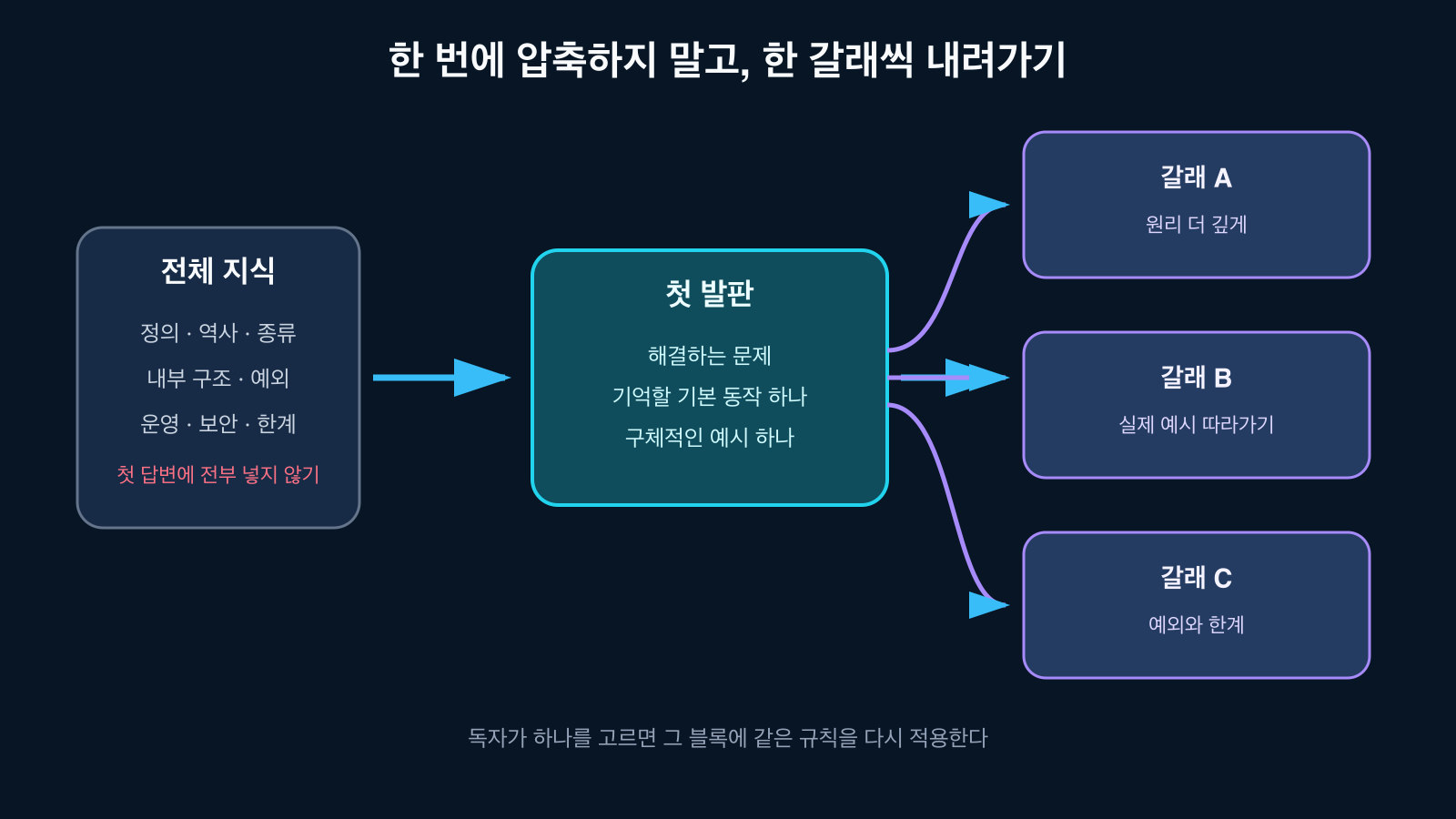
Instead of compressing complex overall knowledge at once, core stepping stones are created, and then one descends through chosen branches. Reconstructed based on the original ELI5 skill document.
Two Explanation Modes
This skill broadly divides the subject of a question into Concept mode and System mode. This is because explaining a single term and guiding through an entire codebase cannot be handled in the same format.
Concept mode: Concepts, Mechanisms, APIs
Concept mode aims for an initial explanation of approximately 200 words or less. The sequence involves four steps:
- State the problem this concept solves in one everyday sentence.
- Choose exactly one core operation that must be remembered.
- Provide one concrete example.
- Suggest branches for deeper exploration.
For example, when explaining a Kubernetes Pod, it doesn’t enumerate all lifecycle states and network rules in the first answer. Instead, it creates a stepping stone like “the smallest deployable unit in Kubernetes that runs and manages one or more containers together,” then shows a simple YAML or a single request flow. After that, it lets the user choose one of the following: “Why is a Pod, not a container, the unit?”, “How do restarts and replacements differ?”, or “How does a Service find Pods?”.
Good analogies can be used, but if the point where an analogy breaks affects actual judgment, its limitations should also be stated. Analogies should not replace facts.
System mode: Codebases, Architectures, Services
System mode limits the initial explanation to one screen, approximately 450 words or less. It requires actually exploring the code and documentation first, then quietly simplifying. This is because explaining an unread system plausibly and simply can be dangerous.
The explanation follows this sequence:
- State in one sentence what the system does and for whom.
- Divide it into 3-5 large blocks with easy names and assign one task to each.
- Trace the entire journey of a single request, click, or execution through these blocks.
- Select three design decisions that might surprise a beginner and explain why.
- Show a small Mermaid diagram consistent with the names above.
Files and ADRs (Architecture Decision Records) are not continuously interspersed within the main text but gathered into a short reading list at the end. If a user asks to “go deeper,” the entire map is not re-expanded in more detail; instead, the same rules are applied only to the selected block.
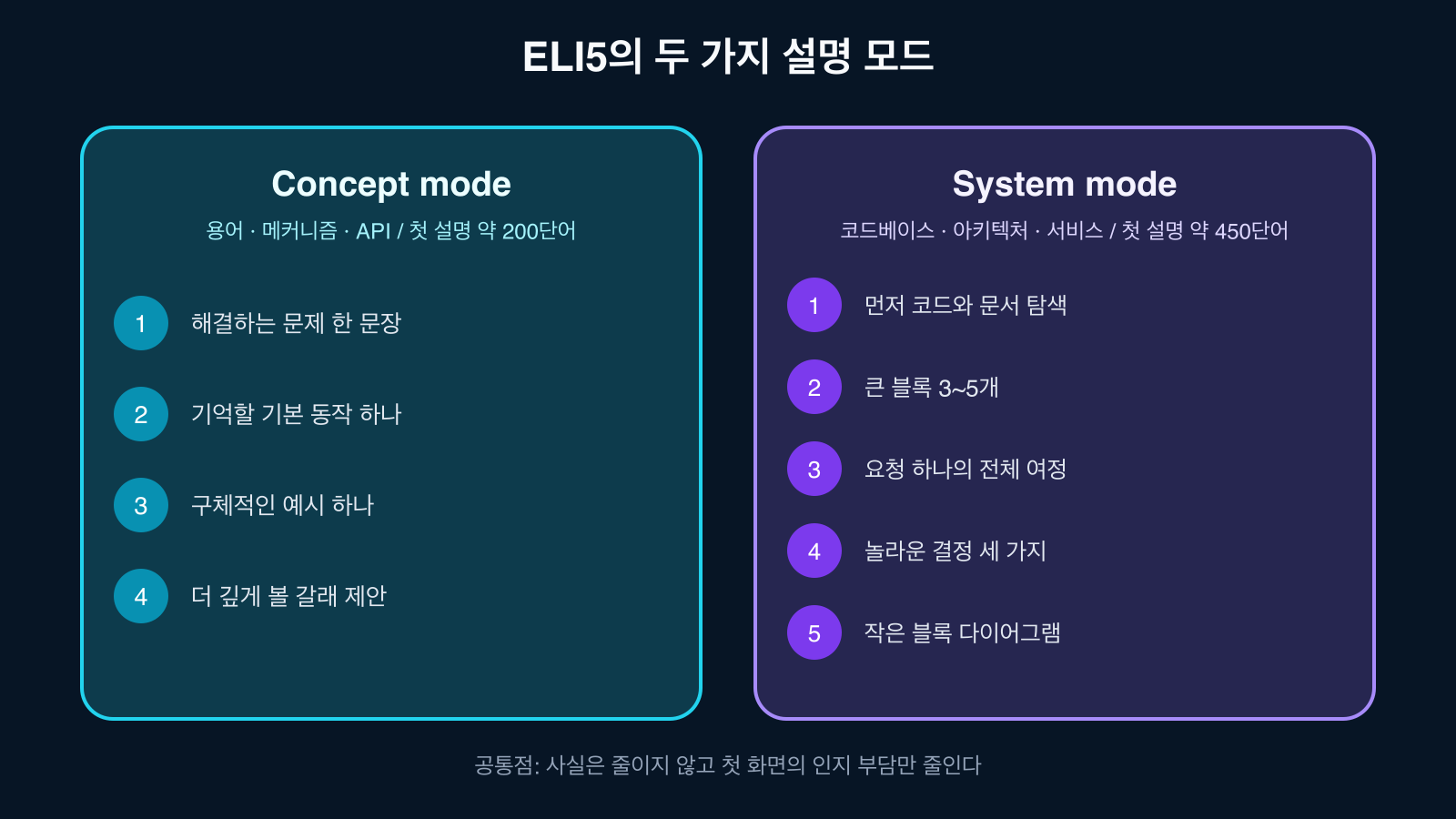
Concept mode and System mode differ in their target, the length of the first answer, and the explanation sequence. Reconstructed based on the original ELI5 skill document.
What Actually Changes?
Let’s compare the difference between a general question and the ELI5 approach using the question “What is TLS?”.
A poor first answer would explain TLS version history, handshake message types, certificate chains, symmetric and asymmetric keys, cipher suites, and session resumption all at once. Even if the content is correct, for someone new to TLS, it’s more like a parts list than a map.
The ELI5 approach first presents the problem and basic operation: “TLS is a set of communication protection rules that verify the identity of the other party on the internet and make it difficult to eavesdrop on or alter content in transit.” It then shows a single journey where a browser verifies a server certificate, agrees on a unique session key, and then exchanges encrypted HTTP. Finally, it allows the user to choose one of the following: certificate validation, key agreement, or changes in TLS 1.3.
The advantage of this method is not just its brevity. It allows the reader to reveal what they already know and what they are truly curious about through their next choices. The explainer can reduce unnecessary content, and the reader can descend to the resolution level they need.
Does Installing It Add New Knowledge to the Model?
No, it does not. Agent Skills is not a feature that retrains the model itself. In the official specification, a skill is at minimum a directory containing SKILL.md, and optionally includes scripts/, references/, and assets/. The client initially only sees metadata like the name and description, loads the full instructions when a request matches, and reads additional resources when needed. This is called progressive disclosure.
eli5 is a single SKILL.md that does not add executable programs or external tools. Therefore, it does not increase the model’s factual knowledge or access permissions. Instead, it makes editorial rules, length budgets, exploration order, and follow-up question formats repeatable for explanations.
The installation location and invocation method for skills vary depending on the agent product used. Even if a common specification is supported, it cannot be assumed that all clients interpret additional metadata like argument-hint identically. Before installation, you should check the skill search path and supported fields of the specific product.
Advantages and Limitations
Advantages
- Reduces cognitive load. The goal of the first answer is clearly “providing a first stepping stone,” not “including all content.”
- Handles concepts and systems with different templates. Specifically, it requires reading actual code and documentation before explaining a system.
- Allows for interactive depth adjustment. 2-3 follow-up branches recover content omitted from a short answer.
- Enforces specificity. Reduces the vicious cycle of explaining abstract terms with other abstract terms.
Limitations and Caveats
First, the eli5 discussed in this article is a community guideline published by an individual on GitHub Gist, not a built-in skill included in an official standard. As of August 26, 2026, no separate license indication is visible. To reproduce or distribute the content as is, it is safer to confirm the terms of use with the author.
Second, a short initial answer is not always appropriate. In fields where omissions themselves are dangerous, such as accident response procedures, medication dosages, or legal requirements, essential warnings and prerequisites should take precedence over length budgets.
Third, even good analogies can blur boundaries. An analogy like “encryption is a lock” is useful as a starting point but cannot explain key exchange, authentication, and integrity entirely. At the point where actual judgment begins, one must return to precise terminology and counterexamples.
Fourth, the quality of system mode depends on the quality of prior exploration. Explaining based only on inaccessible code or outdated documentation can create a concise but incorrect map.
When Is It Good to Use?
It is useful when grasping the initial concept of a new technology, onboarding to an unfamiliar codebase, or when a “I don’t understand” reaction follows a previous answer. Conversely, for someone who needs all fields of an API, all exceptions of a specification, or an entire operational checklist, the ELI5 initial answer should be followed by a link to the official reference.
이 시스템을 ELI5 방식으로 설명해 줘.
먼저 실제 코드와 문서를 확인하고,
큰 블록 3~5개와 요청 하나의 전체 흐름만 보여 줘.
끝에는 더 깊게 볼 갈래 3개를 제시해 줘.
If you only want analogies at a literal five-year-old level, you can explicitly state the --literal-5yo intent and request to exclude code and technical terms.
Conclusion
The essence of the ELI5 skill is not “speaking more briefly” but “disclosing information in an order that the reader can understand.” It preserves facts, creates small initial stepping stones, and lets the reader choose the next level of depth. For concepts, it first shows the problem, basic operation, and examples; for systems, it shows large blocks and a single complete journey.
If an AI workflow frequently receives feedback that its explanations are difficult, these principles alone can significantly change the perceived quality of its answers. However, the source and license of community skills, compatibility with the client being used, and information that should not be omitted in high-risk areas must be separately verified.
Leave a Reply