Hello! 👋 In the recent Kubernetes ecosystem, the hottest topic is undoubtedly the battle for supremacy in Service Mesh. In the past, the formula “Network is Cilium (CNI), Service Mesh is Istio” was dominant, but now the landscape has changed.
Cilium is leveraging eBPF technology to encroach upon the Service Mesh domain, and Istio, not to be outdone, is evolving into a Sidecar-less architecture by introducing Ambient Mesh.
As the roles of these two technologies overlap, I frequently receive the question, “Which one is the BP (Best Practice) for our project?” Today, we will thoroughly explore the differences between these two giants and the criteria for choosing between them. 🚀
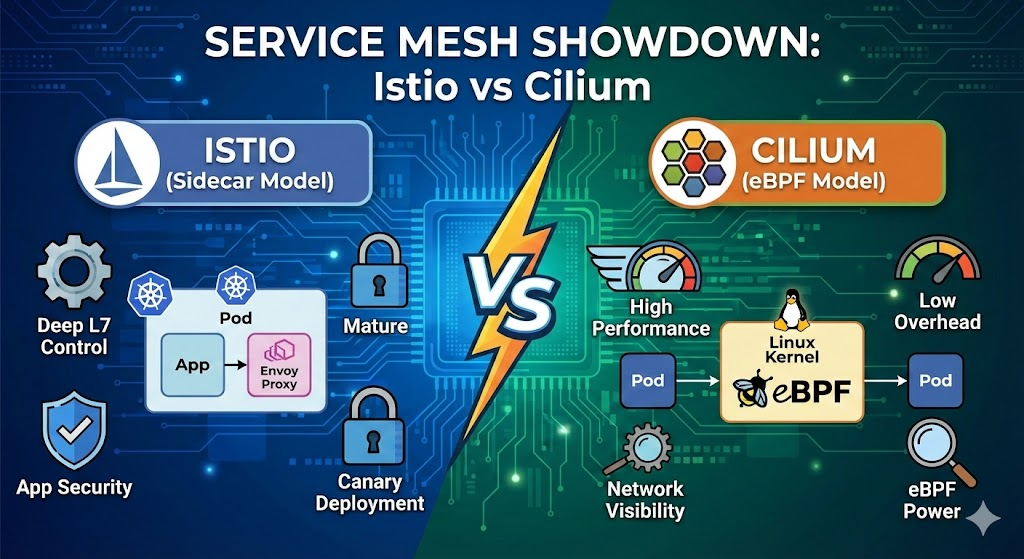
1. 🔍 Why the Deliberation? (The Context)
The biggest reason is the “blurring of boundaries.”
- Istio: Originally the king of the L7 (application) layer. It specializes in finely dissecting and controlling traffic.
- Cilium: Originally the king of the L3/L4 (network) layer. Its specialty was fast and secure packet delivery.
However, Cilium came out saying, “Since we’re already inspecting all packets, we’ll handle L7 processing too (Cilium Service Mesh),” and Istio responded with, “Sidecars are heavy? Then we’ll go lightweight too (Ambient Mesh),” causing the domains of the two technologies to start overlapping.
2. 🏗️ Fundamental Architectural Differences (The Core Difference)
To make a decision, you need to understand “where traffic is processed.”
🥊 Istio (Classic Sidecar Model)
“Attach a secretary (Envoy) next to every Pod.”
- Method: An Envoy Proxy container is injected as a Sidecar within the Pod.
- Characteristics: Application (Business Logic) and network processing are perfectly separated. It offers the most mature and powerful features, but because a proxy runs for each Pod, resource (CPU/Memory) consumption is high, and latency occurs as traffic passes through the proxy.
🥊 Cilium (eBPF Model)
“The operating system kernel handles it directly.”
- Method: Uses the eBPF technology of the Linux kernel to process network packets. Only when L7 processing is required, traffic briefly passes through one Envoy Proxy per node.
- Characteristics: No Sidecar! In other words, it’s a Sidecar-less architecture. Resource efficiency is overwhelmingly superior, and there is almost no network performance degradation. However, there are still limitations in handling complex L7 logic.
3. ⚔️ Detailed Comparison by Category (Deep Dive)
| Comparison Item | Istio (The King of L7) 👑 | Cilium (The King of Perf) ⚡ |
|---|---|---|
| Traffic Management | Excellent. Full 100% utilization of all Envoy features, including header manipulation, mirroring, complex retry logic, and circuit breakers. | Good. Basic routing is possible, but complex HTTP/gRPC logic processing eventually requires Envoy, which can make configuration tricky. |
| Security (mTLS) | Mature. Not only inter-service authentication but also very fine-grained authorization policy implementation at the Request level is possible. | Efficient. Strong in network-level (IP/Identity) control. mTLS is also supported, but Istio is superior for fine-grained application-level control. |
| Visibility (Obs) | App-centric. Specialized in viewing Call Graphs in conjunction with Kiali and Jaeger to see “which API is slow” or “which transaction failed.” | Network-centric. Unrivaled for infrastructure-level troubleshooting via Hubble UI, such as “where packets were dropped” or “DNS response speed.” |
| Performance Overhead | High. As many Proxies as Pods are needed, increasing the burden as the cluster grows. (Being addressed with Ambient Mesh) | Very Low. Overhead is minimized thanks to eBPF. Advantageous for large-scale clusters. |
—
4. 🏆 Winner by Scenario (Best Practice Guide)
When faced with similar requirements in a real-world environment, which tool should you choose? My criteria for Best Practice are as follows:
✅ Case 1: Choose Istio! (Platform & Dev Focus)
“Our MSA is very complex, and we need to give developers fine-grained traffic control.”
- Complex Canary/Blue-Green Deployments: When precise routing based on headers, cookies, or user IDs is essential.
- The Ultimate in Zero Trust Security: When strict security auditing is required beyond inter-service communication encryption (mTLS), to the level of “Service A can only call GET /api/v1/data path of Service B.”
- Maturity and References: When you need to quickly find solutions via Google in case of problems, and prefer a standard technology (De facto) used by many.
- Already have Istio certifications (ICA), etc.: If you have a high understanding of the tool, Istio’s “controllability” is a tremendous weapon.
✅ Case 2: Choose Cilium! (Infra & Ops Focus)
“Performance is paramount for us, and we want to reduce operational complexity.”
- Ultra-high Performance/Low Latency Requirements: When even a few milliseconds (ms) of delay due to Sidecar injection is unacceptable (e.g., financial trading, real-time communication).
- Large-scale Clusters: When there are thousands or tens of thousands of Pods, and attaching a Sidecar to all of them would result in unmanageable resource costs.
- Network Troubleshooting: For infrastructure teams where identifying network disconnections, firewall issues, or DNS problems is more urgent than L7 errors. (Hubble UI is truly fantastic ✨)
- Preference for a Single Stack: If you are already using Cilium as your CNI and don’t want to install Istio as well, doubling your management points.
5. 🔮 Conclusion and Future Outlook
In the past, these two technologies occupied different domains, but now it has become a matter of “preference and philosophy.”
- If you focus on application logic and security 👉 Istio
- If you focus on network performance and infrastructure operational efficiency 👉 Cilium
However, the trend is clear. Istio is abandoning Sidecars through Ambient Mesh, and Cilium continues to expand its capabilities. Ultimately, the winner of the future will be “who can provide L7 functionality more lightly and easily.”
Personally, as a security expert, I prefer Istio, which allows for fine-grained policy control, but as the scale of the infrastructure grows, Cilium’s lightness is an undeniable appeal. Choose the tool that fits your situation!
Leave a Reply