Hello, gamers! 🕹️ When you’re enjoying online multiplayer games, you sometimes hear or say things like “What’s wrong with the ping?” or “It’s lagging!” We often experience frustration due to network delays at crucial moments that determine the outcome of a game.
How exactly do games connect with other players, and why is it sometimes smooth and sometimes severely laggy? Today, we’ll take a simple and detailed look at the hidden secrets of in-game networking: P2P (Peer-to-Peer) communication, NAT Traversal, and the role of Relay Servers! 🚀
❓ How Do Games Connect Players? Two Main Methods!
There are two main communication methods for online multiplayer games.
1. Client-Server Method 🏢
This is the most common method. All players (clients) connect to a central dedicated game server. All data between players (character movements, attack hit detection, etc.) is transmitted to other players via this central server.
- Advantages: 🌐 The server manages all game states, leading to high fairness and better defense against hacks or cheating. Suitable for large-scale concurrent connections.
- Disadvantages: 💸 Server operation costs are high, and if the physical distance between players and the server is great, latency (Ping) can increase. Server failures affect the entire game.
- Key Games: Most large-scale MMORPGs (Lost Ark, MapleStory), popular FPS/AOS games (League of Legends, Overwatch, PUBG)
2. P2P (Peer-to-Peer) Method 🤝
This method allows players to connect and communicate directly with each other without a central server. One player can act as the ‘Host’ and serve as the server, or all players can be connected equally.
- Advantages: 🚀 Since it doesn’t go through a central server, latency is very short and fast. Server operation costs are almost zero.
- Disadvantages: 🚨 The overall game quality depends on the host’s network status. It can be vulnerable to hacks or cheating, and if the host leaves, the game may end. A complex issue called NAT Traversal can arise.
- Key Games: Fighting games (Tekken, Street Fighter), some RTS games (older versions of StarCraft), Co-op games, small-scale instance dungeons, etc.
🤯 P2P’s Challenge: NAT Traversal and ‘Hole Punching’
While P2P is excellent in terms of latency, there’s one major obstacle: NAT (Network Address Translation), which is your home router! 🏠
Most players use private IP addresses hidden behind a router. Routers, to protect the internal network from external intrusions, generally block incoming connections from outside.
“I want to connect to player A, who has a public IP, but A is actually behind a router, so I can’t reach them directly?” This kind of problem arises.
This is where NAT Traversal technology comes in. It’s like opening a locked door from the inside or allowing people to recognize each other through a specific window. The most representative technique is UDP Hole Punching.
Punching! How Does UDP Hole Punching Work? 🥊
- Connecting to the Meeting Place (Matchmaking Server): Players A and B connect to the game’s matchmaking server (central server). (This server coordinates the game but does not relay actual game data!)
- Exchanging Public Information: The matchmaking server informs A and B of each other’s public IP address and the port temporarily assigned by their router for external communication.
- Knocking on the Door Simultaneously (Punching): 🔔
- A sends a UDP packet to B’s public IP:port.
- Simultaneously! B also sends a UDP packet to A’s public IP:port.
- The moment A’s router sends a packet to B, it temporarily opens a specific port (a hole, or ‘hole’) with the thought, “Ah, A sent something that way, so I should allow responses from that direction!” B’s router does the same.
- Initiating Direct Communication: Once ‘holes’ are punched in both routers, A and B can now directly exchange UDP packets with each other without the matchmaking server’s relay! 🎉 This is the moment when latency becomes extremely short.
- Role: When players A and B fail to connect directly, the relay server relays data between A and B.
- How it Works: A and B each connect to the nearest relay server and exchange data with each other through it.
- Disadvantages: Going through a relay server is similar to going through a central server, so latency increases compared to direct P2P connection. One of the main reasons for ping spikes or lag is the use of these relay servers. 📉
- Advantages: Even with some delay, it almost always guarantees a connection in any environment. It creates a situation where “playing is possible even with some lag” rather than “game connection failed.”
- Fighting Games: Games like Tekken and Street Fighter require P2P connections because victory or defeat can be decided by a single frame.
- Older RTS Games: Battle.net in StarCraft 1 (older version), for example, used P2P connections with the host acting as the server.
- Some Co-op Games: P2P is also utilized in co-op mission games enjoyed by small groups of friends.
- Specific Content in Some MMORPGs: In games like Dungeon Fighter Online’s party play, P2P may be used for specific instance dungeons or small parties.
In this way, players can communicate as if they were on the same LAN, even though they are on physically different networks.
😥 What if Connection Still Fails? The Emergence of Relay Servers!
While UDP hole punching succeeds in most network environments, there are very strict router or firewall configurations (e.g., symmetric NAT, strict corporate firewalls) where direct connection via hole punching is impossible.
In such cases, game developers prepare Relay Servers.
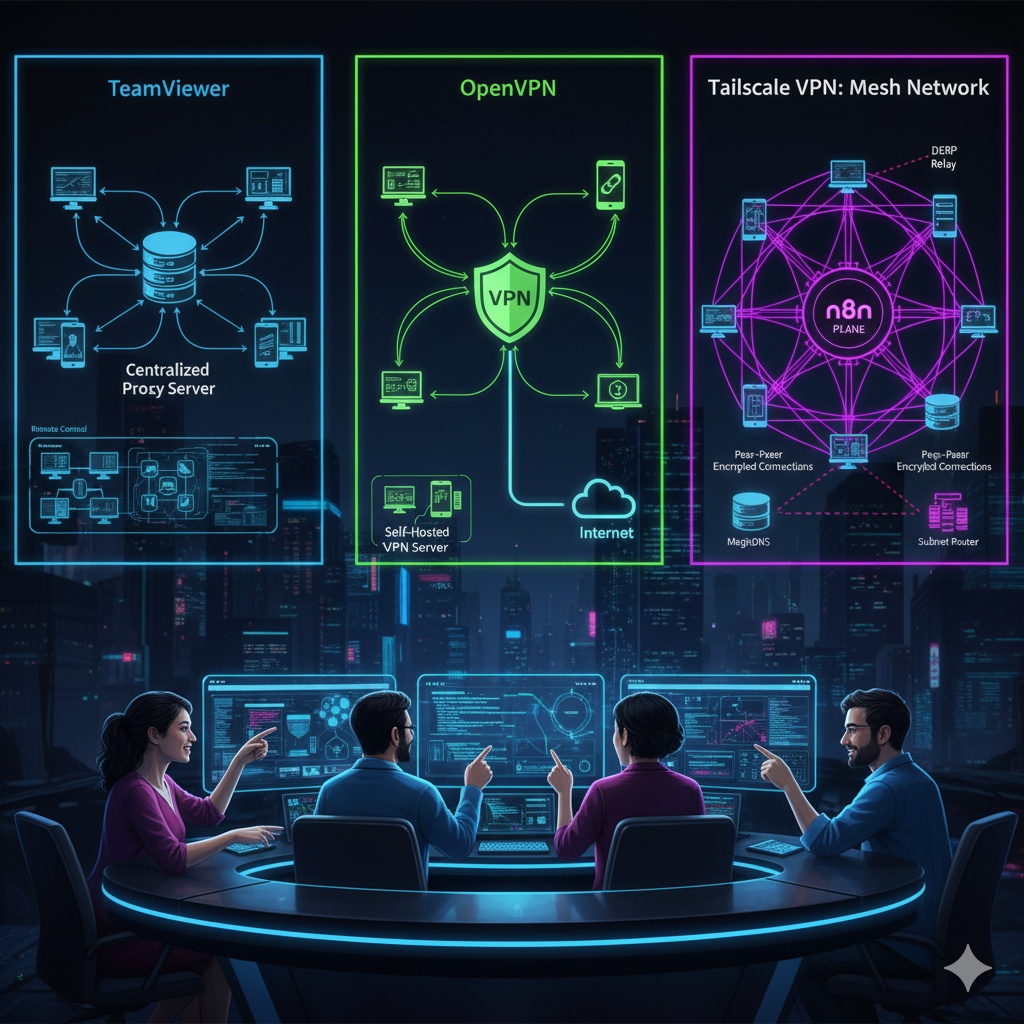
This is conceptually similar to Tailscale’s DERP servers. DERP stands for “Detour Everything Rather than Proxy,” meaning it focuses on simply forwarding data without inspecting its content, just like a game’s relay server.
🎮 Which Games Use This Communication Method?
These P2P and relay methods are primarily used in games where low latency is absolutely critical, or where developers aim to reduce central server operating costs.
However, with the stability and fairness of powerful dedicated servers and advancements in network infrastructure, most large-scale online games (like LoL, Overwatch, PUBG) now adopt the client-server model. P2P methods are used supplementarily for specific game characteristics or applied to auxiliary functions like voice chat.
Conclusion
The network within games goes beyond simply ‘connecting to a server’; complex technologies are hidden to find the most efficient connection path between players. NAT Traversal and relay servers are core technologies for P2P games, and they can be called the unsung heroes working silently behind the scenes to provide us with a lag-free, smooth gaming experience!
Next time you play a game, imagining how your game is connected could be another source of fun! 😊
Tags: Game Network, P2P, NAT Traversal, UDP Hole Punching, Relay Server, Tailscale, DERP, Online Game, Latency, Gaming, Network, Client-Server
Leave a Reply