Hello! This is your information security guardian, protecting your digital safety. 👋 Today, we’re going to thoroughly and easily break down everything from A to Z about a subtle hacking technique that can steal your personal information without you even knowing: Credential Stuffing. 🕵️♂️
🤔 What exactly is Credential Stuffing?
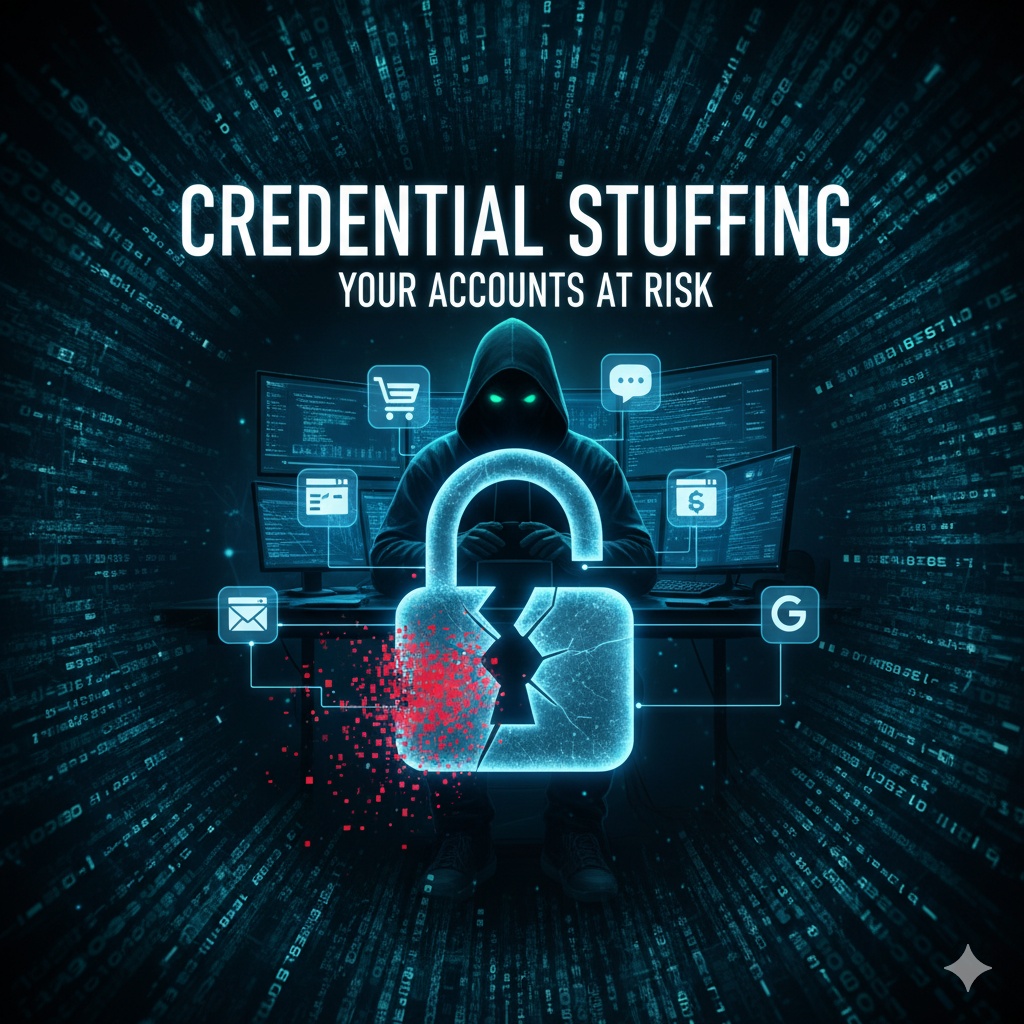
Credential stuffing can be defined in one sentence as ‘an automated attack that attempts to log in to multiple websites using a single ID and password combination.’
Let’s break it down a bit more easily. 🧩
- Information Leakage: Hackers first obtain large-scale lists (databases) of leaked user IDs and passwords through illegal channels such as the dark web. 📂
- Automated Attack: Then, using hacking programs, they automatically and indiscriminately try to log in to various other websites (e.g., shopping malls, portal sites, social media, etc.) by applying numerous ID and password combinations from this list. 🤖
- Account Takeover: What if a user uses the same ID and password across multiple sites? The hacker easily succeeds in logging into that account, stealing personal information or causing financial damage! 😱
The scary thing about this attack is that it doesn’t directly hack the website; it uses already leaked information. This means that no matter how thorough the security of the site you use, you can be defenseless due to your information being leaked elsewhere.
😈 Why do hackers carry out Credential Stuffing attacks?
Hackers’ main goal is ultimately ‘profit.’ There’s an endless array of things they can gain from stolen accounts.
- 💰 Financial Gain: They use registered payment information in the account to purchase goods or cash out points.
- 📄 Personal Information Sale: They extract names, addresses, contact information, and even sensitive personal information to sell to other criminals.
- 🔗 Exploitation for Secondary Crimes: They use stolen accounts to send spam emails to others or carry out phishing scams, serving as a stepping stone for secondary crimes.
- Ransom attack: If a corporate account is stolen, they may access important information and demand money as leverage.
🛡️ How can we prevent Credential Stuffing?
So, is there no way to protect our precious accounts from this terrifying attack? Fortunately, you can prevent it sufficiently by following a few important security rules!
1. 🔑 Use different passwords for each site (Most important! ⭐⭐⭐)
“If all doors could be opened with one key, how happy would a thief be?” The same goes for accounts. Setting a unique and different password for each website is the most effective way to prevent credential stuffing. But it’s hard to remember passwords for countless sites. In such cases, we recommend using a password management tool (e.g., 1Password, LastPass, etc.).
2. 🔢 Create complex and unpredictable passwords
Simple passwords are easy prey for hackers. It is safe to combine uppercase and lowercase English letters, numbers, and special characters to make it 8 characters or more. For example, password123 is less secure than Th!sIsMy$ecurePW2!@.
3. 📲 Actively use 2-Step Verification (MFA)
2-Step Verification (Multi-Factor Authentication) is a method that requires an additional step of phone verification or OTP (One-Time Password) verification after entering your ID and password. Even if a hacker knows your ID and password, they can never log in without passing 2-Step Verification. It’s like a strong shield protecting the front line of security, so be sure to set it up!
4. Be careful about clicking suspicious emails and links
Emails or messages like “Your password has expired. Please click the link below to change it.” should be viewed with suspicion. These could be phishing attacks designed to steal your information. Always make it a habit to access sites through their official homepages.
5. Change passwords regularly
To prepare for the possibility of information leakage, it is safe to change your password regularly. Special attention should be paid to managing financial and portal sites that handle important information.
✨ In closing
Credential stuffing is a subtle attack that preys on our small habits. An easygoing thought like “I’ll be fine” can put valuable personal information at risk. Please remember and practice the prevention tips shared today to enjoy a safer and more enjoyable digital life! 😊
Leave a Reply