LLM (Large Language Model) is a model that reads context and generates sentences, code, and more. Jev is a decision-making model released by TypeSafe AI that reads natural language and returns predefined choices, scores, and probabilities. While writing a reply to a customer and choosing which department to send a customer inquiry to may seem similar, the required outputs are different. TypeSafe AI’s System One Explanation
TypeSafe AI unveiled Jev on September 15, 2026, presenting it as a model that connects rapid judgment to software. This article compares the general usage patterns of generative LLMs with the role of Jev, rather than a performance showdown with a specific LLM. Features and pricing are based on official documentation as of September 28, 2026, and the calculations and business cases below are illustrative examples. No direct performance experiments were conducted. Official Announcement Post
First, let’s examine the differences in output methods, then clarify the criteria for interpreting accuracy and cost, and finally, connect this to how the two models can be deployed together in a real service.

1. Writing a Reply vs. Choosing a Responsible Department
Let’s assume a customer inquiry like the following has been received:
Payment has been completed, but the service has not been activated. Please check if it is in an usable state.
Processing this inquiry requires at least three tasks: determining which team will handle it, checking the actual payment and usage status, and explaining the confirmed information to the customer in an understandable sentence. Judgment, lookup, and explanation are interconnected but not the same task.
If the candidate teams are predefined as billing, technical, account, and other, then the result only needs to be one of them. On the other hand, a reply must include an appropriate tone, confirmed facts, and next steps. It is difficult to enumerate all possible reply sentences in advance. This difference is the starting point for distinguishing between Jev and generative LLMs.
A typical autoregressive LLM predicts the next token based on the input context and the results generated so far. A token is a piece of text processed by the model. By repeating this, it can create anything from short classification results to long explanations and program code. Its high output flexibility makes it easy to handle various tasks with the same interface. Hugging Face’s Text Generation Explanation
Jev is designed to make judgments within the range of answers defined by the application. Developers pass the state (data to be evaluated) and a question, and use the returned value for comparison or as a branching condition in their code. System One in the official documentation is TypeSafe’s model classification referring to such fast, structured judgments. It should not be taken to mean it is exactly the same as human thought processes. System One Concept Document
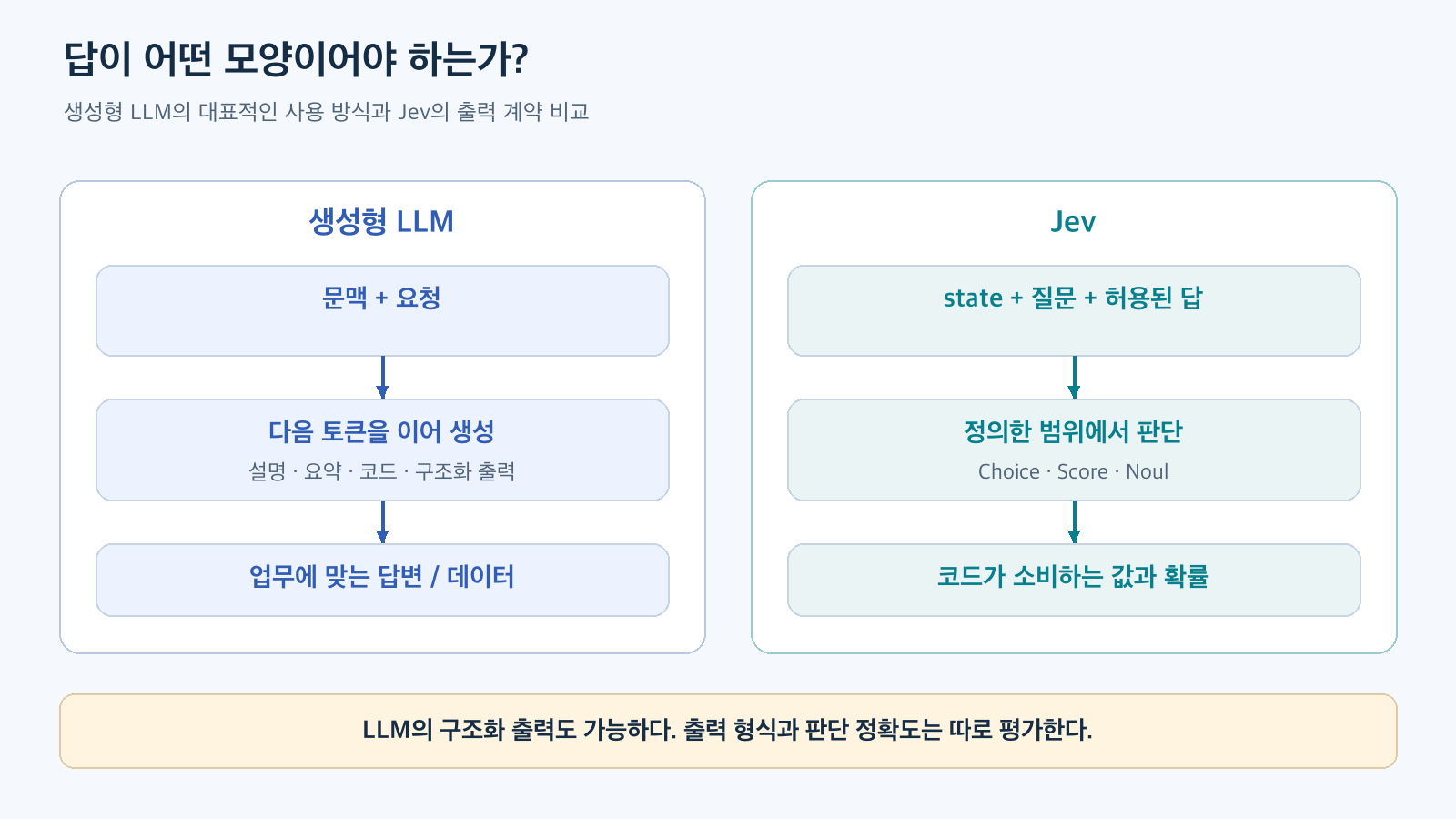
Figure 1. Compares the required output shapes. LLMs also have structured output capabilities, and the figure illustrates the differences in typical usage patterns. Reconstructed based on Hugging Face, TypeSafe AI, and Claude official documentation.
2. LLMs Can Also Generate JSON, So What’s Different?
The comparison goes awry if one assumes LLMs only return free-form sentences. Features already exist to restrict output to JSON Schema, like Claude’s Structured Outputs. This method converts the schema into grammatical constraints, allowing only permitted forms to be generated. Strict tool use, which enforces the format of tool call arguments, is also provided separately. The scope of supported schemas and exception conditions should be checked in the product documentation. Claude Structured Outputs, Strict tool use
Therefore, the comparison question must go beyond “Can it generate JSON?” What matters is how broad the required output range is, how often limited judgments are repeated, and how judgment probabilities will be utilized.
| Comparison Criteria | Generative LLM | Jev |
| — | — | — |
| Typical Output | Explanation, summary, code, structured data | Defined choices, scores by stage, yes/no probabilities |
| Scope of Answers | Broad range including free-form strings | Range defined by developer’s question |
| Format Control | Utilizes JSON Schema / tool schema in supported products | Fixed output contracts: Choice, Score, Noul |
| Primary Tasks to Consider | Reply generation, document summarization, code generation, complex tasks | Classification, routing, relevance assessment, short and clear judgments |
| Explanation of Judgment Reason | Can generate sentences. Accuracy of explanation requires separate verification | Not designed for generating free-form explanations |
| Unit for Price Comparison | Billing conditions such as selected model, input/output, cache | Input token billing per official price list, output tokens free |
For example, if there are hundreds of customer inquiries per day and most require detailed replies, a configuration that handles classification using the structured output of an already-in-use LLM might be simpler. Conversely, if the step of routing a large volume of messages to fixed departments accounts for a significant portion of cost and latency, then there’s a reason to integrate Jev at that stage for comparative evaluation. This is not about determining a universal winner, but about identifying repetitive tasks within a given service.
3. Jev’s Three Questions: Choice, Score, Noul
The quickest way to understand Jev is to imagine the code that consumes its results. Department names are linked to switch or conditional statements, relevance scores to sorting, and probabilities of specific conditions to threshold comparisons. The official documentation divides questions into the following three types: Primitives Document
| Question Type | Content of Question | Meaning of Return Value |
| — | — | — |
| Choice | “Which department should handle this?” | Selected choice, probabilities per option, confidence |
| Score | “How relevant is this document to the question?” | Score between defined stages, legend for stages, distribution and confidence |
| Noul | “Has a refund been explicitly requested?” | Probability of judging “yes” (noul), 0~1 |
The candidates for Choice should also include business-specific exceptions. Just because there are only three departments doesn’t mean every message clearly belongs to one of them. Having an “other” or review path makes it easier to handle requests that haven’t yet entered the classification system.
Below is an example request body to illustrate inquiry classification. It is not actual API call results or code demonstrating verified Korean accuracy. The field configuration follows the official Quickstart. TypeSafe AI Quickstart
{
  "model": "jev-1.13.0",
  "state": {
    "ticket": "결제는 완료됐는데 서비스가 활성화되지 않았습니다."
  },
  "questions": {
    "department": {
      "type": "choice",
      "instructions": "ticket의 문의를 처음 검토할 담당 부서를 고르세요.",
      "criteria": {
        "billing": "결제 승인, 청구 또는 중복 결제 문제",
        "technical": "결제 이후 서비스 기능이나 활성화 문제",
        "account": "계정 접근 또는 계정 정보 문제",
        "other": "위 기준에 해당하지 않거나 판단에 필요한 정보가 부족함"
      }
    }
  }
}
What’s important in this example is the department-specific criteria rather than the model name. If you don’t want classifications that deviate from business meaning, such as “if the word ‘payment’ is present, then billing,” you need to distinguish between payment processing issues and post-payment service issues. Which team to designate as the initial handler should be determined according to the company’s actual business rules.
Multiple questions can be included in a single request. However, each question independently evaluates the same data. If the result of the first question requires changing the second question, then subsequent requests must be configured in the application. Sending questions all at once does not automatically create stepwise inference or a business workflow. Composition and Dependencies of Multiple Questions
4. A Formally Correct Answer and a Judgementally Correct Answer Are Separate
The fact that “technical” is one of the allowed candidates means the output format is correct. Whether the technical support team should actually handle the inquiry must be verified separately with ground truth data or business outcomes. Even if the wrong department is chosen, the resulting string can be perfectly valid.
Dividing output errors clarifies evaluation. First are format errors, where JSON cannot be read or undefined values are returned. Second are semantic errors, where the format is correct but the classification is wrong. Third are system errors, where the classification is correct but an unauthorized operation is executed. Combining these three problems into a single metric, regardless of the output method chosen, makes it difficult to pinpoint the cause.
Jev’s Choice and Score come with both probability distribution and confidence. Here, confidence is a summary statistic of how concentrated the distribution is around a single result. It should not be simply reinterpreted as the probability of the selected item. Noul does not have a separate confidence field; noul itself is the probability of a “yes” judgment. Confidence Document
Let’s also distinguish examples of interpreting probabilities. Noul being close to 0.5 means uncertainty between yes and no, not that customer satisfaction is moderate. To evaluate degrees like satisfaction, a Score with defined meanings for each stage is more natural. Criteria for Question Type Selection
Furthermore, the calibration evaluation “Is the actual correct answer rate for cases predicted as 90% approximately 90%?” is a different question from “Is this single instance definitely correct?” TypeSafe also explains that probability calibration is evaluated against a predicted population and does not guarantee the correctness of individual answers. It is also necessary to measure how often highly confident incorrect answers occur in business operations. Meaning of Probability Calibration
In actual services, a configuration can be considered where inquiries with low confidence are sent to a human agent or another model, and only inquiries meeting a certain threshold are automatically classified. Rather than choosing aesthetically pleasing numbers like 0.8 or 0.9 for boundary values, it is better to determine them based on the acceptable misclassification rate and automatic processing rate from actual data. Branching using Confidence
5. Speed and Cost: How Far Should We Interpret Public Figures?
TypeSafe’s public announcement includes comparative figures stating that Jev is 193.6 times faster and 444.6 times cheaper. These are the results of a workflow evaluation configured by the vendor. The company also noted that these figures might represent the higher end of expected improvements in actual use. The measurement environment, centered in the US West, and an LLM comparison wrapper that outputs probabilities, influence the results. It is difficult to directly apply these as the expected savings rate for all services. Benchmark and Measurement Conditions
The workflow evaluation in the same public article also uses items compared against the average judgment of strong external models, rather than human-confirmed classification ground truths. Therefore, when viewing the graphs, one must separately interpret response time, cost, agreement with reference models, and actual business accuracy. The guarantee of “formally correct output” also cannot be extended to a guarantee that all factual judgments are correct. Official Evaluation Explanation
According to the model documentation as of September 28, 2026, the price for Jev 1.13 is $0.042 per 1 million input tokens, with output tokens being free. Since input includes the actual data sent and the question, calculating fees based solely on customer message length may result in omissions. Jev Model and Pricing Document
Let’s do a simple calculation. If the billable input per call averages 2,000 tokens and there are 1 million calls, the total input tokens would be 2 billion. The model input cost, applying the public unit price directly, is as follows:
2,000토큰 × 1,000,000회 = 2,000,000,000토큰
2,000,000,000 ÷ 1,000,000 × $0.042 = $84
$84 is the model input cost under this assumption. The total processing cost changes when subsequent requests to LLMs, retries, server operations, and human review costs are added. For comparison with LLMs, the unit price of a specific model and actual input/output lengths must be used. Creating a single number like “X times cheaper than LLM” without specifying the model is of weak significance.
For example, if almost all requests still go to an LLM even after adding a classification model, it simply adds another call step. Conversely, if many requests can be resolved with simple data lookups and predefined responses, there is room to reduce subsequent generation costs. Therefore, the unit of comparison should not just be token price, but the total cost of one successfully resolved task.
Speed should also be measured in the same way. Model API response time and the time it takes for a user to receive the final answer are different. To understand actual perceived performance, one must consider the total latency, including network, queues, search, and subsequent LLM generation, as well as the latency of slow requests.
6. Collaborative Structure: Jev for Classification, LLM for Explanation
The differences between the two models become clearer when deployed in a single service. Taking a customer support service as an example, the API server receives requests, organizes only the necessary data, and Jev determines the inquiry type. The application then uses this result to route to either predefined lookup code, an LLM responsible for explanations, or human agent review. TypeSafe’s official Intent routing document also introduces this separation approach. Intent routing
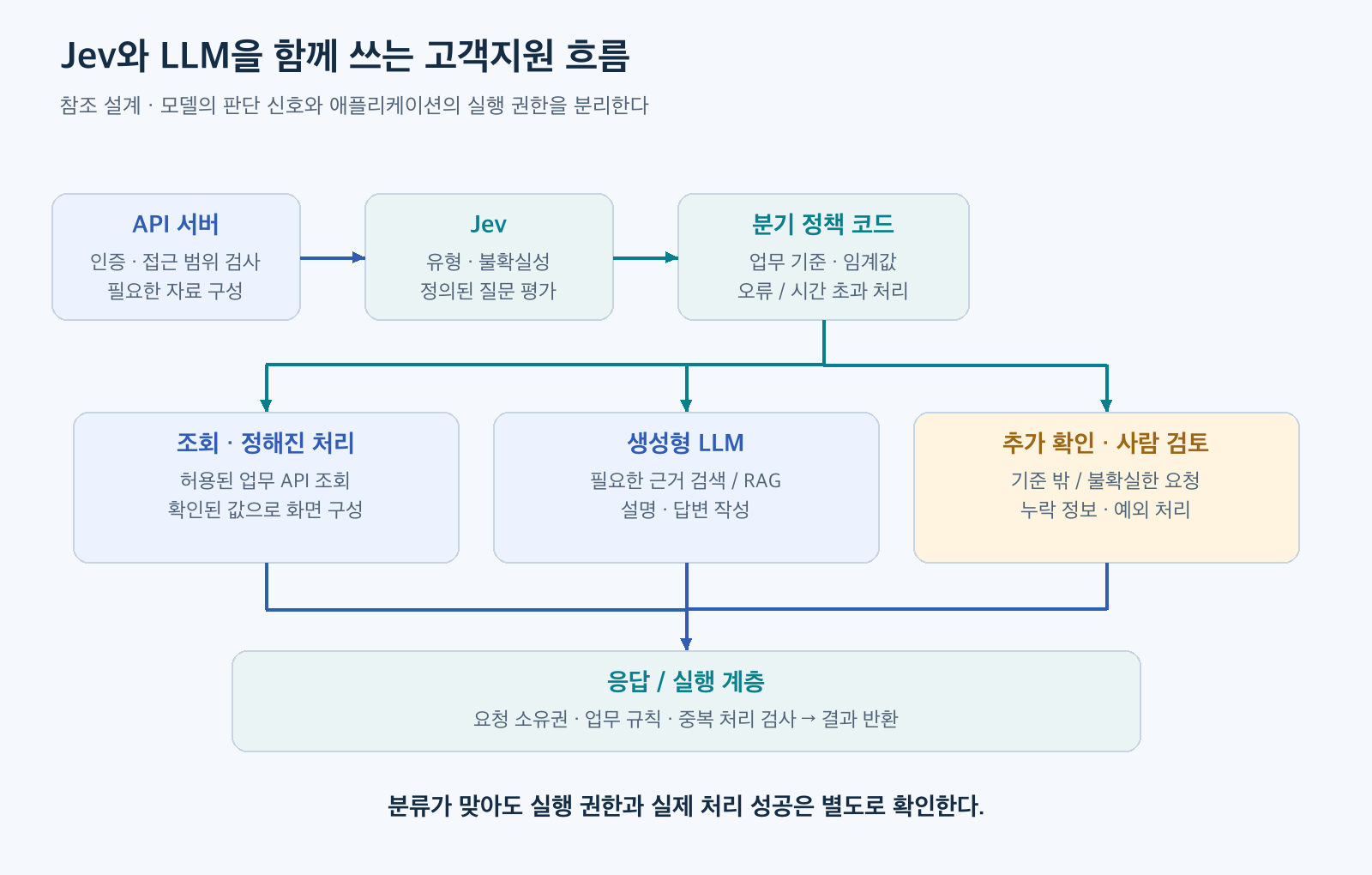
Figure 2. Reference design connecting two models for customer support. Jev returns judgment signals, and the application code determines branching and execution permissions. Reconstructed based on TypeSafe’s Intent routing and Confidence official documentation.
For instance, a request like “Show me the delivery status of my order” might involve looking up the authenticated user’s order and displaying it on a predefined screen. A request like “An error occurred during installation, how do I fix it?” could be sent to an LLM to explain after finding relevant documents. Requests outside classification criteria or uncertain cases are sent for additional information gathering or a review path.
In this case, the model’s selection result does not grant execution authority. Even if classified as a delivery inquiry, it must be verified whether the order belongs to the current user. Even if classified as a refund request, the actual refund eligibility, amount, and duplicate processing status must be checked in the business code and database. A structure that skips these checks merely because the classifier’s confidence is high should be avoided.
A similar division of roles can be applied to RAG (Retrieval-Augmented Generation). When a retriever finds candidate documents, Jev evaluates the relevance or evidentiary suitability of each document, and the code then passes the selected documents to an LLM to generate a response. In this scenario, Jev enters an intermediate evaluation stage without replacing the search index or the entire final answer model. RAG Document Evaluation Example
Classifying whether search results contain suspicious instructions can also be used as an auxiliary signal. However, it should not be assumed that prompt injection is completely blocked by classification results alone. Jev’s official limitations document also states that maliciously crafted inputs can alter judgments. Known Limitations of Jev 1.13
7. Constraints and Evaluation Methods to Check Before Adoption
In the current model documentation, Jev 1.13 supports text input and does not directly accept images, audio, or video. A total request limit of 64k tokens and a combined limit of 32k tokens for state and the longest question are applied. It is stated that English is the primary training language and performance in other languages is not identical. If planning to use it for Korean customer inquiries, actual Korean data must be included in the evaluation. Input, Context, and Language Support
Furthermore, the official limitations document lists numerical calculations, date comparisons, complex indirect inferences, and inputs with excessive irrelevant data as areas to be cautious about. If free-form strings need to be extracted, one could consider a configuration where regular expressions or generative models obtain candidates, and Jev then selects from them. Accurate sums and date operations are clearer when handled by code. Known Failure Types
Adoption evaluation can start small, as follows. The following is a comparison procedure proposed in this article and not an official benchmark result.
- Choose one task. For example, limit the scope to classifying the first responsible department for customer inquiries.
- Establish ground truth criteria. Collect cases judged by a human agent along with ambiguous cases requiring review. Avoid data with only many duplicate sentences.
- Align comparison targets. Provide the same input and candidate/business criteria to the structured output of the currently used LLM, simple rules, and Jev.
- Record failures separately. Distinguish between format errors, misclassifications, the proportion forwarded for review, and actual processing failures.
- Measure total latency and total cost. Look not only at the average but also p95 latency (where 95% of requests complete below this), subsequent call costs, and review costs.
- Fix thresholds and verify with new data. Separate data used for criteria adjustment from final evaluation data, and include Korean expressions, abbreviations, and complex inquiries.
Raising the confidence threshold can reduce the scope of automated processing. What’s important is not just “X percent accuracy,” but how much of the total workload can be automated at an acceptable error level. Reporting only the accuracy of a small number of automatically processed cases while deferring most to humans can easily lead to an overestimation of operational effectiveness.
In operations, model versions should also be recorded. Aliases like `jev-latest` can shift to new versions, so when reproducing evaluation results or maintaining thresholds, consider fixing the version ID. The official documentation states that the actual version that responded can be checked via the `model` field in the response. Model Aliases and Version Management
8. What Should You Choose?
If the required output is open-ended, such as explanations, summaries, or code, a generative LLM is a natural starting point. If you need to repeatedly perform large-scale classification or relevance judgments with predefined candidates, Jev can be included in the comparison. If the correct answer can be precisely obtained through rules and calculations, it is clearer to handle that part with regular code.
Many services incorporate all three. Code is responsible for data access and execution rules, judgment models like Jev provide signals for narrowly defined questions, and LLMs generate necessary explanations and outputs. The decision of which stages to separate should be made after measuring actual errors, latency, and costs.
If you are curious about where these components fit into the overall service, you can also refer to LLM System Architecture: From Frontend to RAG, Agents, and Supply Chain.
When comparing LLM and Jev, the first thing to determine is the shape of the answer the service needs to receive. Then, by comparing the accuracy, latency, and total cost of a single task under the same conditions, it becomes easier to decide where to assign generation and where to assign judgment.
Leave a Reply