GPT‑6.1 Sol is the name of OpenAI’s AI model. If you’re considering switching from the existing GPT‑6 Sol, it’s worth comparing them under the same conditions, starting with repetitive coding and document tasks. However, it’s difficult to conclude that all tasks are more accurate or faster simply because the version number has increased.
This article summarizes the selection criteria based on official documents confirmed on October 4, 2026. It is not a performance experiment or user review based on actual model calls. I will divide the discussion into official descriptions, public pricing, and items to verify directly in the future.

First, let’s distinguish the roles of the models
OpenAI describes GPT‑6.1 Sol as a model that provides Astra-like performance at a lower cost for complex tasks. The guidance is to consider it for repetitive, long coding, app, and document tasks, and to reserve Astra for the most challenging tasks. Luna is an option for repetitive tasks with a clear scope. This is a description of the product’s intended use and does not guarantee the same results for specific projects. Official Model Selection Guide
When choosing a model, what’s important is not the name of the task, but the burden of failure. Refining blog sentences is easy to correct, but if unfounded technical explanations are mixed in, further research is required. Similarly, writing short functions and analyzing failures involving multiple services require different judgments. It’s easier to decide by dividing tasks, including verification costs, rather than unifying everything with one model.
| Task | First comparison options | Parts for human verification |
| — | — | — |
| Small code modifications with tests | Existing 6 Sol and 6.1 Sol | Test results, scope of changes |
| Document drafts combining multiple sources | 6.1 Sol | Omissions, figures, source connections |
| Complex designs with many constraints | 6.1 Sol and Astra | Assumptions, alternatives, failure conditions |
| Extraction/classification with fixed formats | Luna and other smaller options | Omission rate, format compliance |
The table above is the evaluation plan for this article. It is not a results table measuring the superiority of each model.
API pricing and app usage must be calculated separately
API is an interface for programs to call models. A token is a unit for calculating input/output and does not correspond one-to-one with the number of characters. Below are the Standard text prices when the input per request is 272K tokens or less.
WRIMO-MD-TABLE-1]Source: [Official API Pricing, 6 Sol API Documentation, 6.1 Sol API Documentation. Long inputs, cache writes, regional processing, Fast mode, tool usage, etc., have separate conditions, so the final bill cannot be calculated solely from the table above.
The difference lies in the cached input price. Caching is a method of reusing repeated inputs when processing them again, but actual hit rates depend on the request configuration and service conditions. The following is a hypothetical usage amount summing several Standard requests where the input for each request is 272K tokens or less. “General input” refers to regular input, not cache writes, and additional charges such as cache writes, tools, and regional processing are excluded. If a single request’s input exceeds 272K, the input and cache prices for that entire request are doubled, and the output price is 1.5 times.
일반 입력 20만 토큰 + 캐시 적중 입력 80만 토큰 + 출력 10만 토큰
6 Sol:   0.2 × 2 + 0.8 × 0.20 + 0.1 × 10 = $1.56
6.1 Sol: 0.2 × 2 + 0.8 × 0.10 + 0.1 × 10 = $1.48
차이: $0.08
Even if the cache read price is halved, the total cost in this example is reduced by approximately 5.1%. If you calculate the entire input as cache charges, or assume the total cost is halved, the results will differ significantly. The above calculation does not include additional charges such as cache writes and tools.
Credit calculation for ChatGPT Work and Codex is also separate from API dollar prices. The Standard credit prices for general input/output of GPT-6 Sol and GPT-6.1 Sol are one-fifth of Astra’s, but actual token usage per model can vary, so it doesn’t necessarily mean one task costs one-fifth. Included usage in subscriptions also cannot be definitively converted using the same numbers. Official Pricing Guide
Check the comparison target for “faster”
6.1 Sol can be used in Standard or Fast mode depending on the account and client, and Ultrafast support is announced as coming soon. Whether the model selection screen is visible depends on the pricing plan, workspace settings, and deployment status. Model Support Guide
The usage multiplier for Fast is different from the speed multiplier. Also, Astra Ultrafast’s maximum 8x value refers to token generation speed compared to Astra Standard. This cannot be interpreted as 6.1 Sol being 8 times faster than the existing Sol, or that tasks including research and tool execution will finish 8 times faster. Official Speed Guide
In practice, the time to get the first answer and the time to complete verification can differ. If the answer was fast but it took a long time to correct incorrect sources, the perceived productivity decreases. When comparing models, it is useful to measure until a usable result is finally produced.
If switching to API, also check the calling method
When switching to API, check the calling method in addition to the model name. GPT-6.1 Sol does not support reasoning.effort of none or minimal, and uses the Responses API for tool calls. Chat Completions is supported without tool calls. Existing GPT-6 Sol’s ‘none’ setting or Chat Completions function calls will not be compatible if migrated as is. Distinguish between selecting a model in an app and replacing API settings in a program. 6 Sol API Documentation, 6.1 Sol API Documentation
Before switching, create a small comparison table
Prepare three typical tasks with hypothetical data that can be made public. For example, a simple input validation function modification, comparing conditions from two official documents, and drafting a short blog post. You can check basic task suitability without moving customer documents or actual accounts/logs to evaluation prompts.
For each task, provide the same data and requirements, and record the model, inference settings, and speed mode. If you change the requirements during comparison, it becomes difficult to determine which differences came from the model. Repeat by changing the execution order, and look at repeated results rather than a single good answer that occurred by chance.
| Evaluation Item | Value to Record |
| — | — |
| Completion Quality | Number of met essential conditions, number of critical errors |
| Evidence | Existence of sources, consistency between claims and sources |
| Correction Burden | Number of human corrections, review time |
| Time Taken | From start to verification completion |
| Cost | Actual usage and applicable pricing conditions |
For coding, check if tests pass and if there are no unnecessary changes. For documents, check for missing conditions or incorrect figures. For blogs, evaluate not only readable sentences but also whether unverified anecdotes or product performance claims are fabricated.
If both models meet the criteria, you can choose the one with lower cost and less correction burden. If the difference is significant for complex tasks, define the scope to be handled by Astra, and for simple tasks, move to smaller models. This approach also reduces the burden of switching all tasks at once whenever a new model is released.
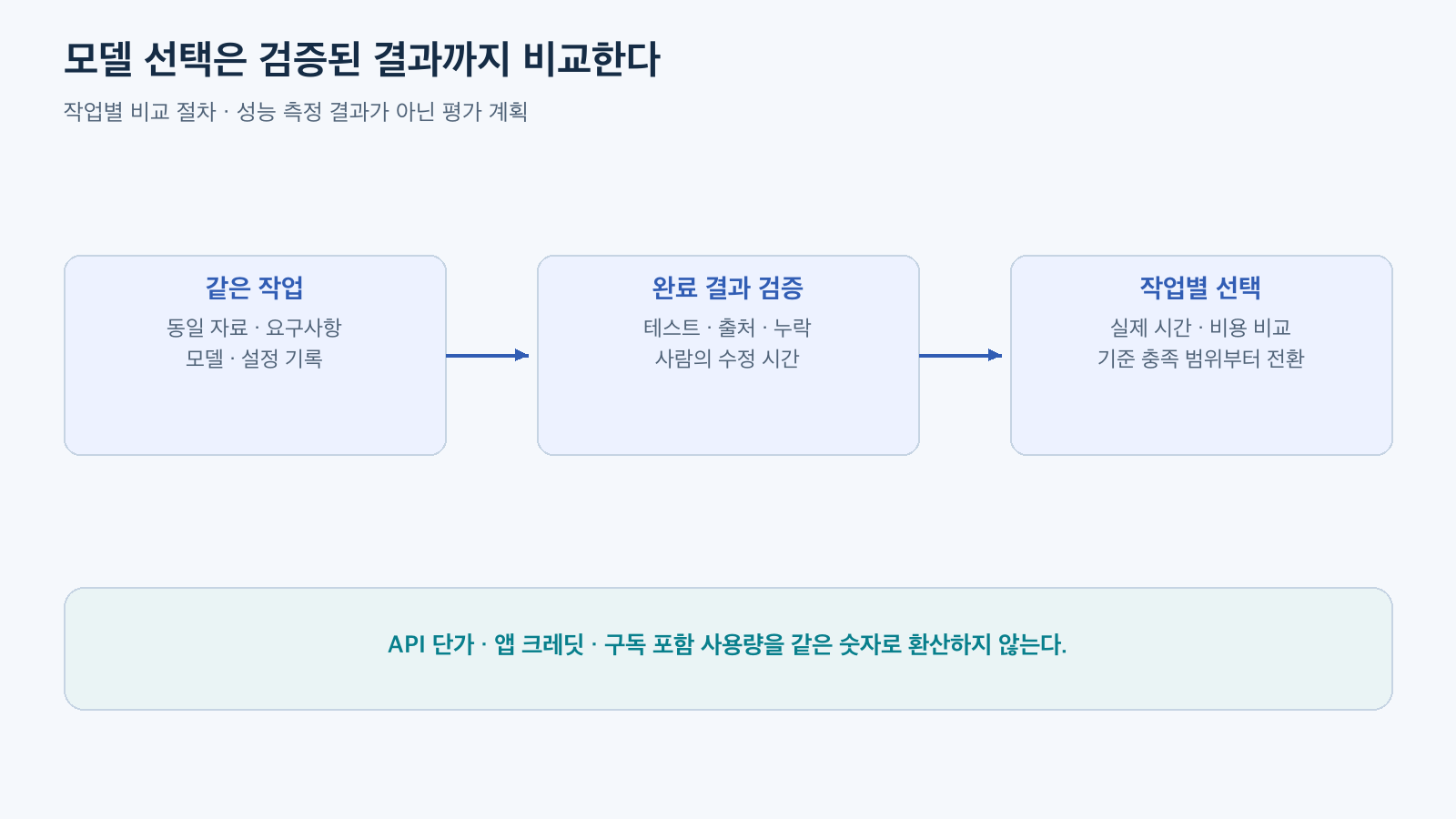
Figure: Comparison procedure by task · Evaluation plan, not performance measurement results · Reconstructed based on official documents
Don’t guess development reasons solely from release intervals
Even if models with similar names are released in a short period, the release interval does not imply the development period. There is no basis to attach reasons like urgent fixes, competitive responses, or internal failures that are not explained in public materials as facts. The information needed for selection is the current support conditions and the results obtained from your own tasks.
6.1 Sol is a good candidate for comparing repetitive coding and document tasks. If the existing 6 Sol already meets your criteria, first evaluate it on a small scale, and then migrate tasks where results and verification costs are improved. What’s more important than the model name is how reliably it meets the same requirements.
Leave a Reply