Hello! Today, we’re going to dive deep into OTLP, the heart of the OpenTelemetry ecosystem and a crucial component of Observability in cloud-native environments. Let’s explore exactly what OTLP is and debunk some common misconceptions, shall we? 😉
🤔 What is OTLP?
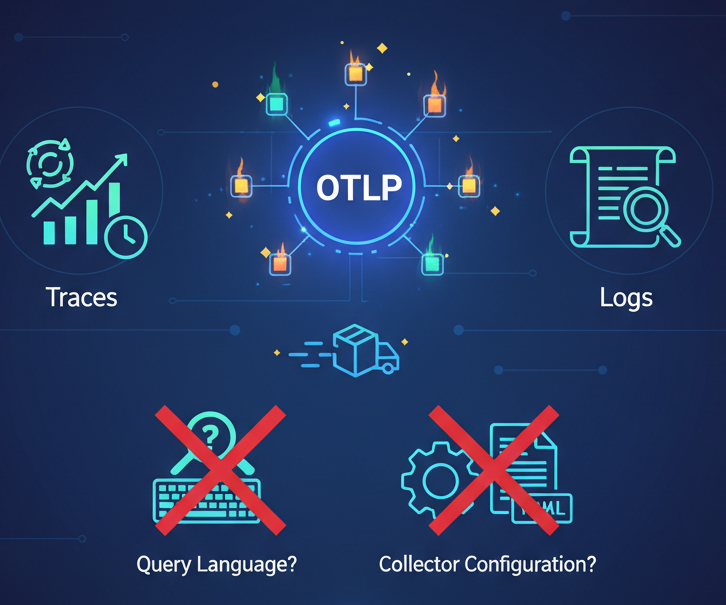
OTLP stands for OpenTelemetry Protocol. As the name suggests, it is a native data format and communication protocol born for OpenTelemetry.
Let’s explain it a bit more simply. To analyze and monitor the vast amount of data generated by our applications—namely, telemetry data such as Traces trace, Metrics 📊, and Logs 📜—we need to send it somewhere, right?
That’s where OTLP comes in! OTLP acts like a ‘delivery system’ 📦, packaging this data in a standardized way and transmitting it safely and efficiently to an OpenTelemetry Collector or other analysis tools (backends).
✅ Key Summary: OTLP is a standard communication protocol specifically designed to transmit all types of telemetry data generated by OpenTelemetry.
🔍 Debunking Common Misconceptions about OTLP!
Because the concept of OTLP is powerful and important, people often get confused by misinformation. Let’s address the three most common misconceptions.
❌ Misconception 1: “Is OTLP a query language for data?”
No! OTLP is a protocol for transporting data, not a language for querying stored data.
- OTLP: Role in sending data 🚚
- Query Language (e.g., PromQL, SQL): Role in querying and analyzing stored data 🧐
It’s like the difference between a postal system that sends letters (OTLP) and a search system that finds books in a library (query language). Their purposes are completely different!
❌ Misconception 2: “Do you configure OpenTelemetry Collector with OTLP?”
This is also incorrect information. The OpenTelemetry Collector is a very flexible tool, and its configuration is typically done via YAML files.
- YAML: A configuration language 📝 that defines how the Collector’s pipeline (receiving, processing, exporting) is structured.
- OTLP: One of several protocols 📥 used by the configured Collector to receive data.
YAML instructs the Collector, “Work like this!”, and OTLP is just one of the methods for receiving data according to those instructions.
❌ Misconception 3: “Is OTLP dependent on a specific company’s technology?”
Quite the opposite! One of OTLP’s biggest advantages is its vendor-neutrality. 🤝
Why is this important? By using a standard protocol that is not tied to a specific vendor, we can easily switch to various analysis tools like Datadog, New Relic, Grafana, etc., whenever needed. This means we can prevent vendor lock-in and maximize system flexibility and interoperability. 🌐
✨ In Summary
Today, we explored OTLP, the core of OpenTelemetry. Let’s summarize once more:
OTLP is…
- A native protocol for OpenTelemetry, transmitting traces, metrics, and logs.
- Not a query language for data.
- Not a configuration language for setting up Collectors.
- A vendor-neutral standard, not dependent on a specific vendor.
A precise understanding of OTLP will greatly help in building more powerful and flexible observability systems. Give your system wings! 🕊️
Leave a Reply