To be static or dynamic, that is the question.
— And LLMs are rewriting the answer.
>

What This Article Covers
- Summarizing the essential differences between SAST and DAST in 5 minutes
- Game-changing shifts LLMs have brought to both camps
- Comparing the strengths and limitations of LLM SAST and LLM DAST
- Pitfalls and cost structures to expect during practical implementation
- Step-by-step guide to integrating into your DevSecOps pipeline
Introduction: Why Security Testing is Hot Again
Today, code is created faster than ever by humans. AI assistants like Copilot, Cursor, and Claude Code churn out tens of thousands of lines daily, and developers merge PRs without time for review. The problem is — code that grows so quickly doesn’t become secure just as fast.
Traditional SAST and DAST struggle to keep up with the pace of this era. Rule-based scanners bombard developers with false positives, leading them to eventually ignore the alerts altogether. The industry calls this “alert fatigue.” It’s the phenomenon where “if the boy cries wolf too many times, no one believes him even when the wolf comes.”
Into this scenario, LLMs have emerged as a new variable. With the advent of AI that understands the meaning of code, the landscape of security testing is being reshaped once again.
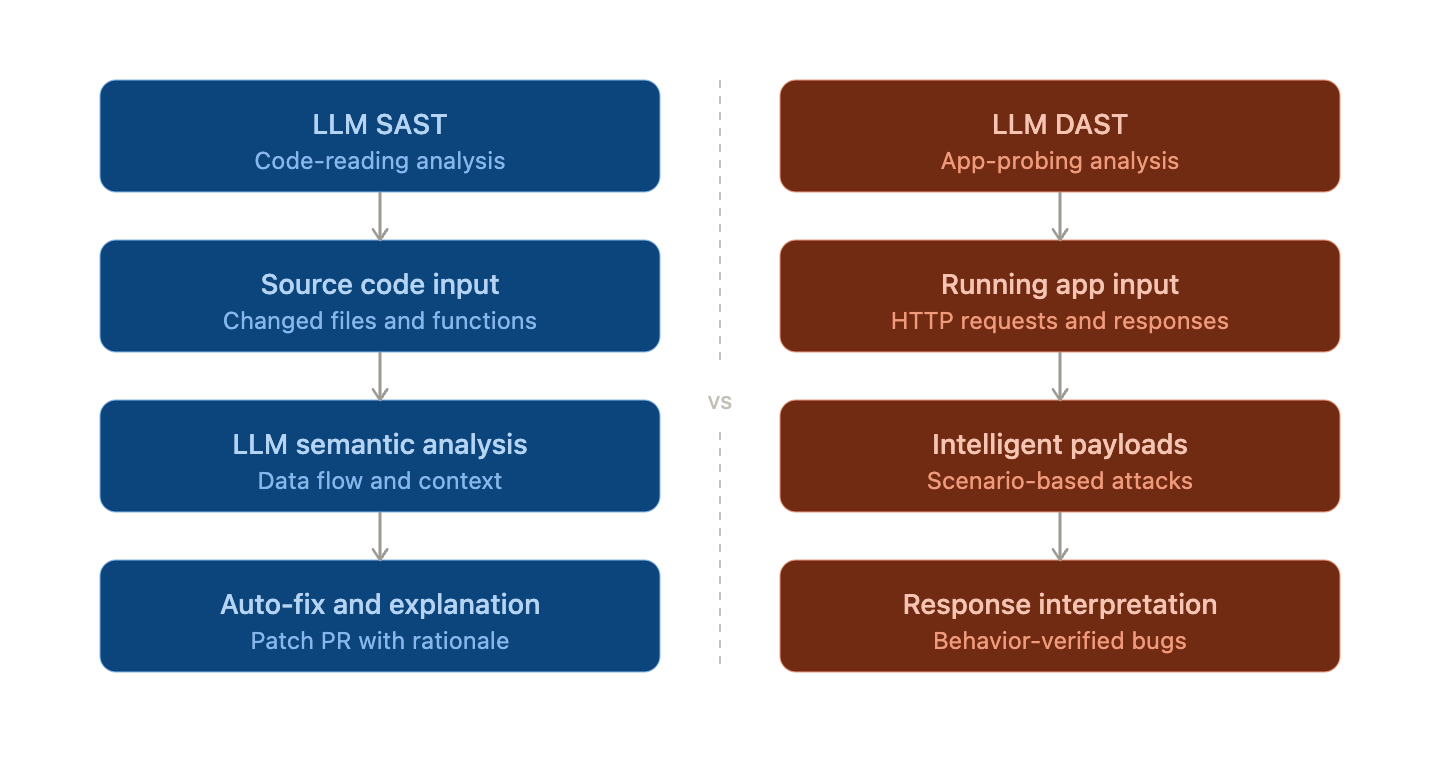
SAST vs DAST: What’s the Difference?
Let’s start with the basics.
SAST (Static Application Security Testing)
- One-liner: “Reads the code laid out”
- Analysis Target: Source code, bytecode, binaries
- Timing: Build phase (without execution)
- Perspective: White-box — knows the internal structure
- What it Catches: SQL Injection patterns, hardcoded passwords, unsafe function calls, data flow vulnerabilities
DAST (Dynamic Application Security Testing)
- One-liner: “Actually knocks on the app”
- Analysis Target: Running application (HTTP requests/responses)
- Timing: Staging or production environment
- Perspective: Black-box — attacks from the outside without knowing the internals
- What it Catches: Authentication/authorization bypass, session management flaws, server configuration errors, XSS that actually triggers
To summarize with a simple analogy:
SAST is like an architectural reviewer who spreads out the building blueprints and points out, “This wall is too thin; there’s a risk of collapse.”
DAST is like a safety inspector who goes to the actual building with a hammer and confirms, “Yes, this part really does collapse.”
Both are necessary. You can’t catch construction flaws just by looking at blueprints, and you can’t catch design flaws just by knocking on the building.
The Change Brought by LLMs: From Pattern Matching to Semantic Understanding
Chronic Problems of Traditional SAST
The core of existing SAST tools is ultimately pattern matching. They parse ASTs (Abstract Syntax Trees) and match them against predefined rules. This leads to clear limitations.
- Lacks context → Fails to recognize “this input value has already been validated by the middleware above”
- Doesn’t understand intent → Insists safe code is dangerous
- Result? An explosion of false positives, loss of developer trust
Chronic Problems of Traditional DAST
DAST mechanically throws predefined payloads. SQL Injection payloads from 1 to 100, XSS payloads from 1 to 50… This means it fails to catch the following:
- Business logic flaws: Logical flaws like “use 10,000 points → refund 15,000 upon return” are simply passed over.
- Multi-step scenarios: Fails to track subtle flaws in multi-step flows like login → order → payment.
- Lack of workflow understanding: Simply throws one-off payloads and stops.
When LLMs Entered the Scene
LLMs view code and HTTP traffic as language, focusing on meaning rather than just patterns. This has led to significant changes in both camps.
Changes in the LLM SAST Camp
- Understands meaning during data flow tracking → Infers in natural language, “This variable is user input and enters SQL without validation.”
- Automatic code suggestion — Automatically generates PRs with “Here’s how to fix it” instead of just warnings.
- Vulnerability explanations in natural language → Junior developers can understand immediately.
- Representative Tools: GitHub Copilot Autofix, Snyk DeepCode AI, Amazon CodeGuru Security, Checkmarx One AI Security Champion
Changes in the LLM DAST Camp
- LLM generates payloads contextually → Adjusts subsequent attacks based on responses.
- Business logic vulnerability detection → Automatically generates multi-step scenarios.
- Semantically interprets responses → LLM recognizes “DB stack trace exposed in error message.”
- Representative Tools: PortSwigger Burp Suite AI, ZAP AI, StackHawk AI
Same Vulnerability, Different Perspectives
Let’s examine how the two camps view the same SQL Injection vulnerability differently.
# Vulnerable code
def get_user(user_id):
    query = f"SELECT * FROM users WHERE id = {user_id}"
    return db.execute(query)
LLM SAST’s Perspective
“user_id is passed as a function parameter and directly inserted into the SQL query via an f-string without validation or escaping. This is an SQL Injection vulnerability and should be changed to a parameterized query (prepared statement). Please modify it as follows:”
# Automatically suggested patch
def get_user(user_id):
    query = "SELECT * FROM users WHERE id = %s"
    return db.execute(query, (user_id,))
LLM DAST’s Perspective
- Request /users?id=1 → Confirm normal response
- Request /users?id=1′ OR ‘1’=’1 → Confirm all user data response
- Discover PostgreSQL error message exposure in response
- Confirm possibility of data extraction with additional payloads → Report vulnerability confirmed
They arrive at the same conclusion via different paths. Therefore, they are complementary. SAST proves “why it’s dangerous,” while DAST proves “if it actually exploits.”
⚠️ Pitfalls of LLM Security Testing
Where there is light, there is shadow. There are definitely aspects to be cautious about in LLM-based security testing.
1. Hallucination Risk
LLMs can generate plausible falsehoods. They might insist that a non-existent function is being called or report safe code as vulnerable. Do not trust without verification.
2. False Negative Trap
Even more dangerous is a false negative. What if an LLM confidently states, “This code is safe,” but it’s actually vulnerable? One false negative can be more critical than ten thousand false positives.
3. Code Leakage Risk
Using SaaS-based LLM SAST means internal source code is transmitted to external LLM APIs. In financial, public, or military environments, this constitutes a compliance violation. On-premise LLM options (such as self-hosted open-source models) must be thoroughly considered.
4. Cost and Response Time
Running LLM SAST on every PR quickly accumulates token costs. Additionally, LLM response times can slow down the CI pipeline. It’s necessary to design at which stage and to what depth to apply it.
5. Prompt Injection — A New Attack Surface
The fact that LLM DAST generates payloads means that the LLM itself could become an attack target. If the application under analysis is integrated with an LLM, scenarios where the security scanner’s LLM is manipulated must also be considered.
️ 5 Steps to Integrate into Your DevSecOps Pipeline
The ideal implementation stages can be designed as follows:
- IDE Stage — Lightweight LLM SAST assistance. Real-time hints during developer coding.
- PR Stage — Precise LLM SAST. Focus on changed files, automatic fix PR generation.
- Build Stage — Traditional SAST + LLM SAST in parallel. Balance of speed and accuracy.
- Staging Stage — LLM DAST execution. Scenario-based, business logic review.
- Production Stage — Lightweight DAST monitoring + RASP (Runtime Application Self-Protection).
The key is “where to put what.” If you put all tools at every stage, both costs and alert fatigue will become unmanageable.
✅ Summary: Not a Competition, but a Duet
LLM SAST and LLM DAST are not substitutes for each other. They are duet partners, viewing the same problem from different angles. True security testing is completed when the perspective of reading code meets the perspective of knocking on code.
LLMs have elevated both camps from “pattern matching” to “semantic understanding.” However, LLMs are not a panacea and are most powerful when combined with human security engineer verification.
Here are some keywords for further learning:
- IAST (Interactive Application Security Testing) — A hybrid of SAST and DAST
- SCA (Software Composition Analysis) — Open-source dependency vulnerabilities
- RASP (Runtime Application Self-Protection) — Self-defense at the operational stage
- AI Red Teaming — Security testing for LLMs themselves
Leave a Reply