The real strength of AI marketing isn’t in quickly creating a single ad copy. It lies in significantly reducing the time it takes to transform ideas into landing pages and ad creatives, measure actual responses, and connect them to the next experiment.
Starting Facebook advertising requires more work than you might think. You need to decide who to inform and what to tell them, create ad copy and images, and prepare a landing page that explains the content in detail. After running the ad, you also need to distinguish whether people clicked the ad, read the page, navigated to the application form, or actually completed the application.
In a large organization, planners, copywriters, designers, performance marketers, and developers can divide these roles. However, in small businesses or personal projects, one person often handles almost all of these tasks. In such cases, AI can become a practical tool that bridges the gaps between various roles, going beyond a simple writing tool.
In the KLC Lab project I operate, we are also utilizing AI to create landing pages for educational programs, organize messages and creatives for Facebook pages and ads, and build a structure that can measure everything from initial traffic to application completion.
There’s an important premise here: this isn’t a success story about significantly increased sales thanks to AI, but rather an example of building a foundation to quickly run ads and learn effectively. The value of AI should be confirmed not by vague expectations, but by the process of transforming hypotheses into actual screens and data.
What is AI-Powered Facebook Marketing?
Understanding AI-powered Facebook marketing merely as “asking AI to write ad copy” is too narrow. In reality, it’s closer to a connected structure of the following three layers:
| Category | AI’s Role | Human Responsibility |
| — | — | — |
| Content Creation | Generate ad copy, headlines, image drafts, video outlines, landing page content | Fact-checking, brand direction, final quality |
| Ad Delivery | Audience exploration, placement, bidding, optimizing budget and creative combinations | Goals, region, budget limits, exclusion criteria |
| Measurement & Improvement | Data summarization, drop-off analysis, proposing next experiments | Correct conversion definition, business judgment, privacy protection |
The first layer is the area where humans use generative AI like ChatGPT and image generation models. The second layer is where Meta’s ad system’s internal machine learning optimizes who sees the ads and where. The third layer is where Pixel, GA4, and application data are connected to determine what actually led to performance.
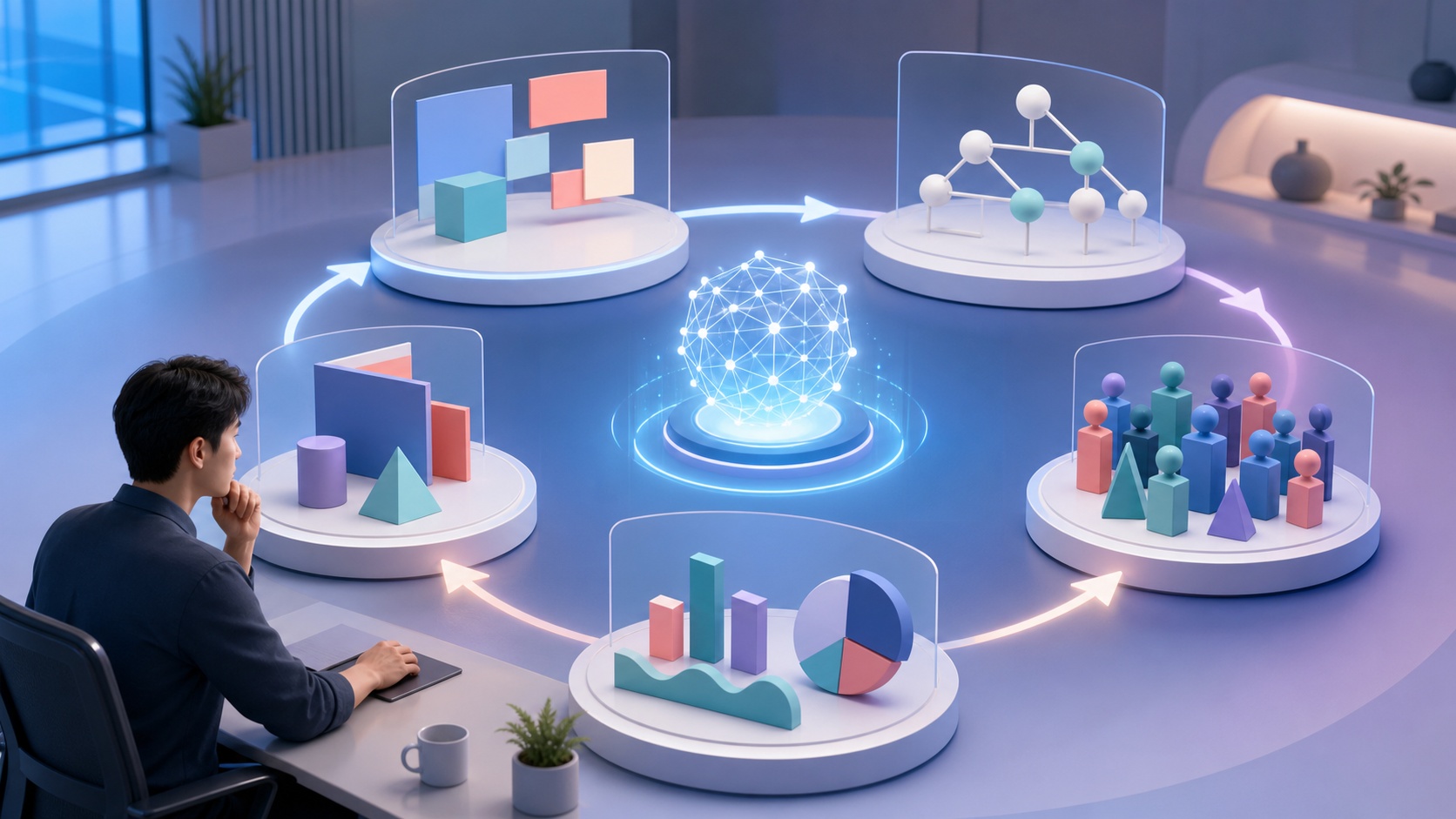
In other words, AI-powered marketing is not a vending machine where a single AI does everything. It’s a method of connecting different tools to shorten the learning cycle as follows:
고객과 제안에 대한 가설
→ 광고 문구와 소재 생성
→ 랜딩 페이지 제작
→ 광고 집행
→ 방문·관심·신청 데이터 측정
→ 결과 해석
→ 다음 문구·소재·페이지 개선
The faster and more accurate this cycle, the more hypotheses even small teams can test.
How KLC Lab Project Utilized It
KLC Lab is a small-scale educational project designed to allow easy experience with new technologies like Roblox, generative AI, and NotebookLM. When advertising such products, a short phrase like “AI class” is not enough. The target audience, what is done in class, schedule, location, deliverables, and application methods must be explained in a coherent flow.
In this project, AI was utilized in four main areas:
1. Transforming Product Content into Landing Page Structure
Just because class information is organized in a document doesn’t mean it immediately becomes a good ad page. Visitors look for answers to the following questions within a few seconds, rather than reading long explanations from start to finish:
- Who is the class for?
- What will they do hands-on?
- How is it different from other classes?
- When and where does it take place?
- What are the costs and application methods?
Using AI, you can quickly reorganize scattered information to match the visitor’s question order, and rapidly create a draft from the core message on the first screen to detailed curricula, FAQs, and application buttons.
The KLC Lab landing page was also revised multiple times in this manner. The important point is that AI didn’t just stop at creating pretty sentences; it ensured that the content promised in the ad matched the content confirmed on the landing page. If an ad says “experience-focused” but the landing page only explains lecture theories, clicks might occur, but conversions to applications will be difficult.
2. Expanding a Single Proposition into Multiple Ad Creatives
Even for the same class, what parents are curious about and what scenes students find interesting differ. Static image ads require a core message that can be understood at a glance, while short videos need scenes that grab attention within the first few seconds.
AI is strong at expanding a single educational program into various expressions like the following:
- For parents: explain focusing on the class’s purpose, safety, schedule, and outcomes.
- For students: explain focusing on games they create themselves or AI results.
- For image ads: use a short, clear sentence.
- For short videos: apply a sequence of problem statement, demonstration, results, and call to action.
- For landing pages: provide evidence and detailed information omitted in the ad.
Not all copy and creatives created this way are correct answers. The advantage of AI is not in guaranteeing correct answers, but in quickly generating comparable candidates and lowering experiment costs.
3. Tracking Between Facebook Ads and Landing Pages
The easiest trap to fall into when running ads is judging performance solely by click counts. There’s a big difference between someone clicking an ad and actually applying for a class.
In the KLC Lab project, we configured each ad creative to use different UTM values. Even if static image ads and short video ads link to the same page, we can distinguish which creative the visitor came from.
utm_source=facebook
utm_medium=paid_social
utm_campaign=캠페인명
utm_content=소재구분
This information also carries over when moving from the landing page to the application form. Therefore, we can examine not only the clicks visible in the ad manager but also GA4 and application completion events together.
4. Measuring Clicks and Actual Applications Separately
In this project, different actions are recorded in Meta Pixel and GA4.
| Stage | Key Event | Meaning |
| — | — | — |
| Visit | PageView | Arrived at the page via an ad or link |
| Content Check | ViewContent | Viewed specific class details |
| Course Selection | CourseSelect | Selected an interesting course |
| Move to Application | ApplyClick | Clicked the application button to move to the form |
| Application Complete | application_submit | Actually submitted the application form |
It’s important not to count ApplyClick as application completion here. This is because even after clicking the application button, users might leave if they have many questions or if the content is unclear.
Actual application completion is confirmed by a separate application_submit event when the Google application form is submitted. In this process, personal information like names and phone numbers are not sent to analysis tools; only values necessary for analysis, such as entry channel and campaign, are transmitted.
Such a measurement structure is necessary to distinguish “whether the ad is the problem, the landing page is the problem, or the application form is the problem.”
How Meta’s AI and Generative AI Work Together
Even if an advertiser prepares creatives with generative AI, the use of AI doesn’t end there. After the ad is registered, Meta’s machine learning takes over the delivery process.
Meta offers audience, placement, budget, and creative optimization features under the name Advantage+. Advertisers set mandatory conditions like region or minimum age, and the system can explore people and placements with high response potential within that scope.
Using Advantage+ Placements allows comparing performance potential across various locations like Instagram, Reels, Stories, and Messenger, instead of just specifying one Facebook Feed. Advantage+ Creative also provides production assistance features such as image resizing, text variations, background generation, and animation for static images.
This can be simply divided as follows:
광고주가 쓰는 생성형 AI
무엇을 말할지, 어떤 페이지와 소재를 만들지 돕는다.

Meta가 쓰는 광고 머신러닝
준비된 광고를 누구에게, 어디에서, 어떤 조합으로 보여줄지 최적화한다.
For both AIs to work well, the input information must be accurate. If there’s only attractive copy but conversion events are incorrectly defined, the ad system might diligently optimize for the wrong goals.
Why It’s Especially Strong for Small Teams
Time from Creation to Execution is Shortened
In the past, even with ad ideas, it often took too much time for design, copywriting, and page revisions, preventing execution. With AI, ideas can be transformed into multiple copy options and screen drafts on the same day.
The meaning of speed isn’t just about finishing work quickly. It means being able to quickly verify incorrect hypotheses and move on to the next attempt.
Reduces Gaps Between Specialized Roles
One person cannot be an expert in all fields. However, by asking AI for copy candidates per target audience, landing page structures, tracking event designs, and checklists, you can get initial drafts that connect each area.
While it doesn’t completely replace experts, it allows you to more quickly distinguish between problems that need to be entrusted to an expert and those you can handle yourself.
Easier to Maintain Message Consistency
If the expressions in Facebook posts, ad images, short videos, landing pages, and application forms are all different, users will feel confused. By providing AI with a single reference document and having it create copy for each channel, it becomes easier to consistently manage key schedules, prices, targets, and benefits.
Of course, AI might also disseminate outdated information or incorrect figures as is. Therefore, frequently changing information like schedules and prices should be managed from a single source, and a human should re-verify before publishing.
Creates More Comparison Options at Lower Cost
Instead of putting all expectations on a single ad creative, you can compare slightly different first sentences, images, video intros, and calls to action. AI is particularly efficient at such variation tasks.
However, if too many elements are changed at once, it becomes impossible to know what influenced the results. It’s more advantageous for learning to compare two distinct creatives, like an image and a video, first, and then change the title or first screen in the next experiment.
Enables Data-Driven Conversations, Not Just Impressions
While opinions like “this image looks prettier” are necessary, they alone cannot explain ad performance. With UTMs per ad and behavioral events, you can answer the following questions with data:
- Which creative led to actual landing page visits?
- Which visitors checked the detailed class content?
- Were application buttons clicked many times, but users dropped off before submission?
- Did a specific copy generate clicks but not actual applications?
AI can help summarize this data and create proposals for the next experiment. The final judgment must be made by someone who understands the business’s cost structure and customer context.
What AI Clearly Doesn’t Do Well
It Doesn’t Understand Real Customers on Your Behalf
AI can quickly create general customer personas, but what parents in a specific region are actually concerned about must be learned through consultations and on-site feedback. Generated personas should be used as hypotheses for interpreting interviews and ad responses, rather than being believed as facts.
Humans Bear Responsibility for Facts and Promises
Class schedules, target ages, refund conditions, and deliverables are information that AI should not plausibly supplement. An exaggerated sentence in an ad might increase short-term clicks, but it will lead to a loss of trust in the long run.
Passing Ad Policy Review Doesn’t Mean It’s a Good Ad
Meta’s ad review checks images, videos, copy, targeting, and even linked landing pages. However, passing the review does not mean the information is accurate and suitable for customers. Policy compliance, fact-checking, and brand quality require separate review.
You Must Control Personal Information and Tracking Scope Yourself
More measurement events are not necessarily better. Collect only the minimum actions necessary for decision-making, and avoid sending personal information like names and phone numbers as event attributes to advertising or analytics tools.
Automation Quickly Optimizes Even for Wrong Goals
If you set clicks as the goal for an ad system, it will find people likely to click. However, what the business truly wants might be application completion or actual purchases. If you don’t distinguish between proxy metrics and final outcomes, the numbers might look good, but business results might not improve.
If You’re Starting Out, This Structure Is Sufficient
There’s no need to build a massive marketing automation system from scratch. For a small project, you can start with the following steps:
- Define one desired final action for a campaign.
- Create a dedicated landing page that explains the same content as promised in the ad.
- Use AI to create copy and creative candidates, but a human must verify facts, prices, and schedules.
- Assign different UTM values to each ad creative.
- Measure visits, content views, application form navigation, and actual submissions as distinct events.
- Do not include personal information in events.
- Compare only two or three clear hypotheses at a time.
- Set budget limits and stop criteria before starting.
- Have AI summarize the data, but a human makes the final judgment.
The most important thing here is not the number of tools. The flow from ad to application completion must be uninterrupted, and you must be able to explain what each number means.
Conclusion: AI’s Strength Is Learning Speed, Not Ad Creation
Using AI allows you to create Facebook ad copy and images much faster. However, that alone is unlikely to be a competitive advantage for a small team, as anyone can use similar tools.
The greater difference arises from the entire process: using generative AI to create landing pages and creatives, optimizing delivery with Meta’s ad AI, measuring actual behavior with Pixel and GA4, and then reflecting those results in the next improvements.
This is precisely where AI provided the most significant help in the KLC Lab project. One person, juggling multiple practical roles, was able to transform ideas into actual ads and pages, distinguish between clicks and application completions, and leave a basis for future decisions.
The essence of AI-powered Facebook marketing is not automation that removes humans. It’s about reducing repetitive tasks so that humans can focus more on customers and propositions, and transforming intuition-based decisions into measurable experiments.
A good AI marketing system is not one that creates ads by itself, but one that enables small teams to learn faster.
Leave a Reply