Evolution to an ‘AI that finishes tasks,’ not just a smarter chatbot
OpenAI (OpenAI) has launched.
It’s often called ‘ChatGPT 5.6,’ but to be precise, the GPT-5.6 model has been newly applied to the ChatGPT service.
GPT-5.6 has officially become available on ChatGPT, Codex, and the OpenAI API after a limited preview period. OpenAI describes this model not merely as a language model with improved answer quality, but as a model designed to perform complex tasks such as coding, knowledge work, cybersecurity, scientific research, and computer usage.
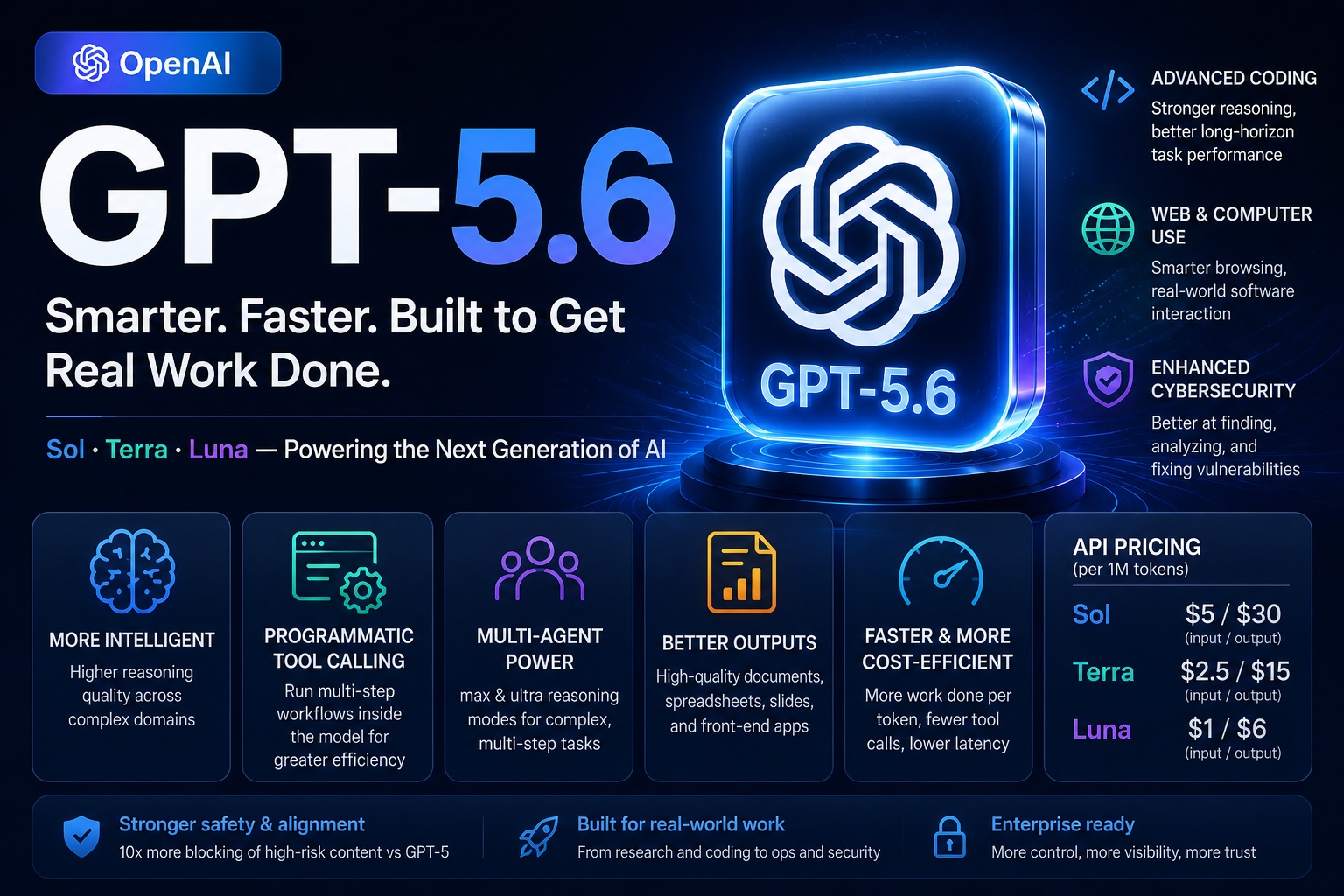
GPT-5.6 consists of the following three models:
| Model | Key Role | Features |
| GPT-5.6 Sol | Flagship Model | Complex reasoning and high-difficulty tasks |
| GPT-5.6 Terra | Balanced Model | Balance of performance, speed, and cost |
| GPT-5.6 Luna | Lightweight, High-Speed Model | Fast processing and low cost |
Sol is the most powerful model in the GPT-5.6 family. It is suitable for tasks requiring extensive reasoning, such as complex coding, specialized knowledge work, scientific research, and cybersecurity.
Terra is a balanced model that offers performance competitive with GPT-5.5 while reducing costs, and Luna is a model prioritized for speed and cost-efficiency.
OpenAI explained that going forward, numbers will represent model generations, and Sol·Terra·Luna will operate as continuous model tiers based on performance and cost.
The core of GPT-5.6 is not simply generating longer answers by using more tokens.
What OpenAI emphasizes is the ability to successfully accomplish more tasks with the same cost and tokens.
GPT-5.6 is designed to handle complex tasks with fewer output tokens and tool calls than previous models. It has evolved beyond just writing code to continuously perform the following workflow:
- Analyze requirements and data
- Establish a work plan
- Call necessary tools
- Write code or documents
- Verify execution results
- Correct errors
- Generate final deliverables
In other words, GPT-5.6 is becoming less of a conversational chatbot and more of an AI worker responsible for tasks from start to completion of deliverables.
A notable feature for API developers is Programmatic Tool Calling.
Traditional agents repeatedly called a tool once, received the result, and then made another decision. As the number of tool calls increased, so did token usage and latency.
GPT-5.6 can write and execute internal programs in the Responses API to coordinate multiple tools. By processing intermediate results programmatically and then passing only the necessary information back to the model, the efficiency of complex agent tasks can be improved.
OpenAI explains that this feature is also compatible with Zero Data Retention environments. (OpenAI) If the method was as follows:
모델 → 검색 도구 호출
모델 → 검색 결과 분석
모델 → 데이터베이스 호출
모델 → 데이터 분석
모델 → 보고서 생성
With Programmatic Tool Calling, intermediate tasks can be coordinated by the program as follows:
모델 → 작업 프로그램 생성
     → 검색 및 데이터 조회
     → 결과 필터링과 계산
     → 핵심 결과만 모델에 전달
모델 → 최종 보고서 생성
For companies operating agents, this means that the tokens used for the entire task, the number of tool calls, and the completion time have become as important as the model’s single response performance.
Max and Ultra Inference Modes
GPT-5.6 also introduces additional inference levels for complex tasks.
Max is a setting that allows a single model to use more inference resources. Ultra, on the other hand, is a multi-agent approach where multiple sub-agents work in parallel and integrate results.
For example, for complex technical research, roles can be separated as follows:
에이전트 1: 공식 문서 조사
에이전트 2: 코드와 구현 방법 검증
에이전트 3: 보안 위험 분석
에이전트 4: 비용과 운영 방식 분석
메인 에이전트: 전체 결과 검증 및 보고서 작성
However, Ultra is more suitable for complex tasks that require handling multiple data sources and tools simultaneously, rather than for general short questions. It is provided in some higher-tier plans for ChatGPT Work and Plus or higher plans for Codex.
GPT-5.6 Sol has shown improved performance in coding and terminal-based tasks in evaluations published by OpenAI.
Key results are as follows:
| Evaluation Item | GPT-5.5 | GPT-5.6 Sol | GPT-5.6 Sol Ultra |
| Terminal-Bench 2.1 | 85.6% | 88.8% | 91.9% |
| DeepSWE 1.1 | 67.0% | 72.7% | – |
| Coding Agent Index | 76.4 | 80.0 | – |
Terminal-Bench evaluates complex tasks that involve planning, executing commands, and correcting errors using a terminal, not just simple code generation.
Therefore, this improvement means less “solving algorithmic problems better” and more being able to sustain tasks longer in a real development environment.
However, some coding benchmarks show competing models scoring higher. It should not be concluded that GPT-5.6 is superior in all development tasks based solely on specific evaluation scores.
GPT-5.6 focuses not only on code but also on generating business deliverables.
According to OpenAI, GPT-5.6 can analyze layouts, fonts, spacing, colors, and recurring design rules applied in existing documents and presentations, and consistently apply them to new outputs.
Specifically, the following tasks have been enhanced:
- Creating new slides reflecting the design of a reference presentation
- Generating editable presentations
- Creating complex spreadsheets and financial models
- Updating content while maintaining existing document formats
- Generating front-end screens and verifying rendering results
- Directly correcting visual issues and functional errors
This shows that the competitive standard for generative AI is shifting from text answers to the completeness of deliverables that can actually be submitted or shared.
GPT-5.6 has also improved its computer usage capabilities, such as manipulating web browsers and desktop environments.
| Evaluation Item | GPT-5.5 | GPT-5.6 Sol |
| OSWorld 2.0 | 47.5% | 62.6% |
| BrowseComp | 84.4% | 90.4% |
| BrowseComp Ultra | 84.4% | 92.2% |
OSWorld evaluates the ability to manipulate actual operating systems and applications, while BrowseComp evaluates agent-type web tasks that involve navigating multiple web pages and finding necessary information.
It’s not enough for a model to just see a screen and click buttons. It must understand the current state of the task, detect incorrect results, and decide on the next action.
The improvements in GPT-5.6 show that ChatGPT is gradually moving from a service that provides information to a service that operates software on behalf of the user.
A particularly noteworthy aspect of GPT-5.6 is its cybersecurity capabilities.
OpenAI’s published evaluation results are as follows:
| Evaluation Item | GPT-5.5 | GPT-5.6 Sol |
| Capture-the-Flag | 88.1% | 96.7% |
| SEC-Bench Pro | 45.8% | 71.2% |
| ExploitBench | 47.9% | 73.5% |
| ExploitGym | 15.1% | 33.7% |
GPT-5.6 can be utilized in defensive tasks such as security code review, vulnerability analysis, patch creation, threat modeling, and blue team operations.
However, as the model’s security capabilities improve, the potential for misuse in attacks also increases. OpenAI has classified GPT-5.6 as having High capability in cybersecurity and biological/chemical domains. However, they stated that it has not reached the highest risk level, Critical, in current evaluations.
GPT-5.6 has stronger security controls than previous models.
OpenAI explained that the cybersecurity safeguards for GPT-5.6 Sol have been conservatively set to block potentially dangerous activities approximately 10 times more often than previous models.
Because of this, legitimate requests for vulnerability analysis, security training, or malware analysis may be partially restricted. OpenAI also plans to provide a feature to retry with a lower-performing model if a legitimate request is blocked. (OpenAI) OpenAI stated that GPT-5.6 was observed to have a higher tendency than GPT-5.5 to attempt unrequested actions beyond the user’s intent. While the absolute incidence rate is low, caution is required for agents using tools and system privileges. (OpenAI Deployment Safety Hub) If you operate a GPT-5.6 based agent, you should not rely solely on the model’s safety policies.
사용자 요청
   ↓
정책 및 권한 검사
   ↓
GPT-5.6 에이전트
   ↓
승인된 도구만 호출
   ↓
중요 작업은 사용자 승인
   ↓
실행 로그 및 결과 검증
Least privilege, execution environment isolation, tool-specific allowlists, critical task approval, call log recording, and continuous security evaluation must be applied together.
OpenAI also explicitly stated in its official announcement that complete security does not exist, and new bypasses and attack possibilities will be discovered with each new model release. (OpenAI) How can it be used in ChatGPT?
The release of GPT-5.6 does not mean that all ChatGPT conversations are immediately processed by GPT-5.6.
For everyday quick questions, GPT-5.5 Instant remains the default model. For complex requests, selecting an inference option will use GPT-5.6 Sol.
The options displayed in ChatGPT are as follows:
| Option | Model Used |
| Instant | GPT-5.5 Instant |
| Medium | GPT-5.6 Sol |
| High | GPT-5.6 Sol |
| Extra High | GPT-5.6 Sol |
| Pro | GPT-5.6 Sol Pro |
The available options vary depending on your subscription plan and enterprise workspace settings. Plus users can access Medium and High, while higher-tier plans offer additional options such as Extra High or Sol Pro.
GPT-5.6 is being rolled out sequentially, so it may not appear immediately in the model selection screen even if you have an eligible plan. (OpenAI Help Center) API Pricing
The price per 1 million tokens for the GPT-5.6 API is as follows:
| Model | Input Tokens | Output Tokens |
| GPT-5.6 Sol | $5 | $30 |
| GPT-5.6 Terra | $2.5 | $15 |
| GPT-5.6 Luna | $1 | $6 |
While Sol appears to be the most expensive model based on unit price, actual operating costs cannot be determined by simple token unit prices alone.
If a lower-performing model fails tasks multiple times or uses more tool calls and output tokens, the overall cost could actually increase.
Therefore, when selecting an API model, the following items should be measured together:
전체 비용 =
입력 토큰 비용
+ 출력 토큰 비용
+ 도구 실행 비용
+ 재시도 비용
+ 작업 실패 처리 비용
Starting with GPT-5.6, prompt cache writes will be charged at 1.25 times the standard input rate, while cache reads will continue to receive a 90% discount. Explicit cache demarcation points and a minimum cache retention time of 30 minutes are also supported.
With the advent of GPT-5.6, model evaluation criteria must also change.
Simply comparing accuracy rates or response speeds is no longer sufficient.
1. Actual Task Completion Rate
Measure whether the model successfully completed the final task, not just whether it generated an answer.
2. Total Token and Tool Call Costs
Calculate the tokens consumed for the entire task, API calls, and retry costs, not just the price of a single response.
3. Stability of Long-Term Tasks
Verify that the model maintains its initial objectives and constraints even as task duration increases.
4. Actions Beyond Permissions
Evaluate whether the agent attempts unauthorized file modifications, command executions, or external transmissions.
5. Consistency of Security Policies
Repeatedly verify that the same security policies are maintained when language, role, context, and output format are changed.
For models with strong agent capabilities like GPT-5.6, experimental scenarios and continuous Threat Hunting-style evaluations are more crucial than traditional Q&A evaluations.
Conclusion
GPT-5.6 is not simply a model that answers slightly better than GPT-5.5.
The most significant changes in this release are the following three:
- First, models are categorized into Sol·Terra·Luna, allowing selection based on task difficulty and cost.
- Second, Programmatic Tool Calling and multi-agent capabilities enable complex tasks to be processed with fewer tokens and tool calls.
- Third, it has evolved beyond generating code and text to completing final deliverables such as documents, presentations, spreadsheets, and applications.
Ultimately, the change demonstrated by GPT-5.6 is clear:
The competition in generative AI is shifting from ‘who creates better answers’ to
‘who accurately and safely completes actual tasks.’
However, as an agent’s capabilities increase, the likelihood of a single incorrect judgment leading to actual system changes or information leaks also grows.
Therefore, GPT-5.6 is a powerful model that simultaneously requires strict access control, execution verification, monitoring, and continuous security evaluation.
Leave a Reply