Traefik is more than just a traffic forwarding tool; it’s a powerful weapon that maximizes the flexibility of cloud-native environments. We’ll systematically cover everything from its core architecture to practical code, so you can apply it directly to your work.
1. Why is Traefik so popular? 🤔
In a Kubernetes environment, the Ingress Controller acts as a ‘gateway’ for external requests to reach internal Pods. While traditional Nginx Ingress relied on configuration file restarts, Traefik was born specifically for cloud-native environments.
- Automatic Service Discovery: When a new service is deployed, Traefik monitors the API server and generates routing rules in real-time.
- Powerful Dashboard: You can check current traffic status and routing rules through an intuitive UI.
- Middleware-centric Design: Authentication, rate limiting, header manipulation, etc., can be plugged in like Lego blocks.
2. Understanding Traefik’s 4 Core Concepts 🏗️
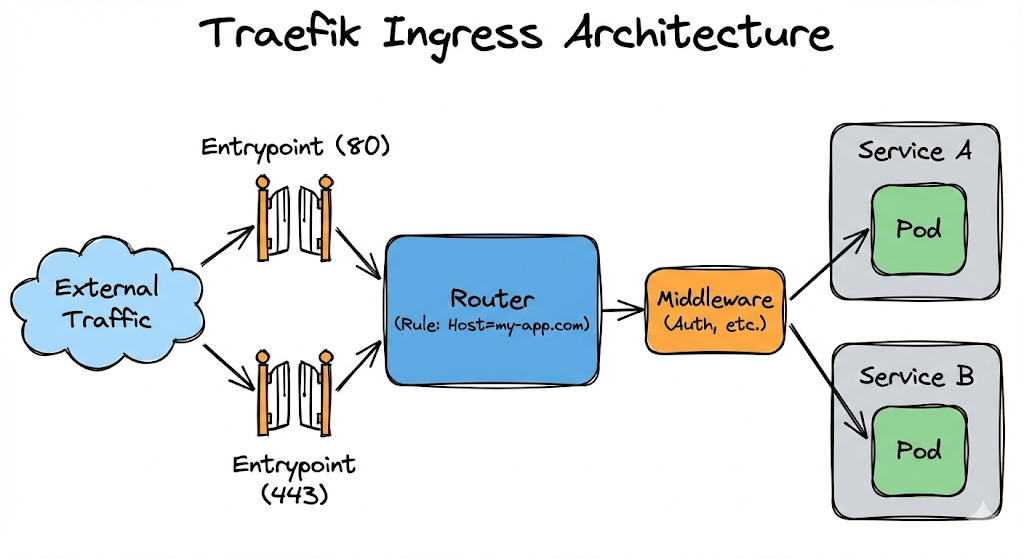
Traefik’s communication flow is very logical. You only need to remember these 4 steps:
- Entrypoints (Gate): These are the ports where external traffic enters. (e.g., HTTP 80, HTTPS 443)
- Routers (Information Desk): They decide where to send incoming requests based on hostnames or paths.
- Middlewares (Checkpoint): They process or validate requests before they reach the service. (e.g., Auth, IP WhiteList)
- Services (Destination): These are the Kubernetes Service resources where traffic ultimately arrives.
3. Practical! Configuring Traefik IngressRoute 🛠️
Traefik supports standard Ingress objects, but its true power is revealed when using its own CRD (Custom Resource Definition), IngressRoute.
🔓 Common HTTP Routing Example
apiVersion: traefik.containo.us/v1alpha1
kind: IngressRoute
metadata:
  name: my-app-route
  namespace: default
spec:
  entryPoints:
    - web  # 80 port
  routes:
    - match: Host(`my-app.com`) && PathPrefix(`/api`)
      kind: Rule
      services:
        - name: my-app-service
          port: 8080
🛡️ Enhancing Security with Middleware (Basic Auth)
Let’s add the security elements emphasized by the instructor.
# 1. Define middleware
apiVersion: traefik.containo.us/v1alpha1
kind: Middleware
metadata:
  name: test-auth
spec:
  basicAuth:
    secret: auth-secret # Secret containing user information

---
# 2. Apply middleware to IngressRoute
spec:
  routes:
    - match: Host(`secure-app.com`)
      kind: Rule
      middlewares:
        - name: test-auth # Connect the middleware defined above
      services:
        - name: secure-app-service
          port: 80
4. Traefik vs Nginx Ingress: What’s the Difference? ⚖️
| Feature | Nginx Ingress Controller | Traefik Proxy |
| — | — | — |
| Configuration Method | Annotation-centric (Complex) | CRD(IngressRoute)-centric (Clear) |
| Dynamic Changes | Some restarts required | 100% Dynamic Changes (Zero Downtime) |
| Dashboard | Requires separate tools (e.g., Grafana) | Built-in UI provided |
| Difficulty | Medium (Requires Nginx syntax understanding) | Low (Intuitive structure) |
—
5. Teaching Points for Instructors (Teaching Tips) 💡
When delivering this content to students, try using the following flow:
- Use Analogies: “An Entrypoint is the main entrance of a building, a Router is a signpost, Middleware is a security checkpoint, and a Service is the office of the relevant department.”
- Encourage Hands-on Practice: “Deploy an IngressRoute yourself and observe the graphs changing in real-time on the Traefik dashboard.”
- Emphasize Security: As a cloud-native security instructor, highlighting the integration of automatic TLS certificate renewal (Let’s Encrypt) will greatly satisfy students.
Tags: Traefik, Kubernetes, Ingress, CloudNative, DevOps, Infrastructure, Microservices
Leave a Reply