The recent decline cannot be explained by a single sentence stating that the U.S. dollar has weakened. It was a combination of semiconductor companies converting export earnings in dollars to won, reduced selling pressure from foreign investors in domestic stocks, and the Bank of Korea raising its policy rate to narrow the interest rate gap between Korea and the U.S. However, U.S. inflation remains high, and the Federal Reserve (Fed) has kept the possibility of further tightening open, so it cannot be concluded that the exchange rate will fall in a straight line every day until November.
This article analyzes the causes of the recent decline using data available as of September 1, 2026, and divides the possibilities from September to November into three paths. The forecast period and the source of the scenarios are not official institutions but ChatGPT’s scenario-based predictions, and this is not an recommendation for investment or currency exchange.

The balance between dollar supply and won demand is tilting towards a decline in the won-dollar exchange rate.
1. What Happened in the Last Two Months?
Looking at the won-dollar spot exchange rate time series from FRED, which provides data from the U.S. Federal Reserve, it fell from 1,555.96 won on June 5, 2026, to 1,379.41 won on August 28. The weekly closing price in the Seoul foreign exchange market on August 31 was 1,368.6 won. This represents approximately a 12% drop from its peak over about two and a half months. FRED Won-Dollar Spot Exchange Rate Time Series · August 31 Seoul FX Market Closing Report
Interpreting this movement as “the won suddenly becoming a strong currency” would be an overstatement. The 1,550 won level in June was an abnormally high range due to multiple overlapping instability factors, and the recent decline also has the characteristic of reversing that excessive weakness. In other words, it is safer to view it not as a structural shift to strength, but rather as a rapid normalization process as dollar supply and demand and interest rate conditions became more favorable for the won.
2. Exchange Rate is Ultimately the Balance of Buying and Selling Dollars
It’s easier to understand exchange rates as a market scale rather than complex formulas. When Korean companies convert dollars received from exports into won, the supply of dollars in the market increases, creating downward pressure on the won-dollar exchange rate. Conversely, if domestic investors seek dollars to buy U.S. stocks or bonds, or if foreign investors sell Korean assets and exit in dollars, upward pressure on the exchange rate is created.
Interest rates, trade balance, stock prices, oil prices, and war news are all factors that weigh one side of this scale. Recently, the power of those selling dollars has increased, while the power of those buying dollars and exiting has weakened.
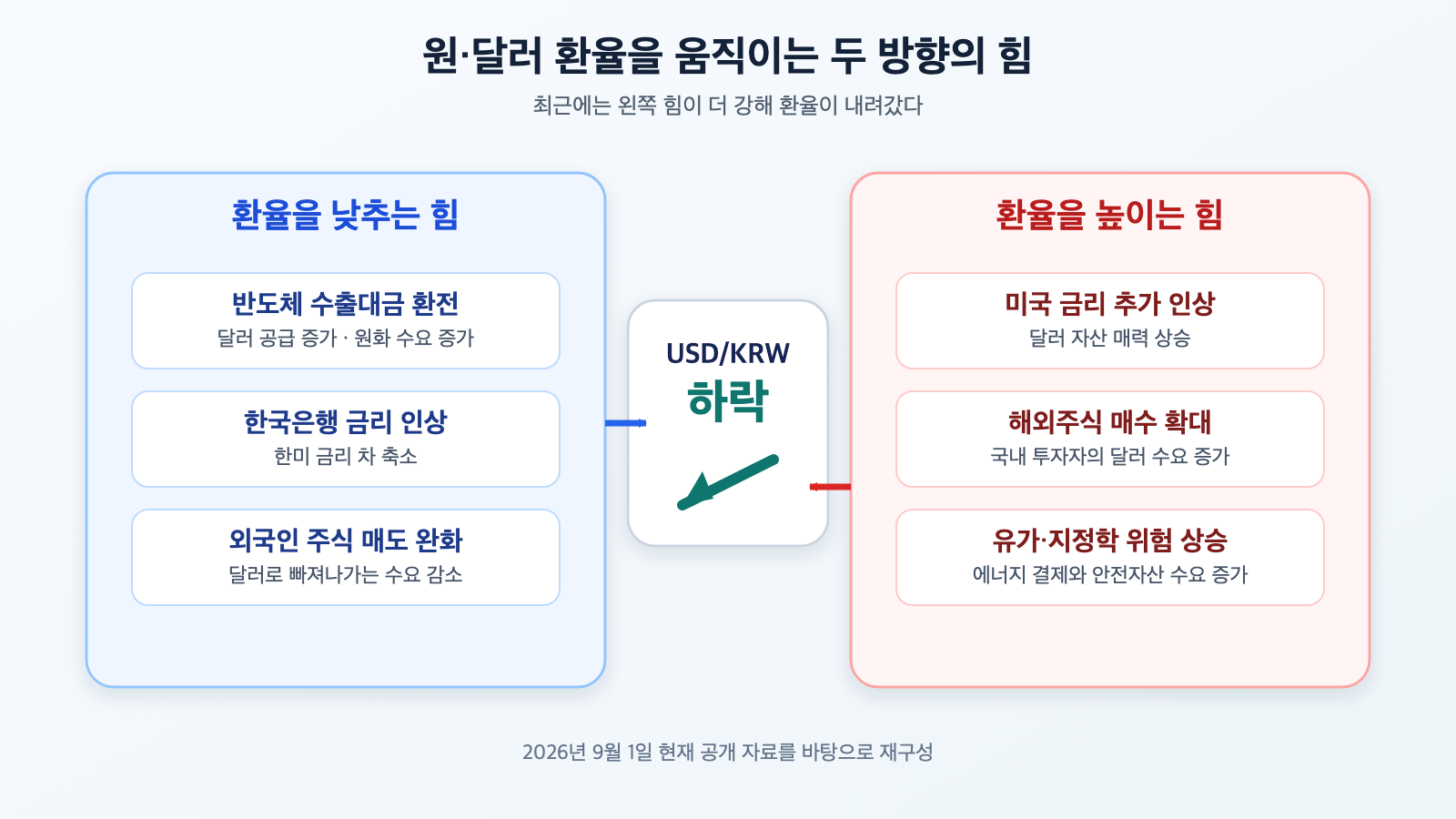
Structure where semiconductor export proceeds and narrowing interest rate differentials lower the exchange rate, while overseas investment and risk aversion raise it.
Figure: Recent two-way forces influencing the won-dollar exchange rate · Reconstructed based on Bank of Korea Monetary Policy Direction and Fed data
3. Reason 1: Semiconductor Export Proceeds Increased Dollar Supply
In its August economic outlook, the Bank of Korea projected that exports and investments would continue to show high growth due to the semiconductor boom, and the current account surplus would expand, mainly driven by the goods balance. Exporting companies that earn dollars overseas need to sell dollars and buy won to fund domestic investments, taxes, and dividends. Bank of Korea August 2026 Economic Outlook
This time, market analysis indicated that not only general export proceeds but also the conversion of SK Hynix’s American Depositary Receipt (ADR) fundraising proceeds and forward sales by shipbuilding companies contributed to the dollar supply. While a single large transaction is not a permanent factor, it amplified the speed of the decline when combined with the semiconductor export boom.
4. Reason 2: Bank of Korea’s Rate Hike Narrowed Korea-U.S. Interest Rate Gap
On August 27, the Bank of Korea raised its policy rate by 0.25 percentage points from 2.75% to 3.00%. The U.S. policy rate, as of the July meeting, is 3.50-3.75%. As Korea’s interest rate rose, the lower bound of the interest rate differential between the two countries narrowed to 0.50 percentage points. Bank of Korea Monetary Policy Direction · Fed July 2026 FOMC Decision
Assets in countries with higher interest rates are more attractive to investors, all else being equal. In reality, currency hedging costs and risks also play a role, so there is no formula that “a narrowing interest rate differential necessarily leads to a fall in the exchange rate.” Nevertheless, the fact that the interest rate disadvantage of holding won has decreased compared to the past supports demand for the won.
The Bank of Korea directly cited the easing of foreign equity outflow, improved foreign exchange supply and demand, and the weakening of the U.S. dollar as reasons for the recent sharp decline in the won-dollar exchange rate. At the same time, Korea’s growth forecast for this year was raised from 2.6% to 3.3%. The upward revision of both growth prospects and interest rates is a favorable combination for the won.
5. Reason 3: Reduced Foreign Selling Pressure and Improved Dollar Supply and Demand
In May-June, large-scale selling of domestic stocks by foreign investors created demand to convert won into dollars. In July-August, as the scale of these sales decreased, it became easier for the market to absorb the dollars supplied by exporting companies. As the Bank of Korea put it, “easing of foreign equity outflow” led to improved foreign exchange supply and demand.
An important point here is that the dollar did not unilaterally collapse against all global currencies. The Fed’s trade-weighted broad dollar index rebounded from 118.06 on August 21 to 118.75 on August 28. The fact that the won strengthened despite this indicates that Korea’s unique semiconductor dollar supply and interest rate factors played a significant role in the recent movement. FRED Trade-Weighted Broad Dollar Index
6. But Why Can’t We Guarantee a Continued Decline?
First, U.S. inflation is still high. U.S. consumer prices rose 3.4% year-over-year in July, and the Fed Chair stated in his August Jackson Hole speech that the 12-month increase in PCE inflation was 3.7%, exceeding the 2% target. If the Fed raises interest rates further in September or signals additional hikes, the dollar could strengthen again. U.S. Bureau of Labor Statistics July CPI · Fed Chair’s Jackson Hole Speech
Second, recent dollar supply includes one-off factors. Once the large-scale ADR fundraising proceeds conversion is complete, selling volume may decrease. If domestic investors, feeling the exchange rate is cheap, buy more overseas stocks, dollar demand will increase again.
Third, if Middle East tensions and international oil prices rise again, it will be unfavorable for South Korea, an energy-importing country. The won could also weaken if the semiconductor and AI industries undergo adjustments or if foreign investors realize profits from Korean stocks. The exchange rate is a price influenced not by economic growth alone, but by interest rates, trade, capital flows, and risk aversion sentiment all moving simultaneously.
7. September-November 2026 Outlook: Base Scenario is a Gradual Decline
Forecast Source: ChatGPT’s Scenario-Based Prediction
The ranges below are conditional expectations formulated by ChatGPT based on data from the Bank of Korea, the Fed, FRED, and the U.S. Bureau of Labor Statistics, as well as market supply and demand reports, publicly available as of September 1, 2026. This is not an official institutional forecast or a target exchange rate from a statistical model, and the actual exchange rate may deviate significantly from these ranges.
Base Scenario: Semiconductor Dollar Inflows Continue, U.S. Acts Cautiously
The most likely path is seen as a period of high volatility and consolidation in September, followed by the central trading range gradually shifting downwards in October-November.
| Period | Expected Trading Range | Month-end Central Range | Interpretation |
|---|---|---|---|
| September 2026 | 1,345~1,410 won | 1,360~1,390 won | Most volatile period due to FOMC and U.S. inflation announcements |
| October 2026 | 1,330~1,400 won | 1,350~1,380 won | Lower bound slightly decreases if export proceeds inflow is maintained |
| November 2026 | 1,320~1,390 won | 1,340~1,370 won | Path where semiconductor boom and narrowing Korea-U.S. interest rate differential effects accumulate |
The “decline” in this table does not mean that the exchange rate will fall every day. It refers to a trend where the month-end central range in November is lower than in September, even if the rate tests 1,400 won multiple times or rebounds by 10-20 won in a single day.
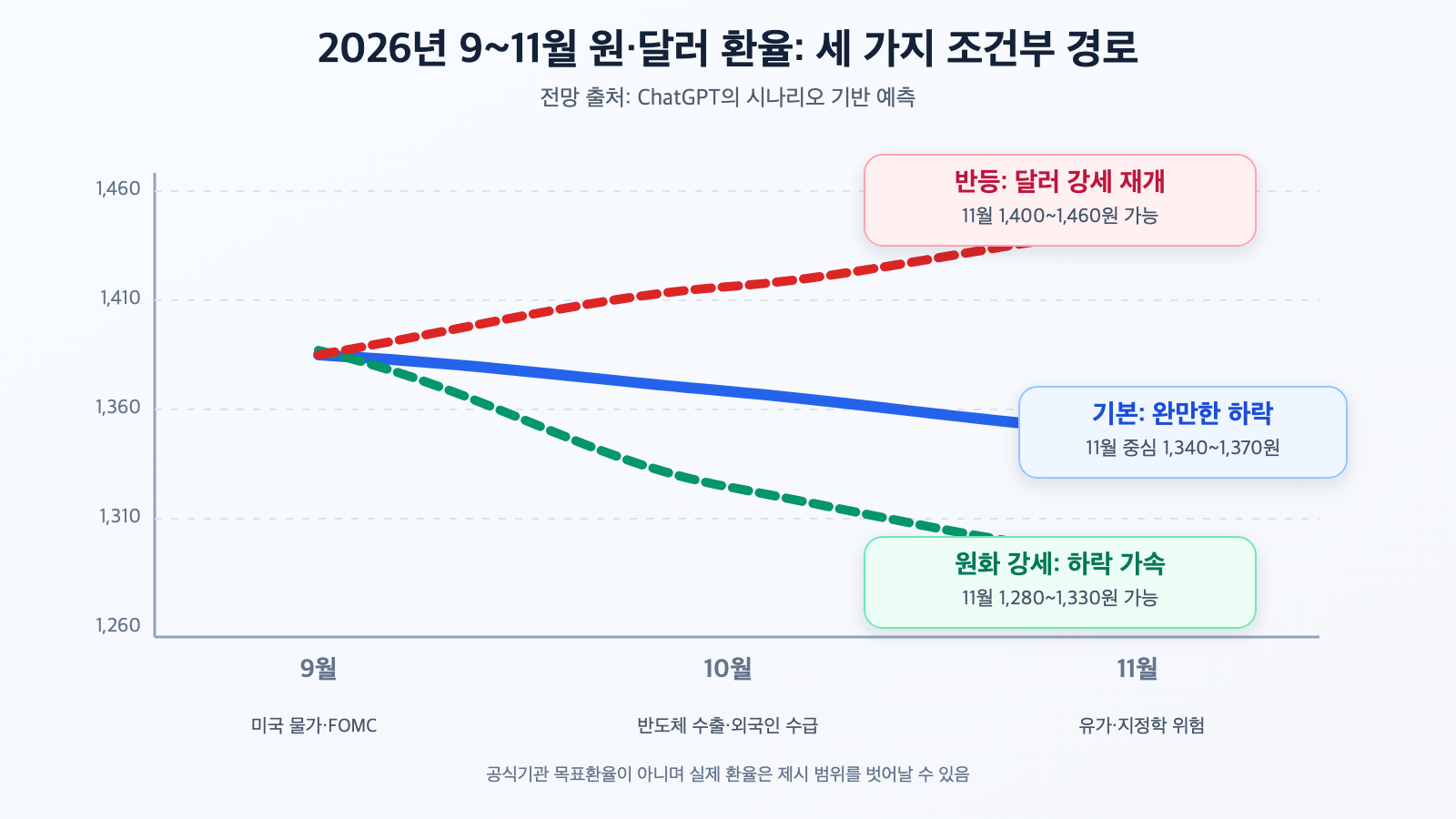
Three conditional paths for the won-dollar exchange rate from September to November: base decline, won strength, and exchange rate rebound.
Figure: Conditional paths for the won-dollar exchange rate, September-November 2026 · ChatGPT’s scenario-based prediction · Reconstructed based on public data from Bank of Korea, Fed, and FRED
Won Strength Scenario: Rapid Decline to Around 1,300 Won
If U.S. inflation rapidly decelerates, alleviating concerns about further Fed rate hikes, and if Korea’s semiconductor exports and foreign capital inflows are stronger than expected, the 1,280-1,330 won range could open up in November. This path is only possible if it coincides with easing Middle East tensions and falling oil prices.
Exchange Rate Rebound Scenario: Rises Back to the 1,400 Won Level
If the Fed raises interest rates in September or October and signals further tightening, or if oil prices surge due to Middle East events and foreign investors again sell Korean stocks on a large scale, the rate could revert to 1,400-1,460 won in November. The rebound could be amplified if it coincides with the end of the one-off dollar supply that caused the recent decline.
8. What to Watch to See if the Forecast is Correct
Instead of just watching daily exchange rate news, it’s better to check the following five things in order:
- U.S. Employment on September 4 and U.S. CPI on September 11: Strong employment and inflation increase the risk of a Fed rate hike.
- FOMC on September 15-16: How the possibility of further rate hikes is explained is more important than the rate decision itself.
- Korea’s Semiconductor Exports and Current Account: Shows whether dollars are actually continuing to flow into the country.
- Foreign Net Buying/Selling of Korean Stocks: Checks if the pressure to convert stock sales into dollars is increasing again.
- Middle East Situation and International Oil Prices: Rising oil prices simultaneously increase Korea’s dollar payment demand and inflation burden.
U.S. employment figures showed a decrease of 23,000 non-farm payrolls in July, but the unemployment rate remained stable at 4.1%. With signs of slowing growth and high inflation coexisting, the Fed’s decision-making is particularly challenging. U.S. Bureau of Labor Statistics July Employment Report
Conclusion: Reasons for Decline are Solid, but November Outlook is Conditional
The key reasons for the recent decline in the won-dollar exchange rate are the dollar supply generated by semiconductor exports, the easing of foreign equity outflow, the Bank of Korea’s consecutive interest rate hikes, and the narrowing of the Korea-U.S. interest rate differential. This also coincided with the normalization process of the excessively weak won in June.
ChatGPT’s base scenario projects a gradual decrease in the monthly central range until November. However, with U.S. inflation and the possibility of further Fed rate hikes remaining, a rebound to the 1,400 won level should also be fully considered. Rather than basing currency exchange or investment decisions on a single number, it is more important to divide the timing and verify whether the four conditions—FOMC, semiconductor exports, foreign supply and demand, and oil prices—are actually maintained.
References
- Bank of Korea Monetary Policy Direction, August 27, 2026
- Bank of Korea Economic Outlook, August 2026
- Federal Reserve, July 2026 FOMC statement
- Federal Reserve, 2026 Jackson Hole speech
- FRED, South Korean Won to U.S. Dollar Spot Exchange Rate
- FRED, Nominal Broad U.S. Dollar Index
- U.S. Bureau of Labor Statistics, July 2026 CPI
- U.S. Bureau of Labor Statistics, July 2026 Employment Situation
- Korea JoongAng Daily, August 31 FX market report
Leave a Reply