Hello everyone! Today, I’d like to talk about one of the most dramatic events in the history of IT infrastructure: ‘The Rise and Fall of Docker.’ We’ll delve deep into the five critical reasons why Docker, which appeared like a comet in 2013 and changed the world, no longer holds its former status. 🧐
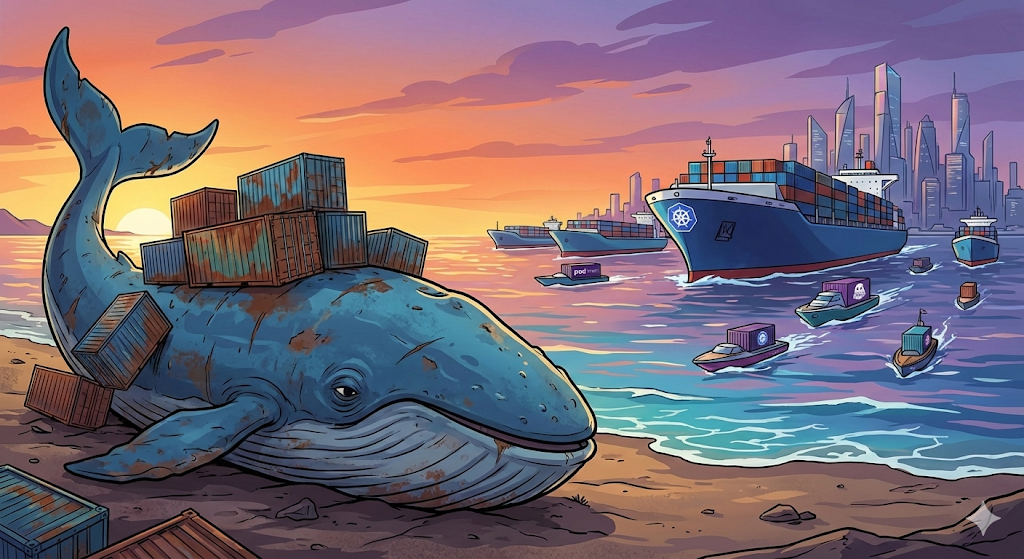
1. Defeat in the Orchestration War: Swarm vs Kubernetes ⚔️
Docker’s biggest misstep was attempting to dominate not just the container runtime, but also the ‘orchestration’ market, which manages numerous containers.
- Limitations of Docker Swarm: Docker promoted its own tool, ‘Swarm.’ While easy to set up and lightweight, it lacked features for managing large-scale clusters.
- Emergence of Kubernetes (K8s): The landscape changed with the arrival of Kubernetes, created by Google. Kubernetes was complex but powerful, becoming the global cloud standard.
- Result: Companies adopted the formula: “Build with Docker, run with Kubernetes.” Docker was relegated to a mere ‘tool,’ and Kubernetes took over the game. ☸️
2. “Goodbye Docker”: Kubernetes Announces DockerShim Deprecation 👋
In fact, the most painful blow to Docker came from Kubernetes.
- Docker Became Bloated: From Kubernetes’ perspective, Docker was too heavy. While only needing to run containers, Docker had too many unnecessary features (networking, volumes, etc.).
- Emergence of CRI (Container Runtime Interface): Kubernetes created a standard interface (CRI) that allowed containers to run without Docker.
- DockerShim Removal: Ultimately, Kubernetes removed DockerShim, the bridge that connected it to Docker (starting from v1.24). Now, there’s no longer a need to install Docker in server operating environments. Lighter alternatives like containerd and CRI-O have taken its place. 🚫
3. The Paradox of Standardization (OCI): Anyone Can Build It 🛠️
Docker spearheaded the creation of OCI (Open Container Initiative), a standardization body for container technology. However, this became a boomerang that broke Docker’s monopoly.
- Technological Standardization: As image formats and runtimes became standardized, alternative tools like Podman and Buildah could handle Docker images identically, without necessarily using Docker itself.
- Red Hat’s Offensive: Red Hat, in particular, pushed Podman, which works perfectly without Docker, narrowing Docker’s foothold in the enterprise market. 📦
4. Inherent Limitations of Docker’s Security Architecture (Root Daemon) 🔒
Docker had inherent vulnerabilities in its security architecture.
- Root Privileges Required: The Docker daemon fundamentally runs with ‘Root’ privileges. If the Docker daemon is compromised, the entire server becomes vulnerable.
- Rise of Rootless: In contrast, competitors like Podman emphasized a ‘Rootless’ architecture from the outset, allowing execution without root privileges. Security-conscious enterprises felt burdened by Docker’s heavy daemon approach. 🛡️
5. Monetization Policy and Developer Fatigue 💸
Beyond technical reasons, there was also a failure in business strategy.
- Lack of Revenue Model: Docker was technically successful but struggled to generate revenue for quite some time. Ultimately, it sold its enterprise business unit to ‘Mirantis,’ shrinking its size.
- Docker Desktop Monetization: To generate revenue, Docker Desktop was made paid for large enterprise users. This led companies to question, “Do we really need to use Docker?” and prompted them to seek free alternatives like Rancher Desktop and Lima. 🏃♂️
📝 Conclusion: Is Docker Dead? No, its role has changed.
While Docker has descended from its throne in ‘Production’ environments, it remains the undisputed leader in ‘Development’ environments. Developers still type docker build and write Dockerfiles.
However, Docker’s dream of becoming “everything in infrastructure” was shattered, and it has now been reduced to ‘one component’ within the vast cloud ecosystem. This is why Docker has embarked on a path of decline, or ‘normalization.’
What are your thoughts? Please leave your comments below! 👇
Leave a Reply