Hello everyone! I’m back with the 14th update on the ‘Golden Kuberstronaut’ project, an unceasing challenge towards 15 certifications. 👋
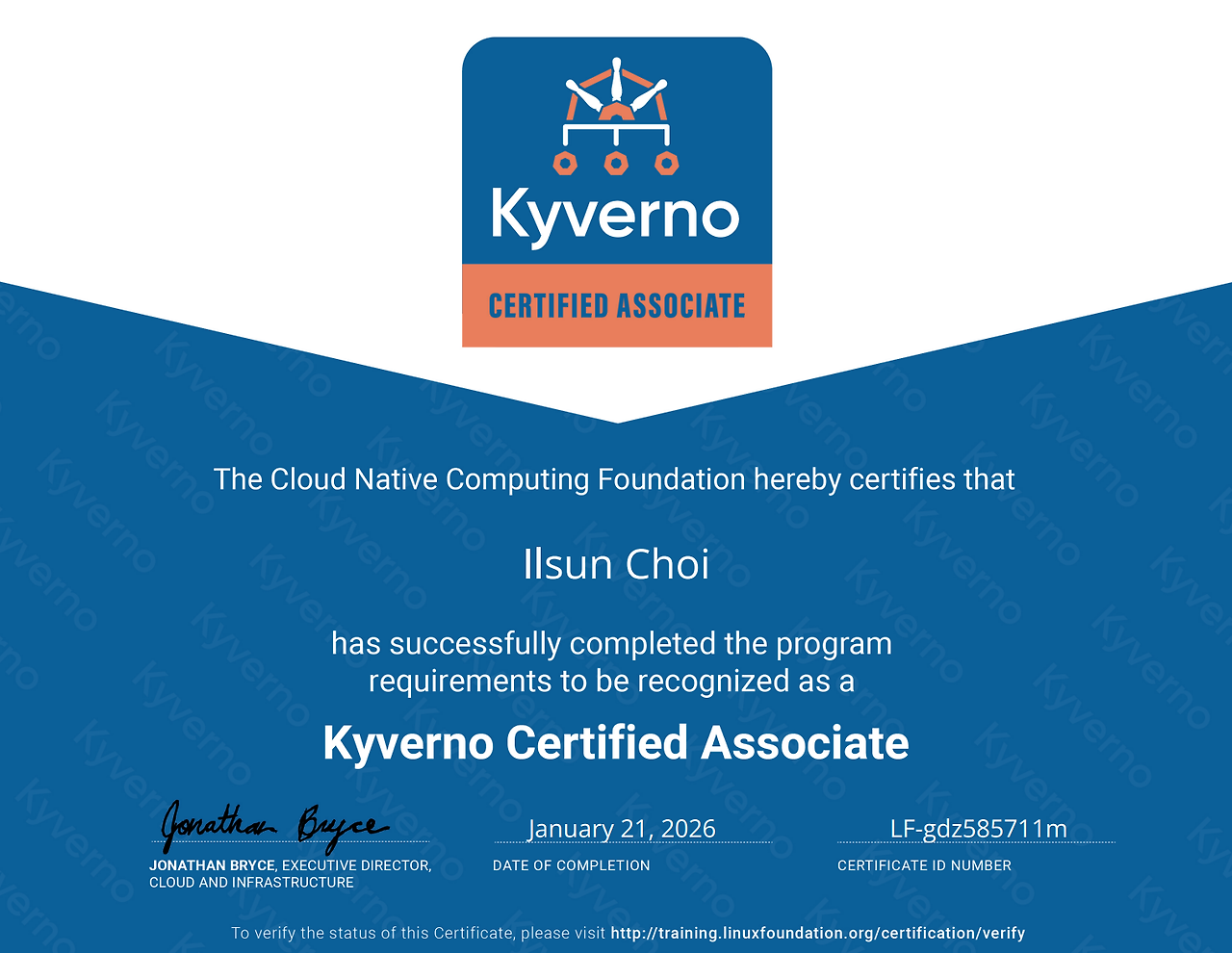
I’ve successfully passed the 14th gateway, KCA (Kyverno Certified Associate)! Now, only one more certification remains out of the 15 I aimed for. 🏔️
The KCA exam was a very interesting process that allowed me to deeply explore the powerful policy control capabilities of Kyverno. Here, I’ll summarize my study methods and key points that led to a pleasant pass with 82 points on my first attempt.
🚀 Getting Started with Kyverno: Official Documentation and Playground are the Key
For those new to Kyverno or preparing for the exam, what I want to emphasize most is the ‘friendliness of the official documentation’.
1. The Power of the Quick Start Guide The practice setup is so well-structured that the Quick Start Guide on the official Kyverno page alone is sufficient. From basic installation to applying the first policy, you can follow it seamlessly, which greatly helped lower the initial barrier to entry. Of course, for more in-depth policy writing, you need to carefully review the detailed documentation.
2. The Pinnacle of Visualization, Utilizing the Playground The game-changer for KCA preparation was the Kyverno Playground. You can instantly see on the web how the Policy you’ve written works on actual resources, and which resources it blocks or transforms. Being able to quickly anticipate and modify the results of rule operations significantly shortened my learning time. 💡
💡 Technical Key Points for Conquering KCA
During the exam, I realized that it not only tested Kyverno’s functionalities but also deeply inquired about its interaction with the Kubernetes API server. These are the points you must cover for success.
1. Understanding the API Server’s Operation Mechanism Since Kyverno operates as an Admission Controller, you must fully understand the order in which requests are processed within the API server. This sequence is repeatedly emphasized in the exam, so be sure to remember it!
- Athn (Authentication) → Athz (Authorization) → Mutate (Mutation) → SchemaValidate (Schema Validation) → Validate (Validation) You need to understand the flow of this pipeline to clearly know at which point a policy intervenes.
2. Familiarity with Server Ports and Their Purposes It’s also important to understand what each server port is used for and what its default port number is. Make sure to carefully note which ports need to be open for Webhook communication, and which ports are for health checks or metric collection.
📝 Exam Strategy: “Details Make the Difference for Passing”
The KCA exam was broader than expected and characterized by detailed questions about Kyverno’s specific functionalities.
- Udemy Mock Exam is essential: Given the nature of the exam, which asks about all sorts of functionalities, I purchased a Kyverno Mock Exam course on Udemy. I practiced solving problems structured like the actual exam about twice to get familiar with the question types.
- Preparation Period: Although I had a heavy workload and juggled other tasks in between, focusing for approximately one week of pure working time was enough to comfortably reach a passing score.
✨ Conclusion: The Finish Line is in Sight! (14/15)
Through this KCA exam, I once again realized how powerful and secure it is to manage ‘Policy’ as code in a cloud-native environment. I am convinced that Kyverno is an essential tool, especially for infrastructure engineers who prioritize security and governance.
Now, only the last one certification remains until I become a ‘Golden Kuberstronaut’! 🏁 I extend my gratitude to myself for coming this far, and to all of you who have always supported me.
Until the day I put an end to this grand journey with the news of passing the final 15th certification, I will complete it without getting exhausted. See you in the next post! Thank you. 🚀
Leave a Reply