It wasn’t a block on Korea, but a “restriction on access for non-US nationals”
Claude Fable 5 is Anthropic’s next-generation high-performance AI model, unveiled in early June 2026. At its launch, Anthropic stated that Fable 5 was “available worldwide,” and the AWS Korea blog also introduced Claude Fable 5 as being available on Amazon Bedrock and Claude Platform on AWS. (Anthropic) (Amazon Web Services, Inc.)
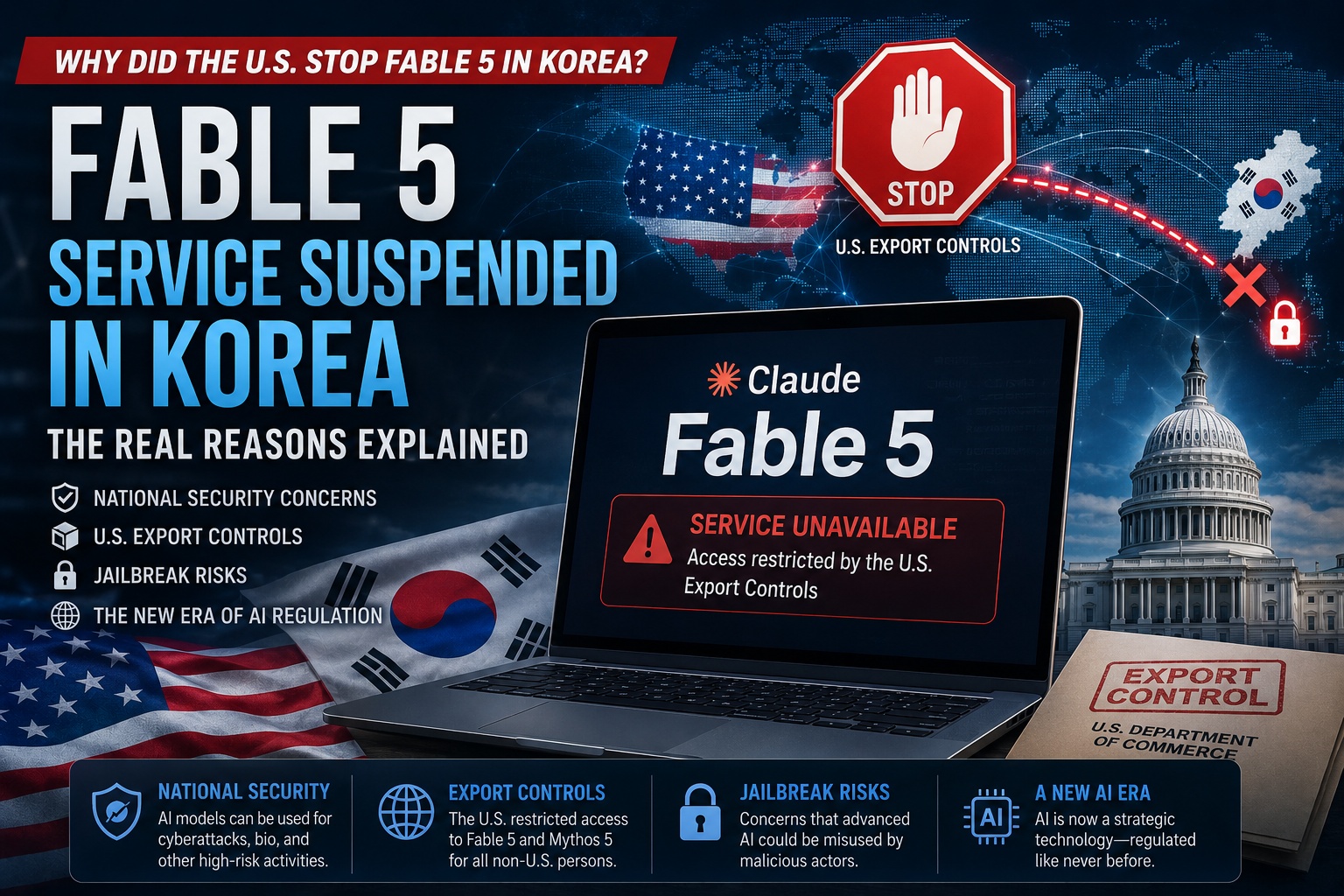
However, the situation changed rapidly a few days later. On June 12, 2026, Anthropic announced that the US government had issued an export control directive, based on national security authority, to suspend access to Fable 5 and Mythos 5 for “all foreign nationals, both inside and outside the US.” This included foreign nationals within the US and foreign national employees within Anthropic. (Anthropic)
In other words, Korea was not specifically targeted for sanctions; rather, all users who are not US nationals became subject to the restriction. Korean users were affected because they fell within this scope.
Official Reason: National Security and Jailbreak Concerns
The primary justification cited by the US government was “national security.” According to Anthropic’s announcement, the government directive was an export control order to suspend access for foreign nationals to Fable 5 and Mythos 5. However, Anthropic stated that the letter did not explain specific national security concerns. (Anthropic)
Anthropic understood the government’s concern to be the possibility of jailbreaking Fable 5’s safeguards. Specifically, the issue seemed to be that Fable 5 could be used to find software vulnerabilities. However, Anthropic explained that the examples provided by the government were limited to identifying “a few minor, already known vulnerabilities.” (Anthropic)
An important point here is that Fable 5 is not just a simple chatbot but a model strong in advanced coding, long-term tasks, security analysis, and scientific research. At its launch, Anthropic explained that Fable 5 performs longer autonomous tasks better than previous Claude models and shows strong performance in software engineering, knowledge work, vision, and scientific research. (Anthropic)
Why Was the Entire Service Shut Down?
Theoretically, one might think, “Why not just block foreign nationals and let US citizens continue to use it?” However, the problem was that the directive’s scope was “foreign nationals,” not “users outside the US.”
Foreign nationals can be located within the US, and even among a company’s internal employees. Anthropic stated that to comply with this directive, they had no choice but to urgently disable Fable 5 and Mythos 5 for all customers. They also explained that other Claude models were not affected. (Anthropic)
According to a Reuters report, AWS was also reportedly asked by Anthropic to withdraw access to the models for “all users in all regions.” (Reuters)
Why Fable 5 Was Treated with Particular Sensitivity
While Fable 5 is a model provided to general users, Anthropic applied safeguards for high-risk areas. For example, harmful prompts related to cybersecurity, biology, chemistry, and health were routed to Opus 4.8 instead of being directly answered by Fable 5. The AWS Korea blog also explained these safeguards and the limited provision method of Mythos 5. (Amazon Web Services, Inc.)
Mythos 5 is based on the same model but with some safeguards removed, and initially, it was provided on a limited basis, primarily to verified partners or specific researchers. Anthropic required a 30-day data retention policy for Mythos-class models like Fable 5 and Mythos 5, explaining this as a measure for detecting jailbreaks or misuse patterns. (Anthropic)
Ultimately, from the US government’s perspective, it is highly likely that Fable 5 and Mythos 5 were seen as both “productivity tools” and “tools that could amplify advanced cyber capabilities.”
Anthropic’s Stance: Excessive and Unclear Measures
Anthropic stated that while they would legally comply with the government’s directive, they disagreed with the measure. Anthropic argued that the evidence presented by the government was merely verbal proof of “a narrow range of non-general-purpose jailbreaks,” and applying such a standard across the entire industry could effectively halt the deployment of all frontier models. (Anthropic)
Furthermore, Anthropic stated that they had conducted thousands of hours of red-team testing with the US government, UK AISI, private third-party organizations, and internal teams before Fable 5’s launch, and no general-purpose jailbreaks have been found to date. (Anthropic)
The Verge described this incident as an unusual case of controlling access to cloud-based AI services through export controls. It particularly pointed out significant regulatory uncertainty regarding whether accessing a remote service, rather than transferring model weights or source code, can be considered an “export.” (The Verge)
Implications for Korean Companies and Developers
The core of this incident is that “US-made AI services can be suspended at any time due to policy risks.” Even if Korean users have not violated terms of service, access to the service can be abruptly halted if the US government restricts it for national security or export control reasons.
For companies, in particular, the following responses are necessary:
- A structure that is not dependent on a single specific model must be created.
- Models such as Claude, OpenAI, Gemini, Mistral, DeepSeek, and open-source models should be abstracted into an interchangeable form.
- In sensitive areas like security, bio, defense, and finance, the model provider’s country, data retention policies, and potential access restrictions must be reviewed.
- In teaching or practical environments, a Plan B is needed to immediately switch to an alternative model if a specific model is blocked.
Conclusion
The suspension of Fable 5’s service in Korea is not a measure targeting Korea specifically, but rather a result of the US government viewing frontier AI models as strategic technology and controlling access for foreign nationals.
The official reasons are national security and jailbreak concerns. However, specific evidence and criteria have not been fully disclosed, and Anthropic has also pushed back, calling the measure excessive and unclear.
This incident signals that in future AI model selection, one must consider not only performance but also “policy risks,” “export control risks,” and “country-specific access restriction possibilities.” AI is no longer just a simple cloud service; it is becoming a critical infrastructure influenced by international politics and national security.
Leave a Reply